


Page 2054 - Williams Hematology ( PDFDrive )
P. 2054
2028  Part XII:  Hemostasis and Thrombosis               Chapter 118:  Heparin-induced Thrombocytopenia              2029


                  HEMORRHAGE                                            IMMUNOASSAYS
                  In contrast to most other forms of drug-induced immune thrombocytope-  These assays detect the presence of circulating anti-PF4–heparin anti-
                  nia, spontaneous hemorrhage is rare in HIT, even when thrombocytopenia   bodies, irrespective of whether they are able to activate platelets and
                  is severe. In a prospective study, bleeding complications were not increased   cause disease. The prototypical immunoassay is the solid-phase enzyme-
                  in HIT patients compared with nonthrombocytopenic controls. 59  linked immunosorbent assay (ELISA), in which dilute patient serum
                                                                        is added to microtiter wells coated with complexes of PF4–heparin (or
                  UNUSUAL CLINICAL MANIFESTATIONS                       PF4–polyvinylsulfonate).  The polyspecific ELISA detects circulating
                                                                                          6
                                                                        anti-PF4–heparin IgG, IgM, and IgA. At the manufacturer-recommended
                  Rare sequelae of HIT include anaphylactoid reactions after intravenous   cutoff, the sensitivity and specificity of this assay for HIT are 94 to
                  heparin bolus, transient global amnesia, and skin necrosis at subcutane-  100 percent and 81 to 93 percent, respectively. 22,68–70
                  ous heparin injection sites. 60,61  Curiously, these phenomena may occur   A key limitation of the polyspecific ELISA is its specificity. False-
                  in the absence of thrombocytopenia. Nonnecrotizing erythematous   positive results are common and may result from detection of nonpatho-
                  injection site lesions are generally caused by delayed type IV hypersen-  genic anti-PF4–heparin antibodies  or antiphospholipid antibodies against
                                                                                                69
                  sitivity rather than HIT. 62
                                                                        either PF4  or PF4-bound β -glycoprotein I.  Specificity may be improved
                                                                               71
                                                                                                       72
                                                                                            2
                                                                        by raising the optical density (OD) cutoff. OD is directly associated with
                  OTHER CAUSES                                          the 4T and HEP scores,  the risk of thrombosis,  and the likelihood of
                                                                                         67
                                                                                                           73
                  The likelihood of other etiologies of thrombocytopenia must be care-  a positive functional assay.  In a Canadian study, only one of 37 patient
                                                                                           74
                  fully considered in patients with suspected HIT. Common causes of   samples  exhibiting  a  weakly  positive OD  (0.40  to  0.99)  demonstrated
                  hospital-acquired  thrombocytopenia include infection;  drugs  other     heparin-dependent platelet activation compared with 33 out of 37 samples
                  than heparin; DIC; dilution; and intravascular devices and extracor-  with a strongly positive OD (>2.0).  In a recent analysis of 1958 patients,
                                                                                                 74
                  poreal circuits such as intraaortic balloon pumps, cardiopulmonary   increasing the cutoff from a manufacturer-recommended threshold of
                  bypass, and extracorporeal membrane oxygenation. 63   0.4 to 0.8 OD units increased specificity from 85 percent to 93 percent with
                     Clinical scoring systems have been developed to permit estima-  a slight reduction in sensitivity from 100 percent to 98 percent. 75
                  tion of the probability of HIT based on the aforementioned features.   Several modifications have been made to the PF4–heparin ELISA
                  The most extensively studied of these systems, the 4T score,  classifies   with the goal of improving specificity. Because pathogenic antibodies
                                                             64
                  the  probability of HIT as low, intermediate, or high on the basis of four   are primarily of the IgG class, detection systems specific for IgG have
                  criteria: Thrombocytopenia, Timing, Thrombosis or other sequelae, and   been developed. In a pooled analysis of studies comparing the IgG-spe-
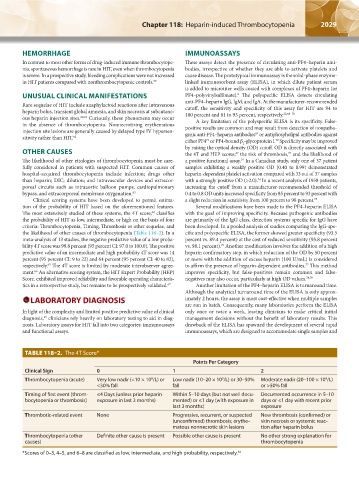
                  the likelihood of other causes of thrombocytopenia (Table 118–2). In a   cific and polyspecific ELISA, the former showed greater specificity (93.5
                  meta-analysis of 13 studies, the negative predictive value of a low proba-  percent vs. 89.4 percent) at the cost of reduced sensitivity (95.8 percent
                  bility 4T score was 99.8 percent (95 percent CI: 97.0 to 100.0). The positive   vs. 98.1 percent).  Another modification involves the addition of a high
                                                                                    76
                  predictive value of an intermediate and high probability 4T score was 14   heparin confirmatory step, in which reduction of the OD by 50 percent
                  percent (95 percent CI: 9 to 22) and 64 percent (95 percent CI: 40 to 82),   or more with the addition of excess heparin (100 U/mL) is considered
                  respectively.  The 4T score is limited by moderate interobserver agree-  to affirm the presence of heparin-dependent antibodies.  This method
                          65
                                                                                                                 77
                  ment.  An alternative scoring system, the HIT Expert Probability (HEP)   improves specificity, but false-positives remain common and false-
                      66
                  Score, exhibited improved reliability and favorable operating characteris-  negatives may also occur, particularly at high OD values. 78,79
                  tics in a retrospective study, but remains to be prospectively validated. 67  Another limitation of the PF4–heparin ELISA is turnaround time.
                                                                        Although the analytical turnaround time of the ELISA is only approx-
                       LABORATORY DIAGNOSIS                             imately 2 hours, the assay is most cost-effective when multiple samples
                                                                        are run in batch. Consequently, many laboratories perform the ELISA
                  In light of the complexity and limited positive predictive value of clinical   only once or twice a week, leaving clinicians to make critical initial
                  diagnosis,  clinicians rely heavily on laboratory testing to aid in diag-  management decisions without the benefit of laboratory results. This
                         65
                  nosis. Laboratory assays for HIT fall into two categories: immunoassays   drawback of the ELISA has spawned the development of several rapid
                  and functional assays.                                immunoassays, which are designed to accommodate single samples and
                   TABLE 118–2.  The 4T Score*
                                                                           Points Per Category
                   Clinical Sign           0                        1                             2
                   Thrombocytopenia (acute)  Very low nadir (<10 × 10 /L) or   Low nadir (10–20 × 10 /L) or 30–50%  Moderate nadir (20–100 × 10 /L)
                                                                                     9
                                                                                                                       9
                                                             9
                                           <30% fall                fall                          or >50% fall
                   Timing of first event (throm-  ≤4 Days (unless prior heparin   Within 5–10 days (but not well docu-  Documented occurrence in 5–10
                   bocytopenia or thrombosis)  exposure in last 3 months)  mented) or ≤1 day (with exposure in   days or ≤1 day with recent prior
                                                                    last 3 months)                exposure
                   Thrombotic-related event  None                   Progressive, recurrent, or suspected   New thrombosis (confirmed) or
                                                                    (unconfirmed) thrombosis; erythe-  skin necrosis or systemic reac-
                                                                    matous nonnecrotic skin lesions  tion after heparin bolus
                   Thrombocytopenia (other   Definite other cause is present  Possible other cause is present  No other strong explanation for
                   causes)                                                                        thrombocytopenia
                  *Scores of 0–3, 4–5, and 6–8 are classified as low, intermediate, and high probability, respectively. 64


          Kaushansky_chapter 118_p2025-2034.indd   2029                                                                 9/18/15   5:43 PM

