


Page 2055 - Williams Hematology ( PDFDrive )
P. 2055
2030           Part XII:  Hemostasis and Thrombosis                                                                                                                  Chapter 118:  Heparin-induced Thrombocytopenia              2031


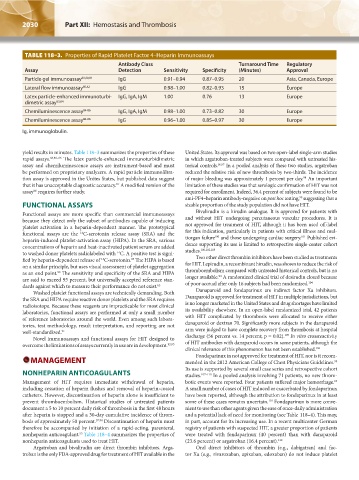
                TABLE 118–3.  Properties of Rapid Platelet Factor 4–Heparin Immunoassays
                                                Antibody Class                          Turnaround Time   Regulatory
                Assay                           Detection      Sensitivity  Specificity  (Minutes)      Approval
                Particle gel immunoassay 68,80,81  IgG         0.91–0.94    0.87–0.95   20              Asia, Canada, Europe
                Lateral flow immunoassay 80,82  IgG            0.98–1.00    0.82–0.93   15              Europe
                Latex particle-enhanced immunoturbi-  IgG, IgA, IgM  1.00   0.76        13              Europe
                dimetric assay 83,84
                Chemiluminescence assay 84-86   IgG, IgA, IgM  0.98–1.00    0.73–0.82   30              Europe
                Chemiluminescence assay 84-86   IgG            0.96–1.00    0.85–0.97   30              Europe
               Ig, immunoglobulin.


               yield results in minutes. Table 118–3 summarizes the properties of these   United States. Its approval was based on two open-label single-arm studies
               rapid assays. 68,80–86  The latex particle-enhanced immunoturbidimetric   in which argatroban-treated subjects were compared with untreated his-
               assay and chemiluminescence assays are instrument-based and must   torical controls. 96,97  In a pooled analysis of these two studies, argatroban
               be performed on proprietary analyzers. A rapid particle immunofiltra-  reduced the relative risk of new thrombosis by two-thirds. The incidence
               tion assay is approved in the Unites States, but published data suggest   of major bleeding was approximately 1 percent per day.  An important
                                                                                                              98
               that it has unacceptable diagnostic accuracy.  A modified version of the   limitation of these studies was that serologic confirmation of HIT was not
                                               87
               assay  requires further study.                         required for enrollment. Indeed, 36.4 percent of subjects were found to be
                   88
                                                                      anti-PF4–heparin antibody-negative on post hoc testing,  suggesting that a
                                                                                                            99
               FUNCTIONAL ASSAYS                                      sizable proportion of the study population did not have HIT.
               Functional assays are more specific than commercial immunoassays   Bivalirudin is a hirudin analogue. It is approved for patients with
               because they detect only the subset of antibodies capable of inducing   and without HIT undergoing percutaneous vascular procedures. It is
               platelet activation in a heparin-dependent manner. The prototypical   not approved for treatment of HIT, although it has been used off-label
               functional assays are the  C-serotonin release assay (SRA) and the   for this indication, particularly in patients with critical illness and mul-
                                   14
                                                                                100
                                                                                                             101
                 heparin-induced platelet-activation assay (HIPA). In the SRA, various   tiorgan failure  and those undergoing cardiac surgery.  Published evi-
               concentrations of heparin and heat-inactivated patient serum are added   dence supporting its use is limited to retrospective single-center cohort
                                                                           100,102,103
                                               14
               to washed donor platelets radiolabeled with  C. A positive test is signi-  studies.
                                          14
               fied by heparin-dependent release of  C-serotonin.  The HIPA is based   Two other direct thrombin inhibitors have been studied as treatments
                                                    89
               on a similar principle, but uses visual assessment of platelet aggregation   for HIT. Lepirudin, a recombinant hirudin, was shown to reduce the risk of
               as an end point.  The sensitivity and specificity of the SRA and HIPA   thromboembolism compared with untreated historical controls, but is no
                           90
                                                                                 94
               are said to exceed 95 percent, but universally accepted reference stan-  longer available.  A randomized clinical trial of desirudin closed because
                                                                                                               104
               dards against which to measure their performance do not exist. 63  of poor accrual after only 16 subjects had been randomized.
                   Washed platelet functional assays are technically demanding. Both   Danaparoid and fondaparinux are indirect factor Xa inhibitors.
               the SRA and HIPA require reactive donor platelets and the SRA requires   Danaparoid is approved for treatment of HIT in multiple jurisdictions, but
               radioisotope. Because these reagents are impracticable for most clinical   is no longer marketed in the United States and drug shortages have limited
               laboratories, functional assays are performed at only a small number   its availability elsewhere. In an open-label randomized trial, 42 patients
               of reference laboratories around the world. Even among such labora-  with HIT complicated by thrombosis were allocated to receive either
               tories, test methodology, result interpretation, and reporting are not   danaparoid or dextran 70. Significantly more subjects in the danaparoid
               well-standardized. 91                                  arm were judged to have complete recovery from thrombosis at hospital
                                                                                                       105
                   Novel immunoassays and functional assays for HIT designed to   discharge (56 percent vs. 14 percent; p = 0.02).  In vitro crossreactivity
               overcome the limitations of assays currently in use are in development. 92,93  of HIT antibodies with danaparoid occurs in some patients, although the
                                                                      clinical relevance of this phenomenon has not been established. 106
                                                                          Fondaparinux in not approved for treatment of HIT, nor is it recom-
                    MANAGEMENT                                        mended in the 2012 American College of Chest Physicians Guidelines.
                                                                                                                        95
                                                                      Its use is supported by several small case series and retrospective cohort
               NONHEPARIN ANTICOAGULANTS                              studies. 107–110  In a pooled analysis involving 71 patients, no new throm-
               Management of HIT requires immediate withdrawal of heparin,   botic events were reported. Four patients suffered major hemorrhage.
                                                                                                                        63
               including cessation of heparin flushes and removal of heparin-coated   A small number of cases of HIT induced or exacerbated by fondaparinux
               catheters. However, discontinuation of heparin alone is insufficient to   have been reported, although the attribution to fondaparinux in at least
               prevent  thromboembolism.  Historical  studies  of  untreated  patients   some of these cases remains uncertain.  Fondaparinux is more conve-
                                                                                                  111
               document a 5 to 10 percent daily risk of thrombosis in the first 48 hours   nient to use than other agents given the ease of once-daily administration
               after heparin is stopped and a 30-day cumulative incidence of throm-  and a potential lack of need for monitoring (see Table  118–4). This may,
               bosis of approximately 50 percent. 57,94  Discontinuation of heparin must   in part, account for its increasing use. In a recent multicenter German
               therefore be accompanied by initiation  of a rapid-acting, parenteral,   registry of patients with suspected HIT, a greater proportion of patients
               nonheparin anticoagulant.  Table 118–4 summarizes the properties of   were treated with  fondaparinux  (40 percent) than with  danaparoid
                                   95
               nonheparin anticoagulants used to treat HIT.           (23.6 percent) or argatroban (16.4 percent). 112
                   Argatroban and bivalirudin are direct thrombin inhibitors. Arga-  Oral direct inhibitors of thrombin  (e.g., dabigatran) and fac-
               troban is the only FDA-approved drug for treatment of HIT available in the   tor Xa (e.g., rivaroxaban, apixaban, edoxaban) do not induce platelet


          Kaushansky_chapter 118_p2025-2034.indd   2030                                                                 9/18/15   5:43 PM

