


Page 2056 - Williams Hematology ( PDFDrive )
P. 2056
2030  Part XII:  Hemostasis and Thrombosis               Chapter 118:  Heparin-induced Thrombocytopenia              2031


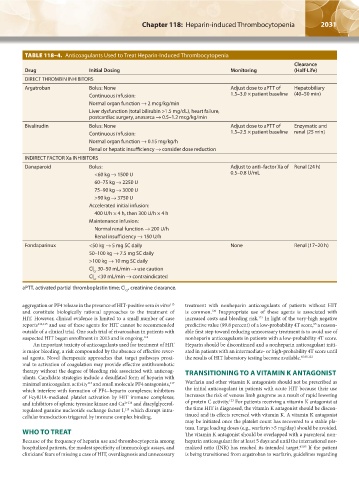
                   TABLE 118–4.  Anticoagulants Used to Treat Heparin-Induced Thrombocytopenia
                                                                                                             Clearance
                   Drug                 Initial Dosing                                  Monitoring           (Half-Life)
                   DIRECT THROMBIN INHIBITORS
                   Argatroban           Bolus: None                                     Adjust dose to aPTT of   Hepatobiliary
                                        Continuous infusion:                            1.5–3.0 × patient baseline  (40–50 min)
                                        Normal organ function → 2 mcg/kg/min
                                        Liver dysfunction (total bilirubin >1.5 mg/dL), heart failure,
                                        postcardiac surgery, anasarca → 0.5–1.2 mcg/kg/min
                   Bivalirudin          Bolus: None                                     Adjust dose to aPTT of   Enzymatic and
                                        Continuous infusion:                            1.5–2.5 × patient baseline  renal (25 min)
                                        Normal organ function → 0.15 mg/kg/h
                                        Renal or hepatic insufficiency → consider dose reduction
                   INDIRECT FACTOR Xa INHIBITORS
                   Danaparoid           Bolus:                                          Adjust to anti–factor Xa of  Renal (24 h)
                                          <60 kg → 1500 U                               0.5–0.8 U/mL
                                          60–75 kg → 2250 U
                                          75–90 kg → 3000 U
                                          >90 kg → 3750 U
                                        Accelerated initial infusion:
                                          400 U/h × 4 h, then 300 U/h × 4 h
                                        Maintenance infusion:
                                          Normal renal function → 200 U/h
                                          Renal insufficiency → 150 U/h
                   Fondaparinux         <50 kg → 5 mg SC daily                          None                 Renal (17–20 h)
                                        50–100 kg → 7.5 mg SC daily
                                        >100 kg → 10 mg SC daily
                                        Cl  30–50 mL/min → use caution
                                          Cr
                                        Cl  <30 mL/min → contraindicated
                                          Cr
                  aPTT, activated partial thromboplastin time; Cl , creatinine clearance.
                                                    Cr

                  aggregation or PF4 release in the presence of HIT-positive sera in vitro    treatment with nonheparin anticoagulants of patients without HIT
                                                                   113
                                                                                 120
                  and constitute biologically rational approaches to the treatment of   is common.  Inappropriate use of these agents is associated with
                                                                                                 121
                  HIT. However, clinical evidence is limited to a small number of case   increased costs and bleeding risk.  In light of the very-high negative
                                                                                                                   65
                  reports 114,115  and use of these agents for HIT cannot be recommended   predictive value (99.8 percent) of a low-probability 4T score,  a reason-
                  outside of a clinical trial. One such trial of rivaroxaban in patients with   able first step toward reducing unnecessary treatment is to avoid use of
                  suspected HIT began enrollment in 2013 and is ongoing. 116  nonheparin anticoagulants in patients with a low-probability 4T score.
                     An important toxicity of anticoagulants used for treatment of HIT   Heparin should be discontinued and a nonheparin anticoagulant initi-
                  is major bleeding, a risk compounded by the absence of effective rever-  ated in patients with an intermediate- or high-probability 4T score until
                  sal agents. Novel therapeutic approaches that target pathways proxi-  the results of HIT laboratory testing become available. 65,95,122
                  mal to activation of coagulation may provide effective antithrombotic
                  therapy without the degree of bleeding risk associated with anticoag-  TRANSITIONING TO A VITAMIN K ANTAGONIST
                  ulants. Candidate strategies include a desulfated form of heparin with
                                                                   117
                  minimal anticoagulant activity  and small molecule PF4 antagonists,    Warfarin and other vitamin K antagonists should not be prescribed as
                                        113
                  which interfere with formation of PF4–heparin complexes; inhibitors   the initial anticoagulant in patients with acute HIT because their use
                  of FcγRIIA-mediated platelet activation by HIT immune complexes;   increases the risk of venous limb gangrene as a result of rapid lowering
                                                                                       123
                  and inhibitors of splenic tyrosine kinase and Ca 2+118  and diacylglycerol-   of protein C activity.  For patients receiving a vitamin K antagonist at
                  regulated guanine nucleotide exchange factor I,  which disrupt intra-  the time HIT is diagnosed, the vitamin K antagonist should be discon-
                                                    119
                  cellular transduction triggered by immune complex binding.  tinued and its effects reversed with vitamin K. A vitamin K antagonist
                                                                        may be initiated once the platelet count has recovered to a stable pla-
                                                                        teau. Large loading doses (e.g., warfarin >5 mg/day) should be avoided.
                  WHO TO TREAT                                          The vitamin K antagonist should be overlapped with a parenteral non-
                  Because of the frequency of heparin use and thrombocytopenia among   heparin anticoagulant for at least 5 days and until the international nor-
                  hospitalized patients, the modest specificity of immunologic assays, and   malized ratio (INR) has reached its intended target. 63,95  If the patient
                  clinicians’ fears of missing a case of HIT, overdiagnosis and unnecessary   is being transitioned from argatroban to warfarin, guidelines regarding


          Kaushansky_chapter 118_p2025-2034.indd   2031                                                                 9/18/15   5:43 PM

