


Page 2071 - Williams Hematology ( PDFDrive )
P. 2071
2046           Part XII:  Hemostasis and Thrombosis                                                                                                               Chapter 120:  Hereditary Qualitative Platelet Disorders        2047


               approximately 50 percent but did not alter function. A series of pre-  Laboratory Features
               diction tools indicated that somewhere between 45 and 74 percent of   Table 120–3 provides characteristic laboratory findings in GT. Patients
               the 114 novel missense mutations may be deleterious. Thus, perhaps   have  normal  platelet  counts  and  morphology,  prolonged  bleeding
               approximately 0.6 percent of individuals in the general population is   times, decreased or absent clot retraction, and abnormal platelet aggre-
               a silent carrier for a GT variant that profoundly affects structure and/  gation responses to physiologic stimuli. The initial slope of high-dose
               or function. In addition, some of the rare individuals in the healthy   ristocetin-induced aggregation is normal (or near normal), reflecting
               population with levels of integrin α β  receptor expression intermedi-  the normal plasma VWF and the normal platelet GPIb/IX content; at
                                         IIb 3
               ate between those of obligate GT carriers and normal individuals may   lower doses of ristocetin, however, where GPIb/IX–mediated activation
               reflect heterozygosity for “hypomorphic” variants that partially affect   of integrin α β  (Chap. 112) normally contributes to the aggregation
                                                                               IIb 3
               receptor expression, but not function. 112             response, patients have decreased second wave aggregation.  GT plate-
                                                                                                                116
                                                                      lets undergo normal shape change in response to ADP and thrombin,
                                                                      demonstrating their ability to undergo metabolic and cytoskeletal
               Clinical Features                                      changes in response to these agents. Similarly, high doses of thrombin
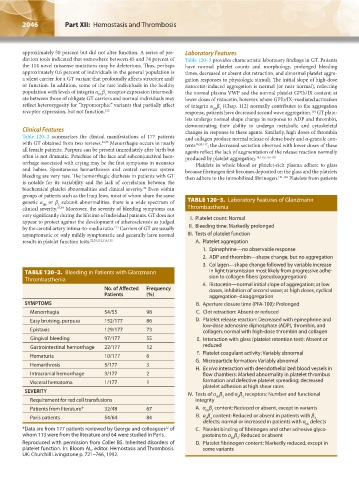
               Table 120–2 summarizes the clinical manifestations of 177 patients   and collagen produce normal release of dense body and α-granule con-
               with GT obtained from two reviews. 22,33  Menorrhagia occurs in nearly   tents 18,20,117 ; the decreased secretion observed with lower doses of these
               all female patients. Purpura can be present immediately after birth but   agents reflect the lack of augmentation of the release reaction normally
               often is not dramatic. Petechiae of the face and subconjunctival hem-  produced by platelet aggregation. 18,116,118–120
               orrhage associated with crying may be the first symptoms in neonates   Platelets in whole blood or platelet-rich plasma adhere to glass
               and babies. Spontaneous hemarthroses and central nervous system   because fibrinogen first becomes deposited on the glass and the platelets
               bleeding are very rare. The hemorrhagic diathesis in patients with GT   then adhere to the immobilized fibrinogen. 121,122  Platelets from patients
               is notable for its variability and the lack of correlation between the
               biochemical platelet abnormalities and clinical severity.  Even within
                                                        22
               groups of patients such as the Iraqi Jews, most of whom share the same
               genetic  α  or  β  subunit abnormalities, there is a wide spectrum of   TABLE 120–3.  Laboratory Features of Glanzmann
                      IIb
                           3
               clinical severity. 33,39  Moreover, the severity of bleeding symptoms can   Thrombasthenia
               vary significantly during the lifetime of individual patients. GT does not   I.  Platelet count: Normal
               appear to protect against the development of atherosclerosis as judged
               by the carotid artery intima-to-media ratio.  Carriers of GT are usually   II.  Bleeding time: Markedly prolonged
                                              113
               asymptomatic or only mildly symptomatic and generally have normal   III.  Tests of platelet function
               results in platelet function tests. 22,33,112,114,115     A.  Platelet aggregation
                                                                            1.   Epinephrine—no observable response
                                                                            2.   ADP and thrombin—shape change, but no aggregation
                                                                            3.   Collagen—shape change followed by variable increase
                TABLE 120–2.  Bleeding in Patients with Glanzmann             in light transmission most likely from progressive adhe-
                Thrombasthenia                                                sion to collagen fibers (pseudoaggregation)
                                                                            4.   Ristocetin—normal initial slope of aggregation; at low
                                           No. of Affected   Frequency        doses, inhibition of second wave; at high doses, cyclical
                                           Patients      (%)                  aggregation–disaggregation
                SYMPTOMS                                                  B.   Aperture closure time (PFA-100): Prolonged
                  Menorrhagia              54/55         98               C.   Clot retraction: Absent or reduced
                  Easy bruising, purpura   152/177       86              D.   Platelet release reaction: Decreased with epinephrine and
                                                                            low-dose adenosine diphosphate (ADP), thrombin, and
                  Epistaxis                129/177       73                 collagen; normal with high-dose thrombin and collagen
                  Gingival bleeding        97/177        55               E.   Interaction with glass (platelet retention test): Absent or
                  Gastrointestinal hemorrhage  22/177    12                 reduced
                                                                          F.   Platelet coagulant activity: Variably abnormal
                  Hematuria                10/177        6
                                                                         G.  Microparticle formation: Variably abnormal
                  Hemarthrosis             5/177         3
                                                                         H.  Ex vivo interaction with deendothelialized blood vessels in
                  Intracranial hemorrhage  3/177         2                  flow chambers: Marked abnormality in platelet thrombus
                  Visceral hematoma        1/177         1                  formation and defective platelet spreading; decreased
                                                                            platelet adhesion at high shear rates
                SEVERITY                                               IV.   Tests of α β  and α β  receptors: Number and functional
                  Requirement for red cell transfusions                  integrity  IIb 3  V 3
                  Patients from literature*  32/48       67              A.  α β  content: Reduced or absent, except in variants
                                                                             IIb 3
                  Paris patients           54/64         84               B.  α β  content: Reduced or absent in patients with β   3
                                                                             V 3
                                                                            defects; normal or increased in patients with α  defects
                                                                                                              IIb
               *Data are from 177 patients reviewed by George and colleagues  of   C.   Platelet binding of fibrinogen and other adhesive glyco-
                                                               22
               whom 113 were from the literature and 64 were studied in Paris.  proteins to α β : Reduced or absent
                                                                                     IIb 3
               Reproduced with permission from Coller BS. Inherited disorders of   D.   Platelet fibrinogen content: Markedly reduced, except in
               platelet function. In: Bloom AL, editor. Hemostasis and Thrombosis.   some variants
               UK: Churchill Livingstone p. 721–766, 1992.


          Kaushansky_chapter 120_p2039-2072.indd   2046                                                                 9/21/15   2:20 PM

