


Page 211 - Williams Hematology ( PDFDrive )
P. 211
186            Part IV:  Molecular and Cellular Hematology                                                                                                         Chapter 13:  Cytogenetics and Genetic Abnormalities             187


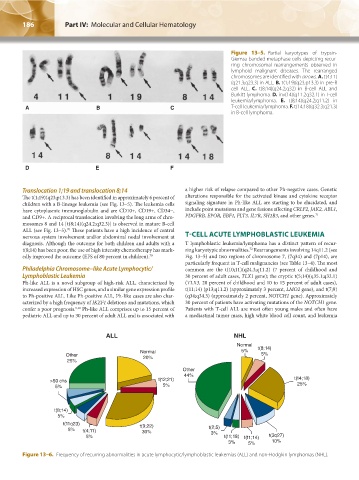
                                                                                     Figure  13–5.  Partial karyotypes of trypsin-
                                                                                     Giemsa-banded metaphase cells depicting recur-
                                                                                     ring chromosomal rearrangements observed in
                                                                                     lymphoid malignant diseases.  The rearranged
                                                                                     chromosomes are identified with arrows. A. t(4;11)
                                                                                     (q21.3;q23.3) in ALL. B. t(1;19)(q23;p13.3) in pre-B
                                                                                     cell ALL.  C. t(8;14)(q24.2;q32) in B-cell ALL and
                                                                                     Burkitt lymphoma. D. inv(14)(q11.2q32.1) in T-cell
                                                                                     leukemia/lymphoma.  E. t(8;14)(q24.2;q11.2) in
                A                       B                        C                   T-cell leukemia/lymphoma. F. t(14;18)(q32.3;q21.3)
                                                                                     in B-cell lymphoma.


                D                       E                        F


               Translocation 1;19 and translocation 8;14              a higher risk of relapse compared to other Ph-negative cases. Genetic
               The t(1;19)(q23;p13.3) has been identified in approximately 6 percent of   alterations responsible for the activated kinase and cytokine receptor
               children with a B-lineage leukemia (see Fig. 13–5). The leukemia cells   signaling signature in Ph-like ALL are starting to be elucidated, and
               have cytoplasmic immunoglobulin and are CD10+, CD19+, CD34−,   include point mutations and gene fusions affecting CRLF2, JAK2, ABL1,
               and CD9+. A reciprocal translocation involving the long arms of chro-  PDGFRB, EPOR, EBF1, FLT3, IL7R, SH2B3, and other genes. 71
               mosomes 8 and 14 [t(8;14)(q24.2;q32.3)] is observed in mature B-cell
               ALL (see Fig. 13–5).  These patients have a high incidence of central
                              70
               nervous system involvement and/or abdominal nodal involvement at   T-CELL ACUTE LYMPHOBLASTIC LEUKEMIA
               diagnosis. Although the outcome for both children and adults with a   T lymphoblastic leukemia/lymphoma has a distinct pattern of recur-
                                                                                            72
               t(8;14) has been poor, the use of high intensity chemotherapy has mark-  ring karyotypic abnormalities.  Rearrangements involving 14q11.2 (see
               edly improved the outcome (EFS of 80 percent in children). 70  Fig. 13–5) and two regions of chromosome 7, (7q34) and (7p14), are
                                                                      particularly frequent in T-cell malignancies (see Table  13–4). The most
               Philadelphia Chromosome–like Acute Lymphocytic/        common are the t(10;11)(q24.3;q11.2) (7 percent of childhood and
               Lymphoblastic Leukemia                                 30 percent of adult cases, TLX1 gene); the cryptic t(5;14)(q35.1;q32.1)
               Ph-like ALL is a novel subgroup of high-risk ALL, characterized by   (TLX3, 20 percent of childhood and 10 to 15 percent of adult cases),
               increased expression of HSC genes, and a similar gene expression profile   t(11;14) (p13;q11.2) (approximately 3 percent, LMO2 gene), and t(7;9)
               to Ph-positive ALL. Like Ph-positive ALL, Ph-like cases are also char-  (q34;q34.3) (approximately 2 percent, NOTCH1 gene). Approximately
               acterized by a high frequency of IKZF1 deletions and mutations, which   30 percent of patients have activating mutations of the NOTCH1 gene.
               confer a poor prognosis.  Ph-like ALL comprises up to 15 percent of   Patients with T-cell ALL are most often young males and often have
                                 9,10
               pediatric ALL and up to 30 percent of adult ALL and is associated with   a mediastinal tumor mass, high white blood cell count, and leukemia


                                           ALL                                        NHL
                                                                                       Normal
                                                       Normal                            5%   t(8;14)
                              Other                     20%                                    5%
                              25%
                                                                     Other
                                                                      44%
                         >50 chs                             t(12;21)                                      t(14;18)
                          5%                                  5%                                            25%


                          t(8;14)
                           5%
                             t(11q23)                  t(9;22)
                               5%   t(4;11)            30%                    t(2;5)
                                                                               3%
                                     5%                                            t(11;18)  t(11;14)  t(3q27)
                                                                                    3%     5%      10%
               Figure 13–6.  Frequency of recurring abnormalities in acute lymphocytic/lymphoblastic leukemias (ALL) and non-Hodgkin lymphomas (NHL).


          Kaushansky_chapter 13_p0173-0190.indd   186                                                                   17/09/15   6:33 pm

