


Page 206 - Williams Hematology ( PDFDrive )
P. 206
180  Part IV:  Molecular and Cellular Hematology       Chapter 13:  Cytogenetics and Genetic Abnormalities            181


                  these as a distinct form of AML (Chap. 88). These aberrations are rel-  KMT2A exons 2 to 6 or 2 to 8 mediated by recombination between Alu
                  atively common, occurring in 5 percent of AML and 25 percent of   repetitive elements and may produce a partially duplicated protein.
                  AMML patients.  These patients have a good response to intensive
                              1
                  chemotherapy with a complete remission rate of approximately 90 per-  Inversion 3 and t(3;3)
                                                      33
                  cent and an overall 5-year survival of 60 percent.  The breakpoint at   Each of the other recurring rearrangements in AML occurs in fewer than
                  16q22 occurs within the CBFB gene, which encodes one subunit of the   3 percent of patients. A unique feature of abnormalities involving the
                  RUNX1/CBFB transcription factor. Thus, like the t(8;21), the inv(16)   long arm of chromosome 3 [inv(3)(q21.3q26.2) or t(3;3)(q21.3;q26.2)]
                  disrupts the RUNX1/AML1 pathway regulating hematopoiesis. Second-  is the presence of platelet counts greater than 100 × 10 /L, sometimes
                                                                                                                 9
                  ary cooperating mutations of KIT, KRAS, and NRAS are common in   greater than 1000 × 10 /L, and an increase in marrow megakaryocytes,
                                                                                         9
                  core-binding factor-associated leukemias, although only KIT mutations   especially micromegakaryocytes.  Most of the recurring translocations
                                                                                                1
                  confer a poor prognosis. 33                           described above occur in younger patients with a median age in the 30s,
                                                                        whereas other abnormalities, such as del(5q), or −7/del(7q), occur in
                  Translocation 15;17                                   patients with a median age greater than 50 years. Moreover, many of the
                  The t(15;17)(q24.1;q21.1) (see Fig. 13–3) is specific for acute promye-  latter patients have occupational exposure to mutagenic agents, such as
                  locytic leukemia (APL) and has not been found in any other disease.    solvents, petroleum, and pesticides.
                                                                    34
                  Rare variant translocations, which occur in less than 2 percent of cases,
                  include the t(11;17)(q23.2;q21.1) and t(5;17)(q35.1;q21.1), which result   Mutations
                  in the ZBTB16 (PLZF)-RARA and NPM1-RARA fusion proteins,   The prognosis of patients with AML is also determined by mutations,
                  respectively. Establishing the diagnosis of APL with the typical t(15;17)   most commonly of the  FLT3,  NPM1, CEBPA, or  KIT genes (Table
                                                                             38
                  is important, because this disease is sensitive to therapy with all-trans   13–3).  Mutations of the FLT3 gene, including both point mutations
                  retinoic acid, whereas other cases of AML and some of the APL-like   within the tyrosine kinase domain and ITDs, are among the most com-
                  disorders associated with the variant translocations do not respond to   mon genetic changes seen in AML, occurring in 15 to 35 percent of
                  this treatment (Chap. 88). The t(15;17) results in a fusion retinoic acid   cases. FLT3-ITD mutations may occur in any subtype of AML, but are
                  receptor-α protein (PML-RARA). The oncogenic potential of the APL   most common in APL and AML with a normal karyotype, and are asso-
                  fusion proteins appears to result from the aberrant repression of RARA-  ciated with a poor prognosis, particularly in those cases with loss of the
                                                                                               39
                  mediated gene transcription through histone deacetylase (HDAC)-   remaining wild type FLT3 allele.  Mutations of the FLT3 tyrosine kinase
                  dependent chromatin remodeling. Genetic mutations that cooperate   domain (codons 835 or 836 of the second tyrosine kinase domain) are
                                                                                                39
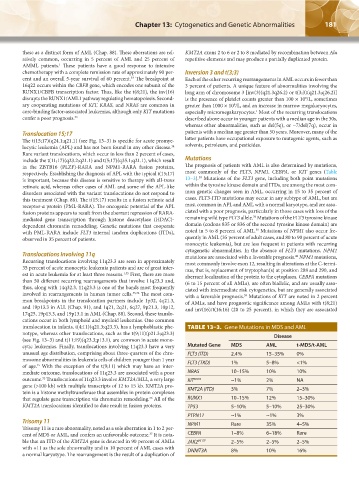
                  with PML-RARA include FLT3 internal tandem duplications (ITDs),   noted in 5 to 8 percent of AML.  Mutations of NPM1 also occur fre-
                  observed in 35 percent of patients.                   quently in AML (35 percent of adult cases, and 80 to 90 percent of acute
                                                                        monocytic leukemia), but are less frequent in patients with recurring
                                                                        cytogenetic abnormalities. In the absence of  FLT3 mutations,  NPM1
                  Translocations Involving 11q                          mutations are associated with a favorable prognosis.  NPM1 mutations,
                                                                                                             40
                  Recurring translocations involving 11q23.3 are seen in approximately   most commonly involve exon 12, resulting in alterations at the C-termi-
                  35 percent of acute monocytic leukemia patients and are of great inter-  nus, that is, replacement of tryptophan(s) at position 288 and 290, and
                                                    1,35
                  est in acute leukemia for at least three reasons.  First, there are more   aberrant localization of the protein to the cytoplasm. CEBPA mutations
                  than 50 different recurring rearrangements that involve 11q23.3 and,   (6 to 15 percent of all AMLs), are often biallelic, and are usually asso-
                  thus, along with 14q32.3, 11q23.3 is one of the bands most frequently   ciated with intermediate risk cytogenetics, but are generally associated
                  involved in rearrangements in human tumor cells. 35,36  The most com-  with a favorable prognosis.  Mutations of KIT are noted in 2 percent
                                                                                            38
                  mon breakpoints in the translocation partners include 1p32, 4q21.3,   of AMLs, and have prognostic significance among AMLs with t(8;21)
                  and 19p13.3 in ALL (Chap. 91), and 1q21, 2q21, 6q27, 9p21.3, 10p12,   and inv(16)/t(16;16) (20 to 25 percent), in which they are associated
                  17q25, 19p13.3, and 19p13.1 in AML (Chap. 88). Second, these translo-
                  cations occur in both lymphoid and myeloid leukemias. One common
                  translocation in infants, t(4;11)(q21.3;q23.3), has a lymphoblastic phe-  TABLE 13–3.  Gene Mutations in MDS and AML
                  notype, whereas other translocations, such as the t(9;11)(p21.3;q23.3)              Disease
                  (see Fig. 13–3) and t(11;19)(q23.3;p13.1), are common in acute mono-
                  cytic leukemias. Finally, translocations involving 11q23.3 have a very   Mutated Gene  MDS  AML  t-MDS/t-AML
                  unusual age distribution, comprising about three-quarters of the chro-  FLT3 (ITD)  2.4%  15–35%  0%
                  mosome abnormalities in leukemia cells of children younger than 1 year   FLT3 (TKD)  1%  5–8%  <1%
                  of age.  With the exception of the t(9;11) which may have an inter-
                       35
                  mediate outcome, translocations of 11q23.3 are associated with a poor   NRAS  10–15%  10%   10%
                  outcome.  Translocations of 11q23.3 involve KMT2A/MLL, a very large   KIT D816  ~1%  2%     NA
                        32
                  gene (>100 kb) with multiple transcripts of 12 to 15 kb. KMT2A pro-  KMT2A (ITD)  3%  7%    2–3%
                  tein is a histone methyltransferase that assembles in protein complexes
                  that regulate gene transcription via chromatin remodeling.  All of the   RUNX1  10–15%  12%  15–30%
                                                            36
                  KMT2A translocations identified to date result in fusion proteins.  TP53  5–10%   5–10%     25–30%
                                                                         PTPN11         ~1%         ~1%       3%
                  Trisomy 11                                             NPM1           Rare        35%       4–5%
                  Trisomy 11 is a rare abnormality, noted as a sole aberration in 1 to 2 per-
                  cent of MDS or AML, and confers an unfavorable outcome.  It is nota-  CEBPA  1–8%  6–18%    Rare
                                                            37
                  ble that an ITD of the KMT2A gene is detected in 90 percent of AMLs   JAK2 V617F  2–5%  2–5%  2–5%
                  with +11 as the sole abnormality and in 10 percent of AML cases with   DNMT3A  8%  10%      16%
                  a normal karyotype. The rearrangement is the result of a duplication of


          Kaushansky_chapter 13_p0173-0190.indd   181                                                                   17/09/15   6:32 pm

