


Page 2147 - Williams Hematology ( PDFDrive )
P. 2147
2122           Part XII:  Hemostasis and Thrombosis                                                                                                                       Chapter 123:  Hemophilia A and Hemophilia B            2123


               cryoprecipitate both contain factor VIII and once were the only prod-  the patient’s plasma volume (approximately 5 percent of body weight
               ucts available for treatment. A disadvantage of plasma is that large vol-  in kilograms) and the level to which factor VIII is to be raised. Thus,
               umes must be infused to achieve and maintain even minimal factor VIII   the plasma volume of a 70 kg adult is approximately equivalent  to
               levels. The highest factor VIII level that can be achieved with plasma   3500 mL (5 percent × 70 kg = 3.5 kg = 3500 g, approximately equivalent
               is approximately 20 percent of normal, which is not always attainable   to 3500 mL). To achieve normal factor VIII levels of 1 U/mL (100 percent),
               or sufficient for hemostasis. Cryoprecipitate, containing approximately     3500 U of factor VIII should be given. This scenario assumes a 100
               80 U of factor VIII in 10 mL of solution, can be used to attain nor-  percent recovery of the administered dose. Recovery has approached
               mal factor VIII levels, but individual bags of cryoprecipitate must be   100 percent in studies, but depends upon the method of assay and the
               pooled; the factor VIII dose can only be estimated; and the product   factor VIII standard used for comparison.  After the initial dose of
                                                                                                      48
               must be stored frozen. Several commercial lyophilized factor VIII con-  factor VIII, further doses of factor VIII are based on a half-life of 8 to
               centrates, using cryoprecipitate of pooled normal human plasmas as   12 hours. Thus, after a loading dose of 3500 U of factor VIII, a dose of
               starting material (2000 to 20,000 donors), are available and do not have   1750 U could be given in 12 hours. However, for practical purposes, the
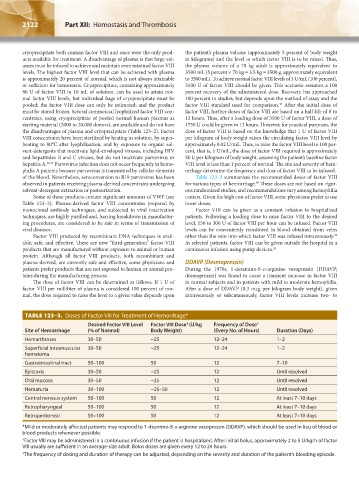
               the disadvantages of plasma and cryoprecipitate (Table  123–2). Factor   dose of factor VIII is based on the knowledge that 1 U of factor VIII
               VIII concentrates have been sterilized by heating in solution, by super-  per kilogram of body weight raises the circulating factor VIII level by
               heating to 80°C after lyophilization, and by exposure to organic sol-  approximately 0.02 U/mL. Thus, to raise the factor VIII level to 100 per-
               vent-detergents that inactivate lipid-enveloped viruses, including HIV   cent, that is, 1 U/mL, the dose of factor VIII required is approximately
               and hepatitides B and C viruses, but do not inactivate parvovirus or   50 U per kilogram of body weight, assuming the patient’s baseline factor
               hepatitis A. 46,47  Parvovirus infection does not occur frequently in hemo-  VIII level is less than 1 percent of normal. The site and severity of hem-
               philia A patients because parvovirus is transmitted by cellular elements   orrhage determine the frequency and dose of factor VIII to be infused.
               of the blood. Nevertheless, seroconversion to B19 parvovirus has been   Table 123–3 summarizes the recommended doses of factor VIII
                                                                                              48
               observed in patients receiving plasma-derived concentrates undergoing   for various types of hemorrhage.  These doses are not based on rigor-
               solvent-detergent extraction or pasteurization.        ous randomized studies, and recommendations vary among hemophilia
                   Some of these products contain significant amounts of VWF (see   centers. Given the high cost of factor VIII, some physicians prefer to use
               Table   123–2). Plasma-derived factor VIII concentrates prepared by   lower doses.
               monoclonal antibody techniques, and subjected to viral inactivation   Factor VIII can be given as a constant infusion to hospitalized
               techniques, are highly purified and, barring breakdown in manufactur-  patients. Following a loading dose to raise factor VIII to the desired
               ing procedures, are considered to be safe in terms of transmission of   level, 150 to 300 U of factor VIII per hour can be infused. Factor VIII
               viral diseases.                                        levels can be conveniently monitored in blood obtained from veins
                   Factor VIII produced by recombinant DNA techniques is avail-  other than the vein into which factor VIII was infused intravenously.
                                                                                                                        49
               able, safe, and effective. There are new “third-generation” factor VIII   In selected patients, factor VIII can be given outside the hospital in a
               products that are manufactured without exposure to animal or human   continuous infusion using pump devices. 50
               protein. Although all factor VIII products, both recombinant and
               plasma-derived, are currently safe and effective, some physicians and   DDAVP (Desmopressin)
               patients prefer products that are not exposed to human or animal pro-  During the 1970s, 1-desamino-8-d-arginine vasopressin (DDAVP;
               teins during the manufacturing process.                desmopressin) was found to cause a transient increase in factor VIII
                   The dose of factor VIII can be determined as follows. If 1 U of   in normal subjects and in patients with mild to moderate hemophilia.
               factor VIII per milliliter of plasma is considered 100 percent of nor-  After a dose of DDAVP (0.3 mcg per kilogram body weight), given
               mal, the dose required to raise the level to a given value depends upon   intravenously  or subcutaneously, factor VIII  levels  increase two-  to


                TABLE 123–3.  Doses of Factor VIII for Treatment of Hemorrhage*
                                     Desired Factor VIII Level   Factor VIII Dose  (U/kg   Frequency of Dose
                                                                                              ‡
                                                                      †
                Site of Hemorrhage   (% of Normal)        Body Weight)          (Every No. of Hours)  Duration (Days)
                Hemarthroses         30–50                ~25                   12–24                1–2
                Superficial intramuscular   30–50         ~25                   12–24                1–2
                hematoma
                Gastrointestinal tract  50–100            50                    12                   7–10
                Epistaxis            30–50                ~25                   12                   Until resolved
                Oral mucosa          30–50                ~25                   12                   Until resolved
                Hematuria            30–100               ~25–50                12                   Until resolved
                Central nervous system  50–100            50                    12                   At least 7–10 days
                Retropharyngeal      50–100               50                    12                   At least 7–10 days
                Retroperitoneal      50–100               50                    12                   At least 7–10 days
               *Mild or moderately affected patients may respond to 1-deamino-8-d-arginine vasopressin (DDAVP), which should be used in lieu of blood or
               blood products whenever possible.
               † Factor VIII may be administered in a continuous infusion if the patient is hospitalized. After initial bolus, approximately 2 to 5 U/kg/h of factor
               VIII usually are sufficient in an average-size adult. Bolus doses are given every 12 to 24 hours.
               ‡ The frequency of dosing and duration of therapy can be adjusted, depending on the severity and duration of the patient’s bleeding episode.


          Kaushansky_chapter 123_p2113-2132.indd   2122                                                                 9/21/15   4:36 PM

