


Page 2190 - Williams Hematology ( PDFDrive )
P. 2190
2164  Part XII:  Hemostasis and Thrombosis                            Chapter 126:  von Willebrand Disease           2165


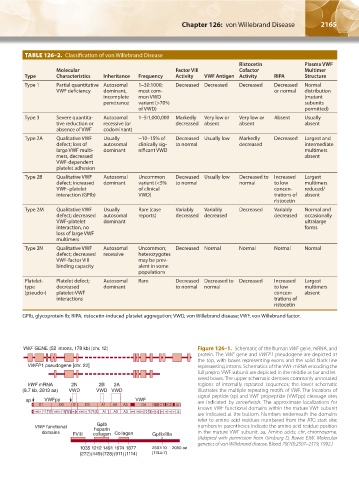
                   TABLE 126–2.  Classification of von Willebrand Disease
                                                                                           Ristocetin           Plasma VWF
                             Molecular                               Factor VIII           Cofactor             Multimer
                   Type      Characteristics  Inheritance  Frequency  Activity  VWF Antigen Activity  RIPA      Structure
                   Type 1    Partial quantitative  Autosomal   1–30:1000;   Decreased Decreased  Decreased  Decreased   Normal
                             VWF deficiency  dominant,   most com-                                    or normal  distribution
                                             incomplete   mon VWD                                               (mutant
                                             penetrance  variant (>70%                                          subunits
                                                         of VWD)                                                permitted)
                   Type 3    Severe quantita-  Autosomal   1–5:1,000,000  Markedly   Very low or   Very low or   Absent  Usually
                             tive reduction or   recessive (or       decreased  absent     absent               absent
                             absence of VWF  codominant)
                   Type 2A   Qualitative VWF   Usually   ~10–15% of   Decreased  Usually low  Markedly   Decreased  Largest and
                             defect; loss of   autosomal   clinically sig-  to normal      decreased            intermediate
                             large VWF multi-  dominant  nificant VWD                                           multimers
                             mers, decreased                                                                    absent
                             VWF-dependent
                             platelet adhesion
                   Type 2B   Qualitative VWF   Autosomal   Uncommon   Decreased  Usually low  Decreased to  Increased   Largest
                             defect; increased   dominant  variant (<5%   to normal        normal     to low    multimers
                             VWF–platelet                of clinical                                  concen-   reduced/
                             interaction (GPIb)          VWD)                                         trations of   absent
                                                                                                      ristocetin
                   Type 2M   Qualitative VWF   Usually   Rare (case   Variably   Variably   Decreased  Variably   Normal and
                             defect; decreased   autosomal   reports)  decreased  decreased           decreased  occasionally
                             VWF-platelet    dominant                                                           ultralarge
                             interaction, no                                                                    forms
                             loss of large VWF
                             multimers
                   Type 2N   Qualitative VWF   Autosomal   Uncommon;   Decreased Normal    Normal     Normal    Normal
                             defect; decreased   recessive  heterozygotes
                             VWF-factor VIII             may be prev-
                             binding capacity            alent in some
                                                         populations
                   Platelet-   Platelet defect;   Autosomal   Rare   Decreased  Decreased to  Decreased  Increased   Largest
                   type      decreased       dominant                to normal  normal                to low    multimers
                   (pseudo-)  platelet-VWF                                                            concen-   absent
                             interactions                                                             trations of
                                                                                                      ristocetin

                  GPIb, glycoprotein Ib; RIPA, ristocetin-induced platelet aggregation; VWD, von Willebrand disease; VWF, von Willebrand factor.


                  VWF GENE (52 introns, 178 kb) [chr. 12]                    Figure 126–1.  Schematic of the human VWF gene, mRNA, and
                                                                             protein. The VWF gene and VWFP1 pseudogene are depicted at
                                                                             the top, with boxes representing exons and the solid black line
                    VWFP1 pseudogene [chr. 22]                               representing introns. Schematics of the VWF mRNA encoding the
                                                                             full prepro-VWF subunit are depicted in the middle as bar and let-
                                                                             tered boxes. The upper schematic denotes commonly annotated
                    VWF mRNA      2N       2B    2A                          regions of internally repeated sequences; the lower schematic
                  (8.7 kb, 2813 aa)  VWD   VWD VWD                           illustrates the multiple repeating motifs of VWF. The locations of
                                                                             signal peptide (sp) and VWF propeptide (VWFpp) cleavage sites
                   sp    VWFpp                          VWF                  are indicated by  arrowheads.  The approximate localizations for
                     S  D1    D2   D′  D3   A1  A2  A3    D4  B B B  C1 C2  CK CI
                                                              1 2 3
                                                                             known VWF functional domains within the mature VWF subunit
                     S VWD1  C8 TIL –1  E VWD2  C8 TIL  –2 E TIL′  E VWD3  C8 TIL –3  –3 E  A1  A2  A3  D4N VWD4  C8 –4  TIL -4  C1  C2  C3  C4  C5  C6  CK CI
                         –1
                                                                             are indicated at the bottom. Numbers underneath the domains
                           –1
                                        –3
                               –2 –2
                                                                             refer to amino acid residues numbered from the ATG start site;
                                           GpIb
                      VWF functional      heparin                            numbers in parentheses indicate the amino acid residue position
                        domains    FVIII  collagen Collagen  GpIIb/IIIa      in the mature VWF subunit. aa, Amino acids; chr, chromosome.
                                                                             (Adapted with permission from Ginsburg D, Bowie EJW. Molecular
                                                                             genetics of von Willebrand disease. Blood 79(10):2507–2519, 1992.)
                                     1035 1212 1491 1674 1877  2507-10  2050 aa
                                     (272)(449)(728)(911)(1114)  (1744-7)
          Kaushansky_chapter 126_p2163-2182.indd   2165                                                                 9/21/15   3:14 PM

