


Page 2193 - Williams Hematology ( PDFDrive )
P. 2193
2168           Part XII:  Hemostasis and Thrombosis                                                                                                                                Chapter 126:  von Willebrand Disease          2169


                                                 113
               colocalizes with VWF in the subendothelium.  Type VI collagen sup-               2A
                                                                                      2A
               ports the binding of VWF under high shear through cooperative inter-  2N  2M    2M
                                                                                  2M
               actions between binding domains within the VWF A1 and A3 repeat.    2N  2A 2N  2M  2B2A  2M             2M
                                                                 114
                                                                                          2A
                                                                            2A
                                                                                                                       2A
               Although VWF binding has also been demonstrated to a number of   S  D1  D2  D′  D3  A1  A2  A3  D4  B B B  C1  C2  CI CK
                                                                                                                1 2 3
               other  potential  components  of  the  subendothelium,  including  gly-  VWF Exon  3–10  11–17  18–20  20–28  Exon 28  28–32  35–39  40–42 42–48 49–52
                                                       118
                                        117
               cosaminoglycans, 115,116   sulfatides,   and  VWF  itself,   the  biologic
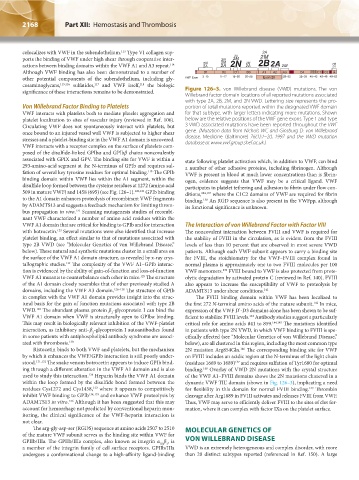
               significance of these interactions remains to be demonstrated.  Figure 126–3.  von  Willebrand disease (VWD) mutations.  The von
                                                                      Willebrand factor domain locations of all reported mutations associated
                                                                      with type 2A, 2B, 2M, and 2N VWD. Lettering size represents the pro-
               Von Willebrand Factor Binding to Platelets             portion of total mutations reported within the designated VWF domain
               VWF interacts with platelets both to mediate platelet aggregation and   for that subtype, with larger letters indicating more mutations. Shown
               platelet localization to sites of vascular injury (reviewed in Ref. 106).   below are the relative positions of the VWF gene exons. Type 1 and type
               Circulating VWF does not spontaneously interact with platelets, but   3 VWD associated mutations have been reported throughout the VWF
               once bound to an injured vessel wall VWF is subjected to higher shear   gene.  (Mutation data from Nichols WC and Ginsburg D: von Willebrand
               stresses and a platelet-binding site in the VWF A1 domain is uncovered.   disease.  Medicine (Baltimore) 76(1):1–20, 1997 and the VWD mutation
               VWF interacts with a receptor complex on the surface of platelets com-  database at www.vwf.group.shef.ac.uk.)
               posed of the disulfide-linked GPIbα and GPIbβ chains noncovalently
               associated with GPIX and GPV. The binding site for VWF is within a   state following platelet activation which, in addition to VWF, can bind
               293-amino-acid segment at the N-terminus of GPIb and requires sul-  a number of other adhesive proteins, including fibrinogen. Although
                                                         119
               fation of several key tyrosine residues for optimal binding.  The GPIb   VWF is present in blood at much lower concentrations than is fibrin-
               binding domain within VWF lies within the A1 segment, within the   ogen, evidence suggests that VWF may be a critical ligand. VWF
               disulfide loop formed between the cysteine residues at 1272 (amino acid   participates in platelet tethering and adhesion to fibrin under flow con-
               509 in mature VWF) and 1458 (695) (see Fig. 126–1). 120,121  GPIb binding   ditions, 104,137  where the C1C2 domains of VWF are required for fibrin
               to the A1 domain enhances proteolysis of recombinant VWF fragments   binding.  An RGD sequence is also present in the VWFpp, although
                                                                            138
               by ADAMTS13 and suggests a feedback mechanism for limiting throm-  its functional significance is unknown.
               bus propagation in vivo.  Scanning mutagenesis studies of recombi-
                                 122
               nant VWF characterized a number of amino acid residues within the
               VWF A1 domain that are critical for binding to GPIb and for interaction   The Interaction of von Willebrand Factor with Factor VIII
               with botrocetin.  Several mutations were also identified that increase   The noncovalent interaction between FVIII and VWF is required for
                           123
               platelet binding, an effect similar to that of mutations associated with   the stability of FVIII in the circulation, as is evident from the FVIII
               type 2B VWD (see “Molecular Genetics of von Willebrand Disease,”   levels of less than 10 percent that are observed in most severe VWD
               below). These natural and synthetic mutations cluster in a small area on   patients. Although each VWF subunit appears to carry a binding site
               the surface of the VWF A1 domain structure, as revealed by x-ray crys-  for FVIII, the stoichiometry for the VWF–FVIII complex found in
                              124
               tallographic studies.  The complexity of the VWF A1–GPIb interac-  normal plasma is approximately one to two FVIII molecules per 100
               tion is evidenced by the ability of gain-of-function and loss-of-function   VWF monomers.  FVIII bound to VWF is also protected from prote-
                                                                                   139
                                                       125
               VWF A1 mutants to counterbalance each other in mice.  The structure   olytic degradation by activated protein C (reviewed in Ref. 140). FVIII
               of the A1 domain closely resembles that of other previously studied A   also  appears  to  increase  the  susceptibility  of  VWF  to  proteolysis  by
               domains, including the VWF A3 domain. 126–128  The structure of GPIb   ADAMTS13 under shear conditions. 141
               in complex with the VWF A1 domain provides insight into the struc-  The FVIII binding domain within VWF has been localized to
               tural basis for the gain of function mutations associated with type 2B   the first 272 N-terminal amino acids of the mature subunit.  In mice,
                                                                                                                 142
               VWD.  The abundant plasma protein β -glycoprotein I can bind the   expression of the VWF D’-D3 domains alone has been shown to be suf-
                    129
                                             2
               VWF A1 domain when VWF is structurally open to GPIbα binding.   ficient to stabilize FVIII levels.  Antibody studies suggest a particularly
                                                                                            143
               This may result in biologically relevant inhibition of the VWF-platelet   critical role for amino acids 841 to 859. 144,145  The mutations identified
               interaction, as inhibitory anti–β -glycoprotein I autoantibodies found   in patients with type 2N VWD, in which VWF binding to FVIII is spe-
                                       2
               in some patients with antiphospholipid antibody syndrome are associ-  cifically affected (see “Molecular Genetics of von Willebrand Disease,”
               ated with thrombosis. 130                              below), are all clustered in this region, including the most common type
                   Ristocetin binds to both VWF and platelets, but the mechanism   2N mutation Arg854Gln.  The corresponding binding site for VWF
                                                                                         146
               by which it enhances the VWF/GPIb interaction is still poorly under-  on FVIII includes an acidic region at the N-terminus of the light chain
               stood. 131,132  The snake venom botrocetin appears to induce GPIb bind-  (residues 1669 to 1689)  and requires sulfation of Tyr1680 for optimal
                                                                                       147
               ing through a different alteration in the VWF A1 domain and is also   binding.  Overlay of VWD 2N mutations with the crystal structure
                                                                            148
               used to study this interaction.  Heparin binds the VWF A1 domain   of the VWF A1–FVIII domains shows the 2N mutations clustered in a
                                      128
               within the loop formed by the disulfide bond formed between the   dynamic VWF TIL’ domain (shown in Fig. 126–3), implicating a need
               residues Cys1272 and Cys1458,  where it appears to competitively   for flexibility in this domain for normal FVIII binding.  Thrombin
                                       133
                                                                                                                149
               inhibit VWF binding to GPIb 134,135  and enhance VWF proteolysis by   cleavage after Arg1689 in FVIII activates and releases FVIII from VWF.
               ADAMTS13 in vitro.  Although it has been suggested that this may   Thus, VWF may serve to efficiently deliver FVIII to the sites of clot for-
                               136
               account for hemorrhage not predicted by conventional heparin mon-  mation, where it can complex with factor IXa on the platelet surface.
               itoring, the clinical significance of the VWF-heparin interaction is
               not clear.
                   The arg-gly-asp-ser (RGDS) sequence at amino acids 2507 to 2510   MOLECULAR GENETICS OF
               of the mature VWF subunit serves as the binding site within VWF for
               GPIIb/IIIa. The GPIIb/IIIa complex, also known as integrin α β , is   VON WILLEBRAND DISEASE
                                                              IIb 3
               a member of the integrin family of cell surface receptors. GPIIb/IIIa   VWD is an extremely heterogeneous and complex disorder, with more
               undergoes a conformational change to a high-affinity ligand-binding   than 20 distinct subtypes reported (referenced in Ref. 150). A large
          Kaushansky_chapter 126_p2163-2182.indd   2168                                                                 9/21/15   3:14 PM

