


Page 2194 - Williams Hematology ( PDFDrive )
P. 2194
2168  Part XII:  Hemostasis and Thrombosis                            Chapter 126:  von Willebrand Disease           2169


                  number of mutations within the VWF gene have been identified (see   Subgroups within type 1 VWD have been proposed based on the rel-
                  Fig. 126–3). However, because of both the genetic complexity of VWD   ative levels of VWF present in the plasma and platelet pools, 156–159  but
                  and the practical considerations of VWF gene sequencing in most clin-  with  the  exception in  some  circumstances  for  an  accelerated  VWF
                                                                                                                  160
                  ical settings, a VWF gene mutation is not required for the diagnosis of   clearance  phenotype  (unofficially  termed  VWF  type  1C ),  subtype
                      151
                  VWD.  A list is maintained by a consortium of VWD investigators   distinctions in type 1 VWD are not generally used in clinical practice.
                  and can be accessed through the Internet at http://www.vwf.group.shef   Type 1 VWF was previously assumed to simply represent the het-
                  .ac.uk/. These findings form the basis for the simplified classification   erozygous form of type 3 VWD. However, in a large Canadian study,
                                          151
                  of VWD outlined in Table  126–2  and used throughout this chapter.   48 percent of heterozygous carriers of type 3 VWD gene mutations
                  Types 1 and 3 VWD are defined as pure quantitative deficiencies of   carried a diagnosis of type 1 VWD, while the remainder were asymp-
                                                                              161
                  VWF that are either partial (type 1) or complete (type 3). Type 2 VWD   tomatic.  Furthermore, in two large studies of type 1 VWD families,
                  is characterized by qualitative abnormalities of VWF structure and/or   numerous putative VWF mutations were identified, but very few were
                  function. The quantity of VWF found in type 2 VWD may be normal,   predictive of VWF null alleles. 31,162  Thus, some, but probably not all (see
                  but it is usually mildly to moderately decreased (see Table  126–2).  section Clinical Features below), type 1 VWD is the result of defects
                     The diagnosis of VWD, particularly type 1 VWD, can be con-  within the VWF gene. Studies of type 1 VWD mutations in patients,
                  founded by the incomplete penetrance of the disease and the wide range   in vitro, and in animal models have characterized diverse mechanisms
                                                                                                                     163
                  of VWF levels in normal populations (see “Laboratory Features” below).   underlying type 1 VWD, including decreased VWF production,  reten-
                  Nonpathogenic variation can impact laboratory assays in vitro, as is the   tion of VWF in the ER, 164,165  impaired VWF secretion, 165,166  and decreased
                  case with Asp1472His, which alters VWF-ristocetin interactions but   VWF survival. 163,166,167  Mutations that give rise to defective VWF subunits
                  has no impact on hemostasis in vivo.  Ethnicity should also be con-  that interfere in a dominant negative way with the normal allele may be
                                             152
                  sidered. European ancestries were overrepresented in the studies which   particularly likely to cause symptomatic VWD in the heterozygote.  For
                                                                                                                       168
                  informed laboratory cutoffs, while African Americans exhibit generally   example, mutations at several cysteine residues in the VWF D3 domain
                  higher VWF and FVIII levels. Additionally, there are numerous VWF   and in the VWFpp of patients with moderately severe type 1 VWD. VWF
                  gene “mutations” previously thought to be causative of VWD which are   carrying one of these mutations is retained in the ER, where it is proposed
                  now known to be common in African Americans 153,154  who have normal   to exert a dominant negative effect on VWF derived from the normal
                                  153
                  VWF and FVIII levels,  including the Asp1472His variant. 155  allele via heterodimerization and degradation. 169,170
                                                                            To date, most mutation studies and genetic linkage analysis of
                  Type 1 von Willebrand Disease                         type 1 VWD have been consistent with defects within the VWF gene.
                  Type 1 VWD is the most common form, accounting for approximately    Although no single mutation can explain the majority of type 1 VWD,
                  70 percent of patients with the disease. Type 1 VWD is generally   common VWF founder mutations can occur within populations, such as
                  autosomal dominant in inheritance and is associated with coordinate   Tyr1584Cys identified in 14 percent of Canadian type 1 VWD patients,
                  reductions in FVIII, ristocetin cofactor activity, and VWF antigen   and possibly a similar proportion of patients in Europe. 162,171  The
                  with maintenance of the full complement of multimers (Fig. 126–4).   Tyr1584Cys mutation is associated with decreased VWF survival, likely
                                                                        a result of increased susceptibility to proteolysis by ADAMTS13. 172–175
                                                                        These large multicenter studies of type 1 VWD families found candi-
                                                                        date VWF mutations in 63 to 70 percent of families with type 1 VWD,
                                                                        leaving 37 to 40 percent of type 1 VWD index cases without a putative
                                                                        mutation in VWF. 162,171  Cases with VWF gene mutations tend to be more
                                                                        severe and highly heritable, while cases without an identifiable VWF
                                                                        mutation  generally  have  higher  VWF  antigen  (VWF:Ag)  levels  (>30
                                                                              31
                                                                        IU/dL).  In a large, multicenter European study of 150 type 1 VWD
                                                                        families, about one-third of cases historically diagnosed to have type
                                                                        1 VWD were found to have abnormal multimers, and of these nearly
                                                                        all (95 percent) had a putative VWF gene mutation and significantly
                  3                                                     lower VWF:Ag, VWF ristocetin cofactor activity (VWF:RCo), assay of
                                                                        FVIII activity (FVIII:C), and VWF collagen-binding assay (VWF:CB)
                  2                                                     levels. Conversely, index cases with normal multimers had higher lab-
                                                                        oratory VWF values and fewer identifiable  VWF mutations (55 per-
                                                                        cent), suggesting that the pathogenic mechanism(s) underlying this
                  1
                                                                                                                          162
                                                                        cohort of “true” type 1 VWD patients is more genetically complex.
                           N     1    2A   2B   2A   2A   2A    N       Given the complex biosynthesis and processing of VWF, defects at a
                                               (IIC)  (IID)  (IIE)      number of other loci could also be expected to result in quantitative
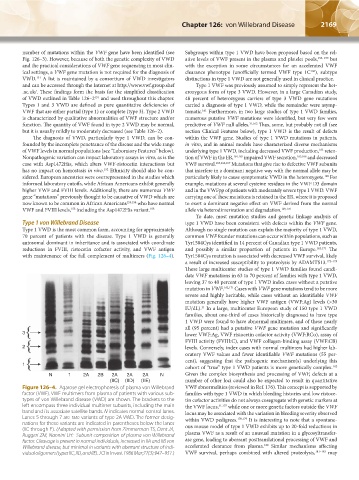
                  Figure 126–4.  Agarose gel electrophoresis of plasma von Willebrand   VWF abnormalities (reviewed in Ref. 176). This concept is supported by
                  factor (VWF). VWF multimers from plasma of patients with various sub-  families with type 1 VWD in which bleeding histories and low ristoce-
                  types of von Willebrand disease (VWD) are shown. The brackets to the   tin cofactor activities do not always cosegregate with genetic markers at
                  left encompass three individual multimer subunits, including the main   the VWF locus, 31,177  while one or more genetic factors outside the VWF
                  band and its associate satellite bands. N indicates normal control lanes.   locus may be associated with the variation in bleeding severity observed
                  Lanes 5 through 7 are rare variants of type 2A VWD. The former desig-  within VWD pedigrees. 178,179  It is interesting to note that a spontane-
                  nations for these variants are indicated in parentheses below the lanes   ous mouse model of type 1 VWD exhibits up to 20-fold reductions in
                  (IIC through E). (Adapted with permission from Zimmerman TS, Dent JA,
                  Ruggeri ZM, Nannini LH:  Subunit composition of plasma von Willebrand   plasma VWF as a result of an unusual mutation in a glycosyltransfer-
                  factor. Cleavage is present in normal individuals, increased in IIA and IIB von   ase gene, leading to aberrant posttranslational processing of VWF and
                                                                                                   180
                  Willebrand disease, but minimal in variants with aberrant structure of indi-  accelerated clearance from plasma.  Similar mechanisms affecting
                  vidual oligomers (types IIC, IID, and IIE). J Clin Invest 1986 Mar;77(3):947–951.)  VWF survival, perhaps combined with altered proteolysis, 181–183  may


          Kaushansky_chapter 126_p2163-2182.indd   2169                                                                 9/21/15   3:14 PM

