


Page 220 - Williams Hematology ( PDFDrive )
P. 220
194  Part IV:  Molecular and Cellular Hematology   Chapter 14:  Metabolism of Hematologic Neoplastic Cells            195


                  which is required for ribosome biogenesis. On the other hand, AMPK   directly regulate genes involved in glycolysis, thereby linking an onco-
                  increases energy yield by stimulating glycolysis through phosphory-  genic transcription factor to metabolism.  Since these initial observa-
                                                                                                      6,19
                  lation and activation of PFK-2. AMPK stimulates mitochondrial bio-  tions, high-throughput methods have mapped MYC to a broad swath
                  genesis through phosphorylation of PGC1α and increases autophagy   of metabolic enzyme genes involved in glycolysis, glutaminolysis, and
                                                   21
                  to recycle energy by phosphorylating ULK-1.  Thus, increased AMPK   lipogenesis. MYC also directly regulates genes involved in mitochon-
                  activity conserves energy and maximizes energy production.  drial  biogenesis  and  the  production  of  ribosomes.  Specifically,  genes
                     Together with posttranscriptional responses to growth signal-  highly induced by MYC include those involved in nucleolar function
                  ing and nutrients, the nuclear transcriptional response is necessary to   and ribosome biogenesis, such as Ncl, NPM1, fibrillarin, and NOP52.
                  sustain the growth program through production of components of the   Collectively, these studies uncover MYC’s role as a central regulator of
                  ribosome and mRNAs that give rise to all other components of the cell.   cell growth through coupling of energy metabolism with cellular bio-
                  mTOR through its direct activation of specific transcription factors con-  synthetic processes.
                  tributes to lipogenesis and mitochondrial biogenesis. Growth signaling   Ribosome biogenesis is a critically important process for cell
                  also activates the MYC protooncogene, that regulates gene expression   growth or cell mass accumulation. 25,26  Ribosomes are produced through
                  broadly to support cell growth and proliferation (see Figs. 14–2 and     RNAs that are transcribed by RNA polymerases I (rRNA [ribosomal
                      19
                  14–3). Loss of function of Drosophila dMYC results in decreased cell   RNA]), II (mRNA), and III (tRNAs [transfer RNAs] and small RNAs).
                                                                    22
                  and body size, a phenotype that underscores MYC’s role in cell growth.    rRNA is synthesized in the nucleolus from high copy numbers of rDNA,
                  This phenotype mimics the loss of ribosome protein gene function in a   whose chromatin structure and transcription depends on nutrient
                  group of mutant flies termed Minutes. Hence, Drosophila genetics links   availability. Under nutrient limitation, rDNA chromatin becomes less
                                                                                                              26
                  MYC to cell growth control. Furthermore, MYC is the only transcrip-  accessible,  thereby  restricting  ribosome  biogenesis.   Ribosomal  pro-
                  tion factor capable of stimulating the activity of RNA polymerases I, II,   teins produced from mRNAs reenter the nucleolus, where components
                  and III, all of which are involved in ribosome biogenesis.  of ribosomes are assembled into mature ribosomal particles, which are
                     MYC  dimerizes  with  its  partner  Max  to  bind  a  specific  DNA   exported to the cytosol. The production of rRNAs and proteins also pro-
                  sequence, termed E-box (CACGTG), and activate transcription.  It   vides an opportunity for bioenergetic sensing of adequate nutrients to
                                                                  23
                  can also inhibit transcription partly through direct binding to Miz-1   support nucleic acid and protein synthesis required for growth. In this
                  and diminishing the expression of Miz-1 target genes, including the   regard, specific ribosomal protein subunits (RPL5, RPL11, and others)
                  cyclin-dependent  kinase  (CDK)  inhibitor  p21  and  genes  involved  in   can bind and inhibit MDM2 (mouse double minute 2 homolog), which
                                                                                                         25
                  autophagy. Upon MYC activation, it is binding to proximal promoters   binds to and mediates the degradation of p53.  Thus, it is surmised that
                  accounts for most of it is transcriptional function in normal cells. When   ribosomal proteins in excess of rRNAs would activate p53, triggering
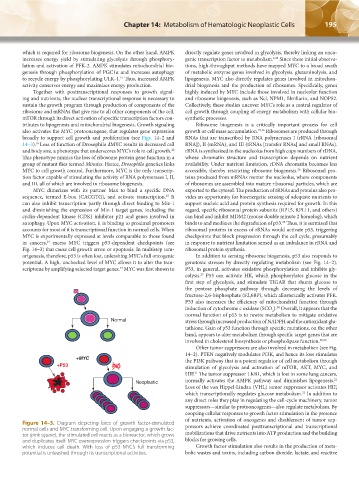
                  MYC is experimentally expressed at levels comparable to those found   checkpoints that block progression through the cell cycle, presumably
                          19
                  in cancers,  excess MYC triggers p53-dependent checkpoints (see    in response to nutrient limitation sensed as an imbalance in rRNA and
                  Fig. 14–3) that cause cell growth arrest or apoptosis. In multistep tum-  ribosomal protein synthesis.
                  origenesis, therefore, p53 is often lost, unleashing MYC’s full oncogenic   In addition to sensing ribosome biogenesis, p53 also responds to
                  potential. A high, unchecked level of MYC allows it to alter the tran-  genotoxic stresses by directly regulating metabolism (see Fig. 14–2).
                  scriptome by amplifying selected target genes.  MYC was first shown to   P53, in general, activates oxidative phosphorylation and inhibits gly-
                                                  24
                                                                        colysis.  P53 can activate HK, which phosphorylates glucose in the
                                                                              27
                                                                        first step of glycolysis, and stimulate TIGAR that shunts glucose to
                                                                        the pentose phosphate  pathway through decreasing  the levels of
                                                                        fructose-2,6-bisphosphate (F2,6BP), which allosterically activates PFK.
                                                                        P53 also  increases the efficiency of mitochondrial function through
                                                                        induction of cytochrome c oxidase (SCO ).  Overall, it appears that the
                                                                                                       28
                                                                                                      2
                                                                        normal function of p53 is to rewire metabolism to mitigate oxidative
                                                Normal                  stress through increased production of NADPH and the antioxidant glu-
                                                                        tathione. Gain of p53 function through specific mutations, on the other
                                                                        hand, appears to alter metabolism through specific target genes that are
                                                                        involved in cholesterol biosynthesis or phospholipase function. 29,30
                                                                            Other tumor suppressors are also involved in metabolism (see Fig.
                                                                        14–2). PTEN negatively modulates PI3K, and hence its loss stimulates
                                    +MYC                                the PI3K pathway that is a potent regulator of cell metabolism through
                             +P53               P53                     stimulation  of  glycolysis  and  activation  of  mTOR,  AKT,  MYC,  and
                                                                            31
                                                                        HIF.  The tumor suppressor LKB1, which is lost in some lung cancers,
                                                                                                                          21
                                                        Neoplastic      normally activates the AMPK pathway and diminishes lipogenesis.
                                                                        Loss of the von Hippel-Lindau (VHL) tumor suppressor activates HIF,
                                                                                                                32
                                                                        which transcriptionally regulates glucose metabolism.  In addition to
                                                                        any direct roles they play in regulating the cell-cycle machinery, tumor
                                                                        suppressors—similar to protooncogenes—also regulate metabolism. By
                                                                        coopting cellular responses to growth factor stimulation in the presence
                                                                        of nutrients, activation of oncogenes and disablement of tumor sup-
                  Figure 14–3.  Diagram depicting fates of growth factor-stimulated
                  normal cells and MYC transforming cell. Upon engaging a growth fac-  pressors  achieve  coordinated posttranscriptional  and transcriptional
                  tor (pink square), the stimulated cell reacts as a bioreactor, which grows   mobilizations that drive nutrients into ATP production and the building
                  and duplicates itself. MYC overexpression triggers checkpoints via p53,   blocks for growing cells.
                  which  induces  cell  death.  With  loss  of  p53  MYC’s  full  transforming   Growth factor stimulation also results in the production of meta-
                  potential is unleashed through its transcriptional activities.  bolic wastes and toxins, including carbon dioxide, lactate, and reactive


          Kaushansky_chapter 14_p0191-0202.indd   195                                                                   17/09/15   6:35 pm

