


Page 224 - Williams Hematology ( PDFDrive )
P. 224
198  Part IV:  Molecular and Cellular Hematology   Chapter 14:  Metabolism of Hematologic Neoplastic Cells            199


                         glutamine                 glucose

                                                Warburg effect

                                                   pyruvate
                                      lactate
                                                  acetyl-CoA
                                             oxaloacetate
                                         malate      citrate
                                                                                               a ketoglutarate–dependent
                                       fumarate      isocitrate                                      oxygenases:
                                                           IDH2, IDH3                             DNA demethylation
                                         succinate  a ketoglutarate                              histone demethylation

                                                     glutamate
                                                   GLS                isocitrate
                                                     glutamine
                                                                          IDH1
                                                                                        mutant IDH1

                                     glutaminolysis
                                                                                       NADPH   NADP+
                                                                       a ketoglutarate         2-hydroxyglutarate

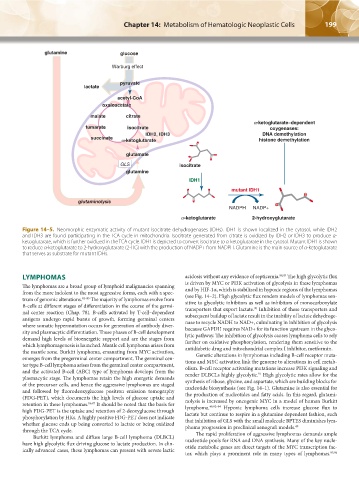
                  Figure 14–5.  Neomorphic enzymatic activity of mutant isocitrate dehydrogenases (IDHs). IDH1 is shown localized in the cytosol, while IDH2
                  and IDH3 are found participating in the TCA cycle in mitochondria. Isocitrate generated from citrate is oxidized by IDH2 or IDH3 to produce α-
                  ketoglutarate, which is further oxidized in the TCA cycle. IDH1 is depicted to convert isocitrate to α-ketoglutarate in the cytosol. Mutant IDH1 is shown
                  to reduce α-ketoglutarate to 2-hydroxyglutarate (2-HG) with the production of NADP+ from NADPH. Glutamine is the main source of α-ketoglutarate
                  that serves as substrate for mutant IDHs.


                  LYMPHOMAS                                             acidosis without any evidence of septicemia. 88,89  The high glycolytic flux

                  The lymphomas are a broad group of lymphoid malignancies spanning   is driven by MYC or PI3K activation of glycolysis in these lymphomas
                                                                        and by HIF-1α, which is stabilized in hypoxic regions of the lymphomas
                  from the more indolent to the most aggressive forms, each with a spec-  (see Fig. 14–2). High glycolytic flux renders models of lymphomas sen-
                  trum of genomic alterations. 82–85  The majority of lymphomas evolve from   sitive to glycolytic inhibitors as well as inhibitors of monocarboxylate
                  B-cells at different stages of differentiation in the course of the germi-  transporters that export lactate.  Inhibition of these transporters and
                                                                                                90
                  nal center reaction (Chap. 78). B-cells activated by T-cell–dependent     subsequent buildup of lactate result in the inability of lactate dehydroge-
                  antigens undergo rapid bursts of growth, forming germinal centers   nase to recycle NADH to NAD+, culminating in inhibition of glycolysis
                  where somatic hypermutation occurs for generation of antibody diver-  because GAPDH requires NAD+ for its function upstream in the glyco-
                  sity and plasmacytic differentiation. These phases of B-cell development   lytic pathway. The inhibition of glycolysis causes lymphoma cells to rely
                  demand high levels of bioenergetic support and are the stages from   further on oxidative phosphorylation, rendering them sensitive to the
                  which lymphomagenesis is launched. Mantle cell lymphoma arises from   antidiabetic drug and mitochondrial complex I inhibitor, metformin.
                  the mantle zone. Burkitt lymphoma, emanating from MYC activation,   Genetic alterations in lymphomas including B-cell receptor muta-
                  emerges from the pregerminal center compartment. The germinal cen-  tions and MYC activation link the genome to alterations in cell metab-
                  ter type B-cell lymphoma arises from the germinal center compartment,   olism. B-cell receptor activating mutations increase PI3K signaling and
                  and the activated B-cell (ABC) type of lymphoma develops from the   render DLBCLs highly glycolytic.  High glycolytic rates allow for the
                                                                                                 91
                  plasmacytic stage. The lymphomas retain the high energetic demands   synthesis of ribose, glycine, and aspartate, which are building blocks for
                  of the precursor cells, and hence the aggressive lymphomas are staged   nucleotide biosynthesis (see Fig. 14–1). Glutamine is also essential for
                  and  followed  by  fluorodeoxyglucose  positron  emission  tomography   the production of nucleotides and fatty acids. In this regard, glutami-
                  (FDG-PET), which documents the high levels of glucose uptake and   nolysis is increased by oncogenic MYC in a model of human Burkitt
                  retention in these lymphomas. 86,87  It should be noted that the basis for   lymphoma. 49,92–94  Hypoxic lymphoma cells increase glucose flux to
                  high FDG-PET is the uptake and retention of 2-deoxyglucose through   lactate but continue to respire in a glutamine dependent fashion, such
                  phosphorylation by HKs. A highly positive FDG-PET does not indicate   that inhibition of GLS with the small molecule BPTES diminishes lym-
                  whether glucose ends up being converted to lactate or being oxidized   phoma progression in preclinical xenograft models. 49
                  through the TCA cycle.                                    The rapid proliferation of aggressive lymphomas demands ample
                     Burkitt lymphoma and diffuse large B-cell lymphoma (DLBCL)   nucleotide pools for RNA and DNA synthesis. Many of the key nucle-
                  have high glycolytic flux driving glucose to lactate production. In clin-  otide metabolic genes are direct targets of the MYC transcription fac-
                  ically advanced cases, these lymphomas can present with severe lactic
                                                                        tor, which plays a prominent role in many types of lymphomas. 95,96


          Kaushansky_chapter 14_p0191-0202.indd   199                                                                   17/09/15   6:36 pm

