


Page 219 - Williams Hematology ( PDFDrive )
P. 219
194            Part IV:  Molecular and Cellular Hematology                                                                                                     Chapter 14:  Metabolism of Hematologic Neoplastic Cells             195


                                         mTORC2     PDK1     LKB


                                                PTEN        AMPK
                       growth
                       factor                                TSC1
                                   RTK      PI3K     AKT     TSC2      Rheb      mTORC1

                                          RAS     RAF   MEK          RSK
                                                             ERK            HIF-1α
                                                     MDM2
                                                                             ribosome biogenesis      CELL GROWTH
                                                             MYC              protein synthesis
                     nutrients                      TP53                                                   &
                                                                                                     PROLIFERATION
                                               glycolysis                       nucleic acid
                                                                                  lipid and
                                                                                carbohydrate
                                                          glutaminolysis         synthesis
                      wastes                    lactate
                                                 CO
                                                   2
                                                                                  NADPH
                                                                     ROS
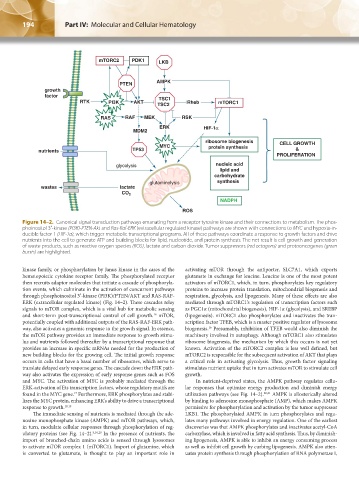
               Figure 14–2.  Canonical signal transduction pathways emanating from a receptor tyrosine kinase and their connections to metabolism. The phos-
               phoinositol 3′-kinase (PI3K)-PTEN-Akt and Ras-Raf-ERK (extracellular regulated kinase) pathways are shown with connections to MYC and hypoxia-in-
               ducible factor 1 (HIF-1α), which trigger metabolic transcriptional programs. All of these pathways coordinate a response to growth factors and drive
               nutrients into the cell to generate ATP and building blocks for lipid, nucleotide, and protein synthesis. The net result is cell growth and generation
               of waste products, such as reactive oxygen species (ROS), lactate and carbon dioxide. Tumor suppressors (red octagons) and protooncogenes (green
               bursts) are highlighted.


               kinase family, or phosphorylation by Janus kinase in the cases of the   activating mTOR through the antiporter, SLC7A1, which exports
               hematopoietic cytokine receptor family. The phosphorylated receptor   glutamate in exchange for leucine. Leucine is one of the most potent
               then recruits adaptor molecules that initiate a cascade of phosphoryla-  activators of mTORC1, which, in turn, phosphorylates key regulatory
               tion events, which culminate in the activation of concurrent pathways   proteins to increase protein translation, mitochondrial biogenesis and
               through phosphoinositol 3′-kinase (PI3K)/PTEN/AKT and RAS-RAF-  respiration, glycolysis, and lipogenesis. Many of these effects are also
               ERK (extracellular regulated kinase) (Fig. 14–2). These cascades relay   mediated through mTORC1’s regulation of transcription factors such
               signals to mTOR complex, which is a vital hub for metabolic sensing   as PGC1α (mitochondrial biogenesis), HIF-1α (glycolysis), and SREBP
                                                           16
               and short-term post-transcriptional control of cell growth.  mTOR,   (lipogenesis). mTORC1 also phosphorylates and inactivates the tran-
               potentially coupled with additional outputs of the RAS-RAF-ERK path-  scription factor TFEB, which is a master positive regulator of lysosome
               way, also activates a genomic response to the growth signal. In essence,   biogenesis.  Presumably, inhibition of TFEB would also diminish the
                                                                              16
               the mTOR pathway provides an immediate response to growth stimu-  machinery involved in autophagy. Although mTORC1 also stimulates
               lus and nutrients followed thereafter by a transcriptional response that   ribosome biogenesis, the mechanism by which this occurs is not yet
               provides an increase in specific mRNAs needed for the production of   known. Activation of the mTORC2 complex is less well defined, but
               new building blocks for the growing cell. The initial growth response   mTORC2 is responsible for the subsequent activation of AKT that plays
               occurs in cells that have a basal number of ribosomes, which serve to   a critical role in activating glycolysis. Thus, growth factor signaling
               translate delayed early response genes. The cascade down the ERK path-  stimulates nutrient uptake that in turn activates mTOR to stimulate cell
               way also activates the expression of early response genes such as FOS   growth.
               and MYC. The activation of MYC is probably mediated through the   In nutrient-deprived states, the AMPK pathway regulates cellu-
               ERK-activation of Ets transcription factors, whose regulatory motifs are   lar responses that optimize energy production and diminish energy
               found in the MYC gene.  Furthermore, ERK phosphorylates and stabi-  utilization pathways (see Fig. 14–2). 20,21  AMPK is allosterically altered
                                 17
               lizes the MYC protein, enhancing ERK’s ability to drive a transcriptional   by binding to adenosine monophosphate (AMP), which makes AMPK
               response to growth. 18,19                              permissive for phosphorylation and activation by the tumor suppressor
                   The immediate sensing of nutrients is mediated through the ade-  LKB1. The phosphorylated AMPK in turn phosphorylates and regu-
               nosine monophosphate kinase (AMPK) and mTOR pathways, which,   lates many pathways involved in energy regulation. One of the earliest
               in turn, modulate cellular responses through phosphorylation of reg-  discoveries was that AMPK phosphorylates and inactivates acetyl-CoA
               ulatory proteins (see Fig. 14–2). 9,16,20  In the presence of nutrients, the   carboxylase, which is involved in fatty acid synthesis. Thus, by diminish-
               import of branched-chain  amino acids is sensed through lysosomes   ing lipogenesis, AMPK is able to inhibit an energy consuming process
               to activate mTOR complex 1 (mTORC1). Import of glutamine, which   as well as inhibit cell growth by curbing lipogenesis. AMPK also atten-
               is converted to glutamate, is thought to play an important role in   uates protein synthesis through phosphorylation of RNA polymerase I,


          Kaushansky_chapter 14_p0191-0202.indd   194                                                                   17/09/15   6:35 pm

