


Page 222 - Williams Hematology ( PDFDrive )
P. 222
196  Part IV:  Molecular and Cellular Hematology   Chapter 14:  Metabolism of Hematologic Neoplastic Cells            197


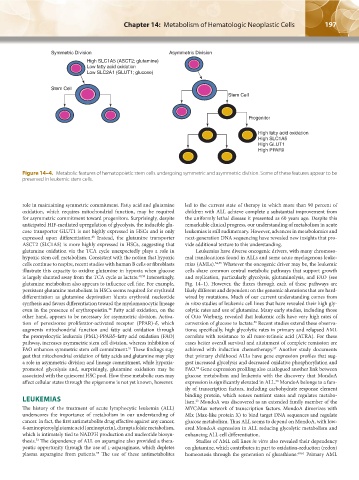
                           Symmetric Division                      Asymmetric Division
                                       High SLC1A5 (ASCT2; glutamine)
                                       Low fatty acid oxidation
                                       Low SLC2A1 (GLUT1; glucose)

                           Stem Cell
                                                                                       Stem Cell


                                                                                              Progenitor


                                                                                                 High fatty acid oxidation
                                                                                                 High SLC1A5
                                                                                                 High GLUT1
                                                                                                 High PPARδ


                  Figure 14–4.  Metabolic features of hematopoietic stem cells undergoing symmetric and asymmetric division. Some of these features appear to be
                  preserved in leukemic stem cells.


                  role in maintaining symmetric commitment. Fatty acid and glutamine   led to the current state of therapy in which more than 90 percent of
                  oxidation, which requires mitochondrial function, may be required   children with ALL achieve complete a substantial improvement from
                  for asymmetric commitment toward progenitors. Surprisingly, despite   the uniformly lethal disease it presented as 60 years ago. Despite this
                  anticipated HIF-mediated upregulation of glycolysis, the inducible glu-  remarkable clinical progress, our understanding of metabolism in acute
                  cose transporter GLUT1 is not highly expressed in HSCs and is only   leukemias is still rudimentary. However, advances in metabolomics and
                  expressed upon differentiation.  Instead, the glutamine transporter   next-generation DNA sequencing have revealed new insights that pro-
                                         48
                  ASCT2 (SLC1A5) is more highly expressed in HSCs, suggesting that   vide additional texture to this understanding.
                  glutamine oxidation via the TCA cycle unexpectedly plays a role in   Leukemias have diverse oncogenic drivers, with many chromoso-
                  hypoxic stem cell metabolism. Consistent with the notion that hypoxic   mal translocations found in ALLs and some acute myelogenous leuke-
                  cells continue to respire, recent studies with human B cells or fibroblasts   mias (AMLs). 54,55  Whatever the oncogenic driver may be, the leukemic
                  illustrate this capacity to oxidize glutamine in hypoxia when glucose   cells share common central metabolic pathways that support growth
                  is largely shunted away from the TCA cycle as lactate. 49,50  Interestingly,   and  replication, particularly glycolysis,  glutaminolysis,  and  FAO  (see
                  glutamine metabolism also appears to influence cell fate. For example,   Fig. 14–1). However, the fluxes through each of these pathways are
                  persistent glutamine metabolism in HSCs seems required for erythroid   likely different and dependent on the genomic alterations that are hard-
                  differentiation as glutamine deprivation blunts erythroid nucleotide   wired by mutations. Much of our current understanding comes from
                  synthesis and favors differentiation toward the myelomonocytic lineage   in vitro studies of leukemic cell lines that have revealed their high gly-
                  even in the presence of erythropoietin.  Fatty acid oxidation, on the   colytic rates and use of glutamine. Many early studies, including those
                                               48
                  other hand, appears to be necessary for asymmetric division. Activa-  of Otto Warburg, revealed that leukemic cells have very high rates of
                  tion of peroxisome proliferator-activated receptor (PPAR)-δ, which   conversion of glucose to lactate.  Recent studies extend these observa-
                                                                                               56
                  augments mitochondrial function and fatty acid oxidation through   tions; specifically, high glycolytic rates in primary and relapsed AML
                  the promyelocytic leukemia (PML)-PPARδ–fatty acid oxidation (FAO)   correlate with resistance to all trans-retinoic acid (ATRA). For these
                  pathway, increases asymmetric stem cell division, whereas inhibition of   cases better overall survival and attainment of complete remission are
                  FAO enhances symmetric stem cell commitment.  These findings sug-  achieved with induction chemotherapy.  Another study documents
                                                                                                      57
                                                     51
                  gest that mitochondrial oxidation of fatty acids and glutamine may play   that primary childhood ALLs have gene expression profiles that sug-
                  a role in asymmetric division and lineage commitment, while hypoxia-   gest increased glycolysis and decreased oxidative phosphorylation and
                  promoted glycolysis and, surprisingly, glutamine oxidation may be   FAO.  Gene expression profiling also catalogued another link between
                                                                            58
                  associated with the quiescent HSC pool. How these metabolic cues may   glucose metabolism and leukemia with the discovery that MondoA
                  affect cellular states through the epigenome is not yet known, however.  expression is significantly elevated in ALL.  MondoA belongs to a fam-
                                                                                                       59
                                                                        ily of transcription factors, including carbohydrate response element
                                                                        binding protein, which senses nutrient states and regulates metabo-
                  LEUKEMIAS                                             lism.  MondoA was discovered as an extended family member of the
                                                                            23
                  The history of the treatment of acute lymphocytic leukemia (ALL)   MYC:Max network of transcription factors. MondoA dimerizes with
                  underscores the importance of metabolism in our understanding of   Mlx (Max-like protein X) to bind target DNA sequences and regulate
                  cancer. In fact, the first antimetabolite drug effective against any cancer,   glucose metabolism. Thus ALL seems to depend on MondoA, with low-
                  4-aminopteroylglutamic acid (aminopterin), disrupts folate metabolism,   ered MondoA expression in ALL reducing glycolytic metabolism and
                  which is intimately tied to NADPH production and nucleotide biosyn-  enhancing ALL cell differentiation.
                  thesis.  The dependency of ALL on asparagine also provided a thera-  Studies of AML cell lines in vitro also revealed their dependency
                      52
                  peutic opportunity through the use of l-asparaginase, which depletes   on glutamine, which contributes in part to oxidation-reduction (redox)
                  plasma asparagine from patients.  The use of these antimetabolites   homeostasis through the generation of glutathione. 60,61  Primary AML
                                           53


          Kaushansky_chapter 14_p0191-0202.indd   197                                                                   17/09/15   6:36 pm

