


Page 218 - Williams Hematology ( PDFDrive )
P. 218
192  Part IV:  Molecular and Cellular Hematology   Chapter 14:  Metabolism of Hematologic Neoplastic Cells            193


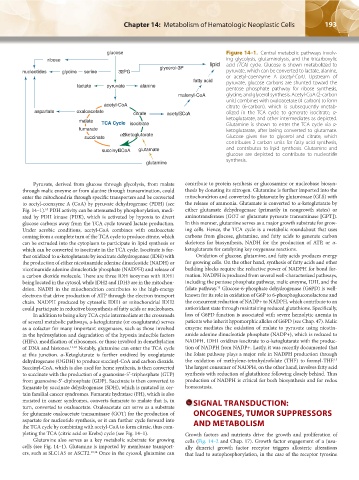
                                              glucose                                 Figure 14–1.  Central metabolic pathways involv-
                          ribose                                                      ing glycolysis, glutaminolysis, and the tricarboxylic
                                                                                 lipid  acid (TCA) cycle. Glucose is shown metabolized to
                                                                glycerol-3P
                  nucleotides  glycine  serine    3 PG                                pyruvate, which can be converted to lactate, alanine,
                                                                                      or acetyl-coenzyme A  (acetyl-CoA). Upstream of
                                                                           fatty acid  pyruvate, glucose carbons are shunted toward the
                                    lactate   pyruvate   alanine
                                                                                      pentose phosphate pathway for ribose synthesis,
                                                                      malonyl-CoA     glycine, and glycerol synthesis. Acetyl-CoA (2-carbon
                                                                                      unit) combines with oxaloacetate (4-carbon) to form
                                             acetyl-CoA                               citrate (6-carbon), which is subsequently  metab-
                      aspartate     oxaloacetate       citrate    acetyl CoA          olized in the  TCA cycle to generate isocitrate,  α-
                                     malate  TCA Cycle  isocitrate                    ketoglutarate, and other intermediates as depicted.
                                                                                      Glutamine is shown to enter the TCA cycle via  α-
                                     fumarate                                         ketoglutarate, after being converted to glutamate.
                                                   a ketoglutarate
                                       succinate                                      Glucose  gives rise  to glycerol  and citrate,  which
                                                                                      contributes 2-carbon units for fatty acid synthesis,
                                            succinyl CoA  glutamate                   and contributes to lipid synthesis. Glutamine and
                                                                                      glucose  are  depicted  to  contribute to nucleotide
                                                                                      synthesis.
                                                           glutamine


                     Pyruvate, derived from glucose  through  glycolysis,  from  malate   contribute to protein synthesis or glucosamine or nucleobase biosyn-
                  through malic enzyme or from alanine through transamination, could   thesis by donating its nitrogen. Glutamine is further imported into the
                  enter the mitochondria through specific transporters and be converted   mitochondrion and converted to glutamate by glutaminase (GLS) with
                  to acetyl-coenzyme A (CoA) by pyruvate dehydrogenase (PDH) (see   the release of ammonia. Glutamate is converted to α-ketoglutarate by
                  Fig. 14–1).  PDH activity can be attenuated by phosphorylation, medi-  either glutamate dehydrogenase (primarily in nongrowth states) or
                         10
                  ated by PDH kinase (PDK), which is activated by hypoxia to divert   aminotransferases (GOT or glutamate pyruvate transaminase [GPT]).
                  glucose carbons away from the TCA cycle toward lactate production.   In this manner, glutamine serves as a major growth substrate for grow-
                  Under aerobic conditions, acetyl-CoA combines with oxaloacetate   ing cells. Hence, the TCA cycle is a metabolic roundabout that uses
                  coming from a complete turn of the TCA cycle to produce citrate, which   carbons from glucose, glutamine, and fatty acids to generate carbon
                  can be extruded into the cytoplasm to participate in lipid synthesis or   skeletons  for  biosynthesis,  NADH  for  the  production  of  ATP,  or  α-
                  which can be converted to isocitrate in the TCA cycle. Isocitrate is fur-  ketoglutarate for catalyzing key oxygenase reactions.
                  ther oxidized to α-ketoglutarate by isocitrate dehydrogenase (IDH) with   Oxidation of glucose, glutamine, and fatty acids produces energy
                  the production of either nicotinamide adenine dinucleotide (NADH) or   for growing cells. On the other hand, synthesis of fatty acids and other
                  nicotinamide adenine dinucleotide phosphate (NADPH) and release of   building blocks require the reductive power of NADPH for bond for-
                  a carbon dioxide molecule. There are three IDH isozymes with IDH1   mation. NADPH is produced from several well-characterized pathways,
                  being located in the cytosol, while IDH2 and IDH3 are in the mitochon-  including the pentose phosphate pathway, malic enzyme, IDH, and the
                  drion.  NADH  in  the  mitochondrion  contributes  to  the  high-energy   folate pathway.  Glucose-6-phosphate dehydrogenase (G6PD) is well-
                                                                                   15
                  electrons that drive production of ATP through the electron transport   known for its role in oxidation of G6P to 6-phosphogluconolactone and
                  chain. NADPH produced by cytosolic IDH1 or mitochondrial IDH2   the concurrent reduction of NADP+ to NADPH, which contribute to an
                  could participate in reductive biosynthesis of fatty acids or nucleobases.  antioxidant state through maintaining reduced glutathione. Specifically,
                     In addition to being a key TCA cycle intermediate at the crossroads   loss of G6PD function is associated with severe hemolytic anemia in
                  of several metabolic pathways, a-ketoglutarate (or oxoglutarate) serves   patients who inherit hypomorphic alleles of G6PD (see Chap. 47). Malic
                  as a cofactor for many important oxygenases, such as those involved   enzyme mediates the oxidation of malate to pyruvate using nicotin-
                  in the hydroxylation and degradation of the hypoxia inducible factors   amide adenine dinucleotide phosphate (NADP+), which is reduced to
                  (HIFs), modification of ribosomes, or those involved in demethylation   NADPH. IDH1 oxidizes isocitrate to α-ketoglutarate with the produc-
                  of DNA and histones. 11,12  Notably, glutamine can enter the TCA cycle   tion of NADPH from NADP+. Lastly, it was recently documented that
                  at this junction.  α-Ketoglutarate is further oxidized by oxoglutarate   the folate pathway plays a major role in NADPH production through
                                                                                                                          15
                  dehydrogenase (OGDH) to produce succinyl-CoA and carbon dioxide.   the oxidation of methylene-tetrahydrofolate (THF) to formyl-THF.
                  Succinyl-CoA, which is also used for heme synthesis, is then converted   The largest consumer of NADPH, on the other hand, involves fatty acid
                  to succinate with the production of a guanosine-5′-triphosphate (GTP)   synthesis with reduction of glutathione following closely behind. Thus
                  from guanosine-5′-diphosphate (GDP). Succinate is then converted to   production of NADPH is critical for both biosynthesis and for redox
                  fumarate by succinate dehydrogenase (SDH), which is mutated in cer-  homeostasis.
                  tain familial cancer syndromes. Fumarate hydratase (FH), which is also
                  mutated in cancer syndromes, converts fumarate to malate that is, in     SIGNAL TRANSDUCTION:
                  turn, converted to oxaloacetate. Oxaloacetate can serve as a substrate
                  for glutamate oxaloacetate transaminase (GOT) for the production of   ONCOGENES, TUMOR SUPPRESSORS
                  aspartate for nucleotide synthesis, or it can further cycle forward into   AND METABOLISM
                  the TCA cycle by combining with acetyl-CoA to form citrate, thus com-
                  pleting the TCA (citric acid or Krebs) cycle (see Fig. 14–1).  Growth factors and nutrients drive the growth and proliferation of
                     Glutamine also serves as a key metabolic substrate for growing   cells (Fig. 14–2 and Chap. 17). Growth factor engagement of a (usu-
                  cells (see Fig. 14–1). Glutamine is imported by membrane transport-  ally dimeric) growth factor receptor triggers allosteric alterations
                  ers, such as SLC1A5 or ASCT2. 13,14  Once in the cytosol, glutamine can   that lead to autophosphorylation, in the case of the receptor tyrosine


          Kaushansky_chapter 14_p0191-0202.indd   193                                                                   17/09/15   6:35 pm

