


Page 2247 - Williams Hematology ( PDFDrive )
P. 2247
2222           Part XII:  Hemostasis and Thrombosis                                                                                                                             Chapter 130:  Hereditary Thrombophilia           2223


                     HISTORY, CLASSIFICATION,                                                        XIa

                  PATHOPHYSIOLOGY, AND PREVALENCE
                  OF THROMBOPHILIA

               HISTORY OF THROMBOPHILIA RESEARCH
                                                                                     IXa + VIIIa    APC + PS
               Research into thrombophilia began with the investigation of candi-
               date coagulation proteins and their genes in highly thrombophilic
               families and linking abnormalities with the clinical phenotype within
               these families. As a next step, findings were confirmed in case-con-
               trol studies, which yielded risk increases compared to controls, often
               derived from the general population. For clinicians and patients how-  TF-VIIa   Xa + Va  Thrombin/IIa  Fibrin
               ever, absolute risk estimates were needed to guide decisions regarding
               prevention or treatment. These were sought again in family studies
               of consecutive probands with a specific thrombophilic defect. The
               major progress in genetic and bioinformatics techniques now allows                        AT
               investigation in populations of patients with VTE, as well as in throm-
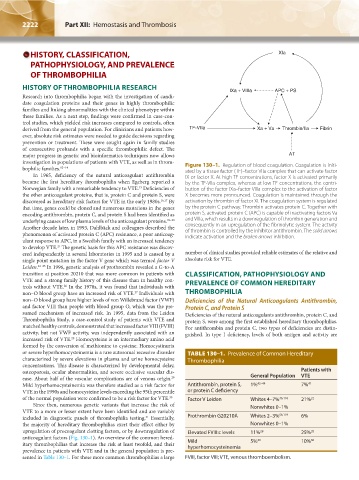
               bophilic families. 12–14                               Figure 130–1.  Regulation of blood coagulation. Coagulation is initi-
                                                                      ated by a tissue factor (TF)–factor VIIa complex that can activate factor
                   In 1965, deficiency of the natural anticoagulant antithrombin   IX or factor X. At high TF concentrations, factor X is activated primarily
               became the first hereditary thrombophilia when Egeberg reported a   by the TF-VIIa complex, whereas at low TF concentrations, the contri-
               Norwegian family with a remarkable tendency to VTE.  Deficiencies of   bution of the factor IXa–factor VIIIa complex to the activation of factor
                                                       15
               the other anticoagulant proteins, that is, protein C and protein S, were   X becomes more pronounced. Coagulation is maintained through the
               discovered as hereditary risk factors for VTE in the early 1980s. 16,17  By   activation by thrombin of factor XI. The coagulation system is regulated
               that time, genes could be cloned and numerous mutations in the genes   by the protein C pathway. Thrombin activates protein C. Together with
               encoding antithrombin, protein C, and protein S had been identified as   protein S, activated protein C (APC) is capable of inactivating factors Va
               underlying causes of low plasma levels of the anticoagulant proteins. 18–20    and VIIIa, which results in a downregulation of thrombin generation and
               Another decade later, in 1993, Dahlbäck and colleagues described the   consequently in an upregulation of the fibrinolytic system. The activity
               phenomenon of activated protein C (APC) resistance, a poor anticoag-  of thrombin is controlled by the inhibitor antithrombin. The solid arrows
                                                                      indicate activation and the broken arrows inhibition.
               ulant response to APC, in a Swedish family with an increased tendency
               to develop VTE.  The genetic basis for this APC resistance was discov-
                           21
               ered independently in several laboratories in 1995 and is caused by a   number of clinical studies provided reliable estimates of the relative and
               single point mutation in the factor V gene which was termed factor V   absolute risk for VTE.
               Leiden. 22–25  In 1996, genetic analysis of prothrombin revealed a G-to-A
               transition at position 20210 that was more common in patients with   CLASSIFICATION, PATHOPHYSIOLOGY AND
               VTE and a strong family history of this disease than in healthy con-  PREVALENCE OF COMMON HEREDITARY
               trols without VTE.  In the 1970s, it was found that individuals with
                             26
               non–O blood group have an increased risk of VTE.  Individuals with    THROMBOPHILIA
                                                     27
               non–O blood group have higher levels of von Willebrand factor (VWF)   Deficiencies of the Natural Anticoagulants Antithrombin,
               and factor VIII than people with blood group O, which was the pre-  Protein C, and Protein S
               sumed mechanism of increased risk. In 1995, data from the Leiden   Deficiencies of the natural anticoagulants antithrombin, protein C, and
               Thrombophilia Study, a case-control study of patients with VTE and   protein S, were among the first established hereditary thrombophilias.
               matched healthy controls, demonstrated that increased factor VIII (FVIII)   For antithrombin and protein C, two types of deficiencies are distin-
               activity, but not VWF activity, was independently associated with an   guished. In type I deficiency, levels of both antigen and activity are
               increased risk of VTE.  Homocysteine is an intermediary amino acid
                                28
               formed by the conversion of methionine to cysteine. Homocystinuria
               or severe hyperhomocysteinemia is a rare autosomal recessive disorder   TABLE 130–1.  Prevalence of Common Hereditary
               characterized by severe elevations in plasma and urine homocysteine   Thrombophilia
               concentrations. This disease is characterized by developmental delay,
               osteoporosis, ocular abnormalities, and severe occlusive vascular dis-                        Patients with
               ease. About half of the vascular complications are of venous origin.         General Population  VTE
                                                                 29
               Mild hyperhomocysteinemia was therefore studied as a risk factor for   Antithrombin, protein S,   1% 42–44  7% 41
               VTE in the 1990s and homocysteine levels exceeding the 95th percentile   or protein C deficiency
               of the normal population were confirmed to be a risk factor for VTE. 30  Factor V Leiden  Whites 4–7% 46,118  21% 22
                   Since then, numerous genetic variants that increase the risk of          Nonwhites 0–1%
               VTE to a more or lesser extent have been identified and are variably
               included in diagnostic panels of thrombophilia testing.  Essentially,   Prothrombin G20210A  Whites 2–3% 56,119  6%
                                                         31
               the majority of hereditary thrombophilias exert their effect either by       Nonwhites 0–1%
               upregulation of procoagulant clotting factors, or by downregulation of   Elevated FVIII:c levels  11% 28  25% 28
               anticoagulant factors (Fig. 130–1). An overview of the common hered-           30                30
               itary thrombophilias that increase the risk at least twofold, and their   Mild   5%           10%
               prevalence in patients with VTE and in the general population is pre-  hyperhomocysteinemia
               sented in Table 130–1. For these more common thrombophilias a large   FVIII, factor VIII; VTE, venous thromboembolism.


          Kaushansky_chapter 130_p2221-2232.indd   2222                                                                 9/21/15   4:33 PM

