


Page 2248 - Williams Hematology ( PDFDrive )
P. 2248
2222  Part XII:  Hemostasis and Thrombosis                          Chapter 130:  Hereditary Thrombophilia           2223


                  reduced and in type II, antigen levels are normal, but one or more func-  anticoagulants  are  rare (see  Table   130–1).  In  cohorts  of  consecutive
                  tional defects in the molecule lead to a decreased activity. Type II antith-  patients with VTE, the prevalence of a deficiency of one of the natu-
                                                                                                    41
                  rombin deficiencies are further subdivided according to the site of the   ral anticoagulants is below 10 percent.  In the general population, the
                  defect in antithrombin. The defect is located in the thrombin binding   prevalence of the deficiencies combined is approximately 1 percent. 42–44
                  domain (i.e., the reactive site) in type IIa deficiency, in the heparin bind-
                  ing domain in type IIb deficiency, and type IIc deficiency comprises a   Factor V Leiden/Factor V G1691A
                                         32
                  pleiotropic group of mutations.  Interestingly, patients with type IIb   In 1993, Dahlbäck and colleagues first described APC resistance in a
                                                                                                          21
                  deficiency seem to have a significantly lower risk of VTE than other   Swedish family with a high tendency of VTE.  In the original paper,
                      32
                  types.  Protein S circulates in two forms: free protein S (approximately   Dahlbäck proposed that APC resistance was best explained by an
                  40 to 50 percent) which functions as a cofactor for APC, and protein S   hereditary deficiency of a previously unrecognized cofactor to APC,
                  bound to complement component C4b-binding protein. In type I defi-  after having ruled out several possible mechanisms, including deficien-
                  ciency, total and free antigen levels and activity are all reduced, in type   cies of protein S and protein C, or linkage with polymorphisms in the
                  II deficiency, total and free antigen are normal, but activity is reduced,   FVIII or VWF genes. He then showed that this "cofactor" was identical
                  and in type III deficiency, activity and free antigen are reduced, while   to coagulation factor V.  Soon thereafter, several laboratories indepen-
                                                                                         21
                  total antigen is low to normal. Type I and type III are probably pheno-  dently from each other reported the underlying genetic defect, a single
                  typical variants of the same disease as family members with the same   G-to-A substitution in the gene of factor V at nucleotide position 1691,
                  DNA mutation can present with either type I or type III deficiency.    resulting in an amino acid change from Arginine (Arg) to Glutamine
                                                                    33
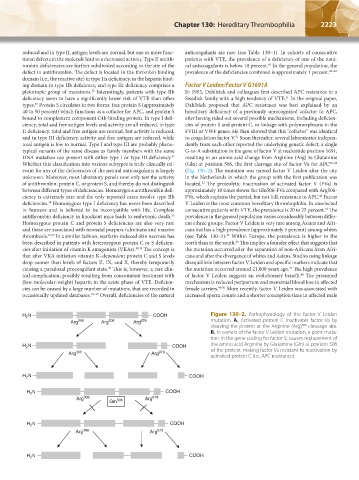
                  Whether this classification into various subtypes is truly clinically rel-  (Gln) at position 506, the first cleavage site of factor Va for APC 22–25
                  evant for any of the deficiencies of the natural anticoagulants is largely   (Fig. 130–2). The mutation was named factor V Leiden after the city
                  unknown. Moreover, most laboratory panels now only test the activity   in the Netherlands in which the group with the first publication was
                                                                              22
                  of antithrombin, protein C, or protein S, and thereby do not distinguish   located.  The proteolytic inactivation of activated factor V (FVa) is
                  between different types of deficiencies. Homozygous antithrombin defi-  approximately 10 times slower for Gln506-FVa compared with Arg506-
                                                                                                                     45
                  ciency is extremely rare and the only reported cases involve type IIb   FVa, which explains the partial, but not full, resistance to APC.  Factor
                           34
                  deficiencies.  Homozygous type I deficiency has never been described   V Leiden is the most common hereditary thrombophilia. In unselected
                  in humans and is believed to be incompatible with life. Complete   consecutive patients with VTE, the prevalence is 20 to 25 percent.  The
                                                                                                                       22
                                                                    35
                  antithrombin deficiency in knockout mice leads to embryonic death.    prevalence in the general population varies considerably between differ-
                  Homozygous protein C and protein S deficiencies are also very rare   ent ethnic groups. Factor V Leiden is very rare among Asians and Afri-
                  and these are associated with neonatal purpura fulminans and massive   cans but has a high prevalence (approximately 5 percent) among whites
                  thrombosis. 36,37  In a similar fashion, warfarin-induced skin necrosis has   (see  Table   130–1).  Within Europe, the prevalence is higher in the
                                                                                      46
                                                                                         46
                  been described in patients with heterozygous protein C or S deficien-  north than in the south.  This implies a founder effect that suggests that
                  cies after initiation of vitamin K antagonists (VKAs). 38,39  The concept is   the mutation occurred after the separation of non-Africans from Afri-
                  that after VKA initiation vitamin K–dependent protein C and S levels   cans and after the divergence of whites and Asians. Studies using linkage
                  drop sooner than levels of factors II, IX, and X, thereby temporarily   disequilibria between factor V Leiden and specific markers indicate that
                  causing a paradoxal procoagulant state.  This is, however, a rare clin-  the mutation occurred around 21,000 years ago.  The high prevalence
                                               40
                                                                                                           47
                                                                                                               48
                  ical complication, possibly resulting from concomitant treatment with   of factor V Leiden suggests an evolutionary benefit.  The presumed
                  (low-molecular-weight) heparin in the acute phase of VTE. Deficien-  mechanism is reduced peripartum and menstrual blood loss in affected
                  cies can be caused by a large number of mutations, that are recorded in   female carriers. 49,50  More recently, factor V Leiden was associated with
                  occasionally updated databases. 18–20  Overall, deficiencies of the natural   increased sperm counts and a shorter conception time in affected male
                  H N                                         COOH               Figure  130–2.  Pathophysiology of the factor  V Leiden
                   2
                                  Arg 306   Arg 506    Arg 676                   mutation.  A. Activated protein C inactivates factor Va by
                                                                                 cleaving the protein at the Arginine (Arg)  cleavage site.
                                                                                                                506
                                                                                 B. In carriers of the factor V Leiden mutation, a point muta-
                                                                                 tion in the gene coding for factor V, causes replacement of
                  H 2 N                                             COOH         the amino acid Arginine by Glutamine (Gln) at position 506
                                                                                 of the protein, making factor Va resistant to inactivation by
                                 Arg 306                     Arg 979             activated protein C (i.e., APC resistance).

                  H 2 N                                                   COOH


                   H N                                            COOH
                    2
                                    Arg 306                Arg 679
                                               Gln 506

                   H N                                             COOH
                    2
                                    Arg 306                  Arg 679


                     N                                                    COOH
                   H 2


          Kaushansky_chapter 130_p2221-2232.indd   2223                                                                 9/21/15   4:33 PM

