


Page 2249 - Williams Hematology ( PDFDrive )
P. 2249
2224           Part XII:  Hemostasis and Thrombosis                                                                                                                             Chapter 130:  Hereditary Thrombophilia           2225


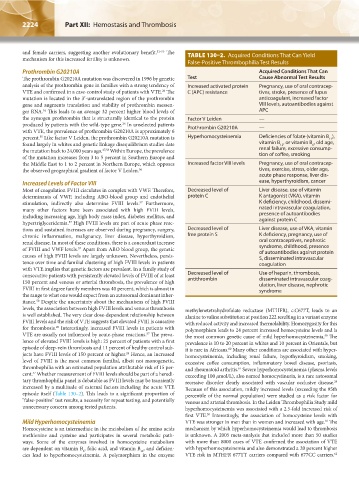
               and female carriers, suggesting another evolutionary benefit. 51–53  The   TABLE 130–2.  Acquired Conditions That Can Yield
               mechanism for this increased fertility is unknown.
                                                                       False-Positive Thrombophilia Test Results
               Prothrombin G20210A                                                             Acquired Conditions That Can
               The prothrombin G20210A mutation was discovered in 1996 by genetic   Test       Cause Abnormal Test Results
               analysis of the prothrombin gene in families with a strong tendency of   Increased activated protein    Pregnancy, use of oral contracep-
                                                              26
               VTE and confirmed in a case-control study of patients with VTE.  The   C (APC) resistance  tives, stroke, presence of lupus
               mutation is located in the 3′-untranslated region of the prothrombin            anticoagulant, increased factor
               gene and augments translation and stability of prothrombin messen-              VIII levels, autoantibodies against
                      54
               ger RNA.  This leads to an average 32 percent higher blood levels of            APC
               the zymogen prothrombin that is structurally identical to the protein   Factor V Leiden  —
                                                 26
               produced by patients with the wild-type gene.  In unselected patients   Prothrombin G20210A  —
               with VTE, the prevalence of prothrombin G20210A is approximately 6
                     55
               percent.  Like factor V Leiden, the prothrombin G20210A mutation is   Hyperhomocysteinemia  Deficiencies of folate (vitamin B ),
                                                                                                                      11
               found largely in whites and genetic linkage disequilibrium studies date         vitamin B , or vitamin B , old age,
                                                                                                      12
                                                                                                                 6
               the mutation back to 24,000 years ago. 47,56  Within Europe, the prevalence     renal failure, excessive consump-
               of the mutation increases from 3 to 5 percent in Southern Europe and            tion of coffee, smoking
               the Middle East to 1 to 2 percent in Northern Europe, which opposes   Increased factor VIII levels  Pregnancy, use of oral contracep-
               the observed geographical gradient of factor V Leiden. 56                       tives, exercise, stress, older age,
                                                                                               acute phase response, liver dis-
               Increased Levels of Factor VIII                                                 ease, hyperthyroidism, cancer
               Most of coagulation FVIII circulates in complex with VWF. Therefore,   Decreased level of    Liver disease, use of vitamin
               determinants of VWF, including ABO-blood group and endothelial   protein C      K antagonist (VKA), vitamin
                                                       57
               stimulation, indirectly also determine FVIII levels.  Furthermore,              K deficiency, childhood, dissemi-
               many other factors have been associated with high FVIII levels,                 nated intravascular coagulation,
               including increasing age, high body mass index, diabetes mellitus, and          presence of autoantibodies
                                                                                               against protein C
                               57
               hypertriglyceridemia.  High FVIII levels are part of acute phase reac-
               tions and sustained increases are observed during pregnancy, surgery,   Decreased level of    Liver disease, use of VKA, vitamin
               chronic inflammation, malignancy, liver disease, hyperthyroidism,   free protein S  K deficiency, pregnancy, use of
               renal disease. In most of these conditions, there is a concordant increase      oral contraceptives, nephrotic
               of FVIII and VWF levels.  Apart from ABO blood group, the genetic               syndrome, childhood, presence
                                  57
                                                                                               of autoantibodies against protein
               causes of high FVIII levels are largely unknown. Nevertheless, persis-          S, disseminated intravascular
               tence over time and familial clustering of high FVIII levels in patients        coagulation
               with VTE implies that genetic factors are prevalent. In a family study of
               consecutive patients with persistently elevated levels of FVIII of at least   Decreased level of   Use of heparin, thrombosis,
               150 percent and venous or arterial thrombosis, the prevalence of high   antithrombin  disseminated intravascular coag-
                                                                                               ulation, liver disease, nephrotic
               FVIII in first degree family members was 40 percent, which is almost in         syndrome
               the range to what one would expect from an autosomal dominant inher-
                    58
               itance.  Despite the uncertainty about the mechanisms of high FVIII
               levels, the association between high FVIII levels and venous thrombosis   methylenetetrahydrofolate reductase (MTHFR), c.C677T, leads to an
               is well established. The very clear dose-dependent relationship between   alanine to valine substitution at position 222 resulting in a variant enzyme
               FVIII levels and the risk of VTE suggests that elevated FVIII is causative   with reduced activity and increased thermolability. Homozygosity for this
                           28
               for thrombosis.  Interestingly, increased FVIII levels in patients with   polymorphism leads to 24 percent increased homocysteine levels and is
                                                         57
               VTE are usually not influenced by acute-phase reactions.  The preva-  the most common genetic cause of mild hyperhomocysteinemia.  The
                                                                                                                     59
               lence of elevated FVIII levels is high: 25 percent of patients with a first   prevalence is 10 to 20 percent in whites and 10 percent in Orientals, but
               episode of deep-vein thrombosis and 11 percent of healthy control sub-  it is rare in Africans.  Many other conditions are associated with hyper-
                                                                                    60
                                                  28
               jects have FVIII levels of 150 percent or higher.  Hence, an increased   homocysteinemia, including renal failure, hypothyroidism, smoking,
               level of FVIII is the most common familial, albeit not monogenetic,   excessive  coffee  consumption,  inflammatory  bowel  disease,  psoriasis,
               thrombophilia with an estimated population attributable risk of 15 per-  and rheumatoid arthritis.  Severe hyperhomocysteinemia (plasma levels
                                                                                        61
                   57
               cent.  Whether measurement of FVIII levels should be part of a heredi-  exceeding 100 μmol/L), also named homocystinuria, is a rare autosomal
               tary thrombophilia panel is debatable as FVIII levels may be transiently   recessive disorder clearly associated with vascular occlusive disease.
                                                                                                                        29
               increased by a multitude of external factors including the acute VTE   Because of this association, mildly increased levels (exceeding the 95th
               episode itself (Table 130–2). This leads to a significant proportion of   percentile  of  the  normal  population)  were  studied  as  a  risk  factor  for
               "false-positive" test results, a necessity for repeat testing, and potentially   venous and arterial thrombosis. In the Leiden Thrombophilia Study mild
               unnecessary concern among tested patients.             hyperhomocysteinemia was associated with a 2.5-fold increased risk of
                                                                      first VTE.  Interestingly, the association of homocysteine levels with
                                                                             30
               Mild Hyperhomocysteinemia                              VTE was stronger in men than in women and increased with age.  The
                                                                                                                     30
               Homocysteine is an intermediate in the metabolism of the amino acids   mechanism by which hyperhomocysteinemia would lead to thrombosis
               methionine and cysteine and participates in several metabolic path-  is unknown. A 2005 meta-analysis that included more than 50 studies
               ways. Some of the enzymes involved in homocysteine metabolism   with more than 8000 cases of VTE confirmed the association of VTE
               are dependent on vitamin B , folic acid, and vitamin B , and deficien-  with hyperhomocysteinemia and also demonstrated a 20 percent higher
                                                       12
                                    6
               cies lead to hyperhomocysteinemia. A polymorphism in the enzyme   VTE risk in MTHFR 677TT carriers compared with 677CC carriers.
                                                                                                                        62
          Kaushansky_chapter 130_p2221-2232.indd   2224                                                                 9/21/15   4:33 PM

