


Page 2250 - Williams Hematology ( PDFDrive )
P. 2250
2224  Part XII:  Hemostasis and Thrombosis                          Chapter 130:  Hereditary Thrombophilia           2225


                  The association between homocysteine levels is again under scrutiny in   heterozygotes. Likewise, patients with combined thrombophilic disor-
                  newer studies. The single largest case-control study of more than 4000   ders have a higher risk of VTE than those with a single defect.  One can
                                                                                                                    11
                  patients with a first VTE found no association between MTHFR 677TT   estimate the absolute risk of VTE by multiplying the relative risk with
                         63
                  and VTE.  Furthermore, a family study of probands with mild hyperho-  the absolute incidence in cohorts from the general population, in which
                                                                                                                          68
                  mocysteinemia and venous or arterial thrombosis found that the asso-  the risk of first VTE is approximately 0.2 to 0.3 per 100 person-years.
                  ciation between homocysteine and VTE disappeared after adjustment   Because this may however lead to imprecise estimates, it is prefera-
                             64
                  for FVIII levels.  Finally, homocysteine lowering by B vitamins did not   ble to use absolute risk estimates derived from cohort studies. Retro-
                  reduce the incidence of recurrent events both in patients with VTE as well   spective cohort studies may produce less-reliable incidence estimates
                  as in patients with arterial cardiovascular disease. 65,66  As a result of these   because retrospective studies carry the risk of (unconscious) selection
                  studies, homocysteine testing (either its levels of polymorphisms) as part   of patients and data and the clinical diagnosis of VTE may not have
                  of a thrombophilia panel has been largely abandoned.  been confirmed by objective tests. Prospective cohort studies of asymp-
                                                                        tomatic carriers of hereditary thrombophilic defects are probably better
                  PITFALLS IN LABORATORY TESTING FOR                    suited to estimate the true incidence of thrombosis in thrombophilic
                  HEREDITARY THROMBOPHILIA                              patients. It is important to note that cohort studies have been mainly
                                                                        performed in relatives of (consecutive) patients with a particular throm-
                  Testing  for hereditary thrombophilia is performed in many patients,   bophilic defect. Absolute risk estimates from family studies are higher
                  or family members of patients, with various thromboembolic diseases   than from population based studies. Even in the absence of any hered-
                                       9
                  or pregnancy complications.  However, it is important to realize that   itary thrombophilia, the risk of VTE is still twofold increased in first
                                                                                                          69
                  many acquired, often transient, conditions may affect the test results.   degree family members of patients with VTE.  This suggests cosegre-
                  Most known is the use of VKAs, which reduces the levels of anticoag-  gation of other, unmeasured or unknown thrombophilias. Table 130–4
                  ulant factors protein C and protein S, which can thereby mimic severe   presents absolute risk estimates for a first-episode VTE for asymptom-
                  deficiencies. Another example is pregnancy that reduces free protein S   atic carriers with a family history of VTE. These risk estimates can be
                  levels and increases APC resistance and FVIII levels.  However, other   used to counsel both affected and unaffected family members about
                                                        67
                  factors can also affect test results and should be considered in the inter-  their risk of VTE. These studies also provide absolute risk estimates for
                  pretation of results or, better yet, in the timing of testing. Table  130–2   VTE associated with exogenous additional risk factors such as surgery,
                  presents an overview of acquired conditions that can yield false-positive   trauma or immobilization, and pregnancy or use of hormonal contra-
                  thrombophilia tests. For deficiencies of the natural anticoagulants as   ception (Table  130–4). These incidences are derived from retrospective
                  well as for elevated FVIII levels, repeated testing should be performed to   family studies, as prospective studies are limited by shorter followup
                  exclude spuriously abnormal tests. Genetic testing for deficiencies of the   duration and reduced power.
                  natural anticoagulants is not performed because of the large number of
                  known mutations. The hereditary nature of deficiencies must be estab-  Thrombophilia and the Risk of Recurrent Venous
                  lished by confirming the abnormality in a first-degree family member.  Thromboembolism
                                                                        Regardless of thrombophilia, the absolute risk of a recurrent episode is
                        HEREDITARY THROMBOPHILIA AND                    much higher than the risk of a first episode of VTE. The most impor-
                                                                        tant determinant of recurrence is the presence of transient clinical risk
                     THE RISK OF DISEASE                                factors during the time of the first episode.  After an unprovoked first
                                                                                                       70
                                                                        episode of VTE, the risk of recurrence is approximately 10 percent in
                  VENOUS THROMBOEMBOLISM                                the first year after cessation of anticoagulation and approximately 5 per-
                  The relative risk of a first episode of VTE in individuals with a form of   cent per year thereafter.  The risk is lower after VTE that was associated
                                                                                         70
                  common hereditary thrombophilia ranges from 2 to 11 (Table 130–3).   with a transient risk factor, with an incidence in the first 2 years of 0.7
                  These figures were derived from family and population-based cohort   percent per year for surgery-provoked VTE and 4.2 percent per year for
                  or case-control studies.  Individuals homozygous for the prothrombin   VTE provoked by estrogen use, pregnancy, temporary immobilization,
                                   11
                                                                                70
                  G20210A or factor V Leiden mutations are at higher risk for VTE than   or trauma.  Other determinants for recurrence are male sex, proximal

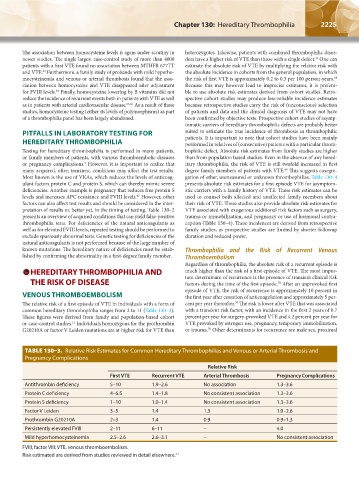
                   TABLE 130–3.  Relative Risk Estimates for Common Hereditary Thrombophilias and Venous or Arterial Thrombosis and
                   Pregnancy Complications
                                                                                Relative Risk
                                               First VTE     Recurrent VTE     Arterial Thrombosis     Pregnancy Complications
                   Antithrombin deficiency     5–10          1.9–2.6           No association          1.3–3.6
                   Protein C deficiency        4–6.5         1.4–1.8           No consistent association  1.3–3.6
                   Protein S deficiency        1–10          1.0–1.4           No consistent association  1.3–3.6
                   Factor V Leiden             3–5           1.4               1.3                     1.0–2.6
                   Prothrombin G20210A         2–3           1.4               0.9                     0.9–1.3
                   Persistently elevated FVIII  2–11         6–11              –                       4.0
                   Mild hyperhomocysteinemia   2.5–2.6       2.6–3.1           –                       No consistent association
                  FVIII, factor VIII; VTE, venous thromboembolism.
                  Risk estimated are derived from studies reviewed in detail elsewhere. 11


          Kaushansky_chapter 130_p2221-2232.indd   2225                                                                 9/21/15   4:33 PM

