


Page 2251 - Williams Hematology ( PDFDrive )
P. 2251
2226           Part XII:  Hemostasis and Thrombosis                                                                                                                             Chapter 130:  Hereditary Thrombophilia           2227


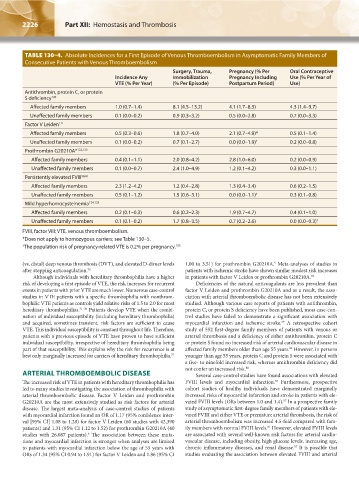
                TABLE 130–4.  Absolute Incidences for a First Episode of Venous Thromboembolism in Asymptomatic Family Members of
                Consecutive Patients with Venous Thromboembolism
                                                                  Surgery, Trauma,   Pregnancy (% Per    Oral Contraceptive
                                              Incidence Any       Immobilization     Pregnancy Including   Use (% Per Year of
                                              VTE (% Per Year)    (% Per Episode)    Postpartum Period)  Use)
                Antithrombin, protein C, or protein
                S deficiency 120
                  Affected family members      1.0 (0.7–1.4)      8.1 (4.5–13.2)     4.1 (1.7–8.3)       4.3 (1.4–9.7)
                   Unaffected family members   0.1 (0.0–0.2)      0.9 (0.3–3.2)      0.5 (0.0–2.8)       0.7 (0.0–3.3)
                Factor V Leiden 121
                  Affected family members      0.5 (0.3–0.6)      1.8 (0.7–4.0)      2.1 (0.7–4.9)*      0.5 (0.1–1.4)
                   Unaffected family members   0.1 (0.0–0.2)      0.7 (0.1–2.7)      0.0 (0.0–1.9) †     0.2 (0.0–0.8)
                Prothrombin G20210A* 122,123
                    Affected family members    0.4 (0.1–1.1)      2.0 (0.8–4.2)      2.8 (1.0–6.0)       0.2 (0.0–0.9)
                    Unaffected family members  0.1 (0.0–0.7)      2.4 (1.0–4.9)      1.2 (0.1–4.2)       0.3 (0.0–1.1)
                Persistently elevated FVIII 58,81
                    Affected family members    2.3 (1.2–4.2)      1.2 (0.4–2.8)      1.3 (0.4–3.4)       0.6 (0.2–1.5)
                    Unaffected family members  0.5 (0.1–1.2)      1.5 (0.6–3.1)      0.0 (0.0–1.1) †     0.3 (0.1–0.8)
                Mild hyperhomocysteinemia 124,125
                    Affected family members    0.2 (0.1–0.3)      0.6 (0.2–2.3)      1.9 (0.7–4.7)       0.4 (0.1–1.0)
                    Unaffected family members  0.1 (0.1–0.2)      1.7 (0.8–3.5)      0.7 (0.2–2.6)       0.0 (0.0–0.3) †
               FVIII, factor VIII; VTE, venous thromboembolism.
               *Does not apply to homozygous carriers; see Table 130–5.
               † The population risk of pregnancy-related VTE is 0.2% per pregnancy. 103


               (vs. distal) deep venous thrombosis (DVT), and elevated D-dimer levels   1.00 to 3.51) for prothrombin G20210A.  Meta-analyses of studies in
                                                                                                    5
               after stopping anticoagulation. 70                     patients with ischemic stroke have shown similar modest risk increases
                   Although individuals with hereditary thrombophilia have a higher   in patients with factor V Leiden or prothrombin G20210A. 78
               risk of developing a first episode of VTE, the risk increases for recurrent   Deficiencies of the natural anticoagulants are less prevalent than
               events in patients with prior VTE are much lower. Numerous case-control   factor V Leiden and prothrombin G20210A and as a result, the asso-
               studies in VTE patients with a specific thrombophilia with nonthrom-  ciation with arterial thromboembolic disease has not been extensively
               bophilic VTE patients as controls yield relative risks of 1.5 to 2.0 for most   studied. Although various case reports of patients with antithrombin,
               hereditary thrombophilias. 71–76  Patients develop VTE when the combi-  protein C, or protein S deficiency have been published, most case-con-
               nation of individual susceptibility (including hereditary thrombophilia)   trol studies have failed to demonstrate a significant association with
               and  acquired,  sometimes  transient,  risk  factors  are sufficient  to  cause   myocardial infarction and ischemic stroke.  A retrospective cohort
                                                                                                      79
               VTE. This individual susceptibility is constant throughout life. Therefore,   study of 552 first-degree family members of patients with venous or
               patients with a previous episode of VTE have proven to have sufficient   arterial thrombosis and a deficiency of either antithrombin, protein C
               individual susceptibility, irrespective of hereditary thrombophilia being   or protein S found no increased risk of arterial cardiovascular disease in
               part of that susceptibility. This explains why the risk for recurrence is at   affected family members older than age 55 years.  However, in persons
                                                                                                         80
               best only marginally increased for carriers of hereditary thrombophilia. 77  younger than age 55 years, protein C and protein S were associated with
                                                                      a five- to ninefold increased risk, whereas antithrombin deficiency did
                                                                      not confer an increased risk. 80
               ARTERIAL THROMBOEMBOLIC DISEASE                            Several case-control studies have found associations with elevated
               The increased risk of VTE in patients with hereditary thrombophilia has   FVIII levels and myocardial infarction.  Furthermore, prospective
                                                                                                    57
               led to many studies investigating the association of thrombophilia with   cohort studies of healthy individuals have demonstrated marginally
               arterial thromboembolic disease. Factor V Leiden and prothrombin   increased risks of myocardial infarction and stroke in patients with ele-
               G20210A are the most extensively studied as risk factors for arterial   vated FVIII levels (ORs between 1.0 and 1.4).  In a prospective family
                                                                                                       57
               disease. The largest meta-analysis of case-control studies  of  patients   study of asymptomatic first-degree family members of patients with ele-
               with myocardial infarction found an OR of 1.17 (95% confidence inter-  vated FVIII and either VTE or premature arterial thrombosis, the risk of
               val [95% CI] 1.08 to 1.28) for factor V Leiden (60 studies with 42,390   arterial thromboembolism was increased 4.5-fold compared with fam-
               patients) and 1.31 (95% CI 1.12 to 1.52) for prothrombin G20210A (40   ily members with normal FVIII levels.  However, elevated FVIII levels
                                                                                                  81
               studies with 26,087 patients).  The association between these muta-  are associated with several well-known risk factors for arterial cardio-
                                     4
               tions and myocardial infarction is stronger when analyses are limited   vascular disease, including obesity, high glucose levels, increasing age,
                                                                                                           57
               to patients with myocardial infarction below the age of 55 years with   chronic inflammatory diseases, and renal disease.  It is possible that
               ORs of 1.34 (95% CI 0.94 to 1.91) for factor V Leiden and 1.86 (95% CI   studies evaluating the association between elevated FVIII and arterial


          Kaushansky_chapter 130_p2221-2232.indd   2226                                                                 9/21/15   4:33 PM

