


Page 2253 - Williams Hematology ( PDFDrive )
P. 2253
2228           Part XII:  Hemostasis and Thrombosis                                                                                                                             Chapter 130:  Hereditary Thrombophilia           2229


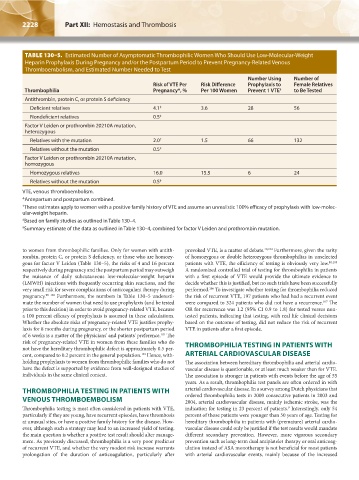
                TABLE 130–5.  Estimated Number of Asymptomatic Thrombophilic Women Who Should Use Low-Molecular-Weight
                Heparin Prophylaxis During Pregnancy and/or the Postpartum Period to Prevent Pregnancy-Related Venous
                Thromboembolism, and Estimated Number Needed to Test
                                                                                           Number Using    Number of
                                                           Risk of VTE Per   Risk Difference   Prophylaxis to   Female Relatives
                Thrombophilia                              Pregnancy*, %   Per 100 Women   Prevent 1 VTE †  to Be Tested
                Antithrombin, protein C, or protein S deficiency
                  Deficient relatives                      4.1 ‡           3.6             28             56
                  Nondeficient relatives                   0.5 ‡
                Factor V Leiden or prothrombin 20210A  mutation,
                heterozygous
                  Relatives with the mutation              2.0 ‡           1.5             66             132
                  Relatives without the mutation           0.5 ‡
                Factor V Leiden or prothrombin 20210A  mutation,
                homozygous
                  Homozygous relatives                     16.0            15.5            6               24
                  Relatives without the mutation           0.5 §
               VTE, venous thromboembolism.
               *Antepartum and postpartum combined.
               † These estimates apply to women with a positive family history of VTE and assume an unrealistic 100% efficacy of prophylaxis with low-molec-
               ular-weight heparin.
               ‡ Based on family studies as outlined in Table 130–4.
               § Summary estimate of the data as outlined in Table 130–4, combined for factor V Leiden and prothrombin mutation.


               to women from thrombophilic families. Only for women with antith-  provoked VTE, is a matter of debate. 70,104  Furthermore, given the rarity
               rombin, protein C, or protein S deficiency, or those who are homozy-  of homozygous or double heterozygous thrombophilias in unselected
               gous for factor V Leiden (Table  130–5), the risks of 4 and 16 percent   patients with VTE, the efficiency of testing is obviously very low. 10,105
               respectively during pregnancy and the postpartum period may outweigh   A randomized controlled trial of testing for thrombophilia in patients
               the nuisance of daily subcutaneous low-molecular-weight heparin   with a first episode of VTE would provide the ultimate evidence to
               (LMWH) injections with frequently occurring skin reactions, and the   decide whether this is justified, but no such trials have been successfully
               very small risk for severe complications of anticoagulant therapy during   performed.  To investigate whether testing for thrombophilia reduced
                                                                              106
               pregnancy. 99–102  Furthermore, the numbers in Table  130–5 underesti-  the risk of recurrent VTE, 197 patients who had had a recurrent event
               mate the number of women that need to use prophylaxis (and be tested   were compared to 324 patients who did not have a recurrence.  The
                                                                                                                    107
               prior to this decision) in order to avoid pregnancy-related VTE, because   OR for recurrence was 1.2 (95% CI 0.9 to 1.8) for tested versus non-
               a 100 percent efficacy of prophylaxis is assumed in these calculations.   tested patients, indicating that testing, with real life clinical decisions
               Whether the absolute risks of pregnancy-related VTE justifies prophy-  based on the outcome of testing, did not reduce the risk of recurrent
               laxis for 8 months during pregnancy, or the shorter postpartum period   VTE in patients after a first episode.
               of 6 weeks is a matter of the physicians' and patients' preference.  The
                                                              102
               risk of pregnancy-related VTE in women from these families who do   THROMBOPHILIA TESTING IN PATIENTS WITH
               not have the hereditary thrombophilic defect is approximately 0.5 per-
               cent, compared to 0.2 percent in the general population.  Hence, with-  ARTERIAL CARDIOVASCULAR DISEASE
                                                       103
               holding prophylaxis to women from thrombophilic families who do not   The association between hereditary thrombophilia and arterial cardio-
               have the defect is supported by evidence from well-designed studies of   vascular disease is questionable, or at least much weaker than for VTE.
               individuals in the same clinical context.              The association is stronger in patients with events before the age of 55
                                                                      years. As a result, thrombophilia test panels are often ordered in with
               THROMBOPHILIA TESTING IN PATIENTS WITH                 arterial cardiovascular disease. In a survey among Dutch physicians that
               VENOUS THROMBOEMBOLISM                                 ordered thrombophilia tests in 2000 consecutive patients in 2003 and
                                                                      2004, arterial cardiovascular disease, mainly ischemic stroke, was the
                                                                                                         9
               Thrombophilia testing is most often considered in patients with VTE,   indication for testing in 23 percent of patients.  Interestingly, only 54
               particularly if they are young, have recurrent episodes, have thrombosis   percent of those patients were younger than 50 years of age. Testing for
               at unusual sites, or have a positive family history for the disease. How-  hereditary thrombophilia in patients with (premature) arterial cardio-
               ever, although such a strategy may lead to an increased yield of testing,   vascular disease could only be justified if the test results would mandate
               the main question is whether a positive test result should alter manage-  different secondary prevention. However, more vigorous secondary
               ment. As previously discussed, thrombophilia is a very poor predictor   prevention such as long-term dual antiplatelet therapy or oral anticoag-
               of recurrent VTE, and whether the very modest risk increase warrants   ulation instead of ASA monotherapy is not beneficial for most patients
               prolongation of the duration of anticoagulation, particularly after   with arterial cardiovascular events, mainly because of the increased


          Kaushansky_chapter 130_p2221-2232.indd   2228                                                                 9/21/15   4:34 PM

