


Page 2259 - Williams Hematology ( PDFDrive )
P. 2259
2234           Part XII:  Hemostasis and Thrombosis                                                                                                                      Chapter 131:  The Antiphospholipid Syndrome             2235


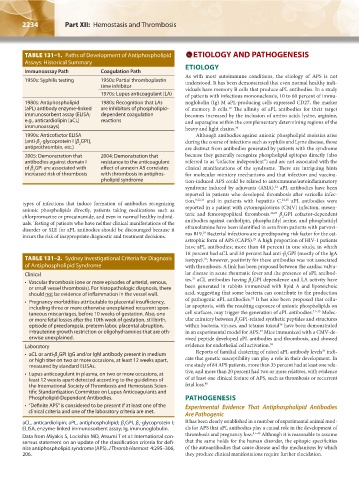
                TABLE 131–1.  Paths of Development of Antiphospholipid   ETIOLOGY AND PATHOGENESIS
                Assays: Historical Summary
                Immunoassay Path          Coagulation Path            ETIOLOGY
                                                                      As with most autoimmune conditions, the etiology of APS is not
                1950s: Syphilis testing   1950s: Partial thromboplastin   understood. It has been demonstrated that even normal healthy indi-
                                          time inhibitor              viduals have memory B cells that produce aPL antibodies. In a study
                                          1970s: Lupus anticoagulant (LA)  of patients with infectious mononucleosis, 10 to 60 percent of immu-
                1980s: Antiphospholipid    1980s: Recognition that LAs   noglobulin (Ig) M aPL-producing cells expressed CD27, the marker
                (aPL) antibody enzyme-linked   are inhibitors of phospholipid-   of memory B cells.  The affinity of aPL antibodies for their target
                                                                                     19
                immunosorbent assay (ELISA;   dependent coagulation   becomes increased by the inclusion of amino acids lysine, arginine,
                e.g., anticardiolipin [aCL]   reactions               and asparagine within the complementary determining regions of the
                immunoassays)                                         heavy and light chains. 20
                1990s: Anticofactor ELISA                                 Although antibodies against anionic phospholipid moieties arise
                (anti-β -glycoprotein I [β GPI],                      during the course of infections such as syphilis and Lyme disease, those
                     2
                                  2
                antiprothrombin, etc.)                                are distinct from antibodies generated by patients with the syndrome
                2005: Demonstration that   2004: Demonstration that   because they generally recognize phospholipid epitopes directly (also
                antibodies against domain I   resistance to the anticoagulant   referred to as “cofactor independent”) and are not associated with the
                of β GPI are associated with   effect of annexin A5 correlates   clinical  manifestations  of  the  syndrome.  There  are  intriguing  hints
                   2
                increased risk of thrombosis  with thrombosis in antiphos-  for molecular mimicry mechanisms and that infection and vaccina-
                                          pholipid syndrome           tion-induced APS could be related to autoimmune/autoinflammatory
                                                                      syndrome induced by adjuvants (ASIA).  aPL antibodies have been
                                                                                                    21
                                                                      reported in patients who developed thrombosis after varicella infec-
                                                                      tion, 8,22,23  and in patients with hepatitis C. 24,25  aPL antibodies were
               types  of  infections  that  induce  formation  of  antibodies  recognizing
               anionic phospholipids directly, patients taking medications such as   reported in a patient with cytomegalovirus (CMV) infection, mesen-
                                                                                                   26,27
               chlorpromazine or procainamide, and even in normal healthy individ-  teric and femoropopliteal thrombosis.    β GPI cofactor-dependent
                                                                                                       2
               uals. Testing of patients who have neither clinical manifestations of the   antibodies against cardiolipin, phosphatidyl serine, and phosphatidyl
               disorder or SLE for aPL antibodies should be discouraged because it   ethanolamine have been identified in sera from patients with parvovi-
                                                                            28
               incurs the risk of inappropriate diagnostic and treatment decisions.  rus B19.  Bacterial infections are a predisposing risk factor for the cat-
                                                                      astrophic form of APS (CAPS).  A high proportion of HIV-1 patients
                                                                                             29
                                                                      have aPL antibodies; more than 40 percent in one study, in which
                                                                      18 percent had aCL and 30 percent had anti-β GPI (mostly of the IgA
                                                                                                        2
                TABLE 131–2.  Sydney Investigational Criteria for Diagnosis   isotype), ; however, positivity for these antibodies was not associated
                                                                            30
                of Antiphospholipid Syndrome                          with thrombosis. A link has been proposed between the cardiac valvu-
                Clinical                                              lar disease in acute rheumatic fever and the presence of aPL antibod-
                                                                        31
                •   Vascular thrombosis (one or more episodes of arterial, venous,   ies.  aCL antibodies having β GPI dependence and LA activity have
                                                                                            2
                  or small vessel thrombosis). For histopathologic diagnosis, there   been generated in rabbits immunized with lipid A and lipoteichoic
                  should not be evidence of inflammation in the vessel wall.  acid, suggesting that some bacteria can contribute to the production
                                                                                            32
                •   Pregnancy morbidities attributable to placental insufficiency,   of pathogenic aPL antibodies.  It has also been proposed that cellu-
                  including three or more otherwise unexplained recurrent spon-  lar apoptosis, with the resulting exposure of anionic phospholipids on
                  taneous miscarriages, before 10 weeks of gestation. Also, one   cell surfaces, may trigger the generation of aPL antibodies. 33–35  Molec-
                  or more fetal losses after the 10th week of gestation, stillbirth,   ular mimicry between β GPI-related synthetic peptides and structures
                                                                                       2
                  episode of preeclampsia, preterm labor, placental abruption,   within bacteria, viruses, and tetanus toxoid  have been demonstrated
                                                                                                      36
                  intrauterine growth restriction or oligohydramnios that are oth-  in an experimental model for APS.  Mice immunized with a CMV-de-
                                                                                               37
                  erwise unexplained.                                 rived peptide developed aPL antibodies and thrombosis, and showed
                Laboratory                                            evidence for endothelial cell activation. 38
                                                                                                                    39
                •   aCL or anti-β GPI IgG and/or IgM antibody present in medium   Reports of familial clustering of raised aPL antibody levels  indi-
                           2
                  or high titer on two or more occasions, at least 12 weeks apart,   cate that genetic susceptibility can play a role in their development. In
                  measured by standard ELISAs.                        one study of 84 APS patients, more than 35 percent had at least one rela-
                •   Lupus anticoagulant in plasma, on two or more occasions, at   tive, and more than 20 percent had two or more relatives, with evidence
                  least 12 weeks apart detected according to the guidelines of   of at least one clinical feature of APS, such as thrombosis or recurrent
                  the International Society of Thrombosis and Hemostasis Scien-  fetal loss. 40
                  tific Standardization Committee on Lupus Anticoagulants and
                    Phospholipid-Dependent Antibodies.                PATHOGENESIS
                •   “Definite APS” is considered to be present if at least one of the   Experimental Evidence That Antiphospholipid Antibodies
                 clinical criteria and one of the laboratory criteria are met.
                                                                      Are Pathogenic
               aCL, anticardiolipin; aPL, antiphospholipid; β GPI, β -glycoprotein I;   It has been clearly established in a number of experimental animal mod-
                                                      2
                                                 2
               ELISA, enzyme-linked immunosorbent assay; Ig, immunoglobulin.  els for APS that aPL antibodies play a causal role in the development of
               Data from Miyakis S, Lockshin MD, Atsumi T et al: International con-  thrombosis and pregnancy loss. 41–45  Although it is reasonable to assume
               sensus statement on an update of the classification criteria for defi-  that the same holds for the human disorder, the epitopic specificities
               nite antiphospholipid syndrome (APS). J Thromb Haemost  4:295–306,   of the autoantibodies that cause disease and the mechanisms by which
               206.                                                   they produce clinical manifestations require further elucidation.


          Kaushansky_chapter 131_p2233-2252.indd   2234                                                                 9/18/15   5:10 PM

