


Page 2263 - Williams Hematology ( PDFDrive )
P. 2263
2238           Part XII:  Hemostasis and Thrombosis                                                                                                                      Chapter 131:  The Antiphospholipid Syndrome             2239


                  CLINICAL FEATURES                                        6

               Table 131–4 summarizes the clinical features of APS. Patients generally
               present with thrombotic manifestations, that is, evidence for vasooc-
               clusion or end-organ ischemia or infarction, and/or pregnancy losses   4
               and complications attributable to placental insufficiency. The usual age
               at presentation with thrombosis is approximately 35 to 45 years. Except   Events per 100 pt/yrs
               for patients with SLE, men and women are equally susceptible to throm-
               botic manifestations. No differences have been observed between the   2
               arterial and venous distributions of thromboses of primary and second-
               ary APS patients. 134

               SYSTEMIC VASCULAR THROMBOSIS                                0
               Patients can present with spontaneous venous and/or arterial throm-  Normal     Carriers     Carriers
               bosis or embolism in any site; however, about half of all patients have   subjects  single positivity  triple positivity
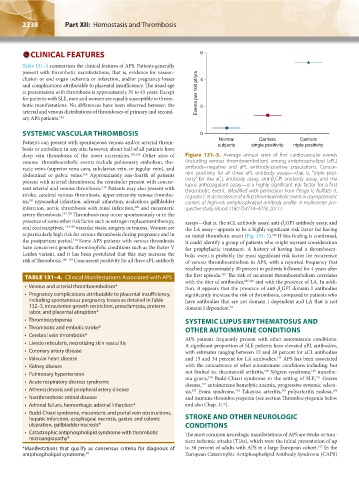
               deep vein thrombosis of the lower extremities. 135,136  Other sites of   Figure 131–5.  Average annual rates of first cardiovascular events
               venous  thromboembolic events include pulmonary embolism, tho-  (including venous thromboembolism) among antiphospholipid (aPL)
               racic veins (superior vena cava, subclavian vein, or jugular vein), and   antibody–negative and aPL antibody-positive populations. Concur-
               abdominal or pelvic veins.  Approximately one-fourth of patients   rent positivity for all three aPL antibody assays—that is, “triple posi-
                                    136
               present with arterial thromboses; the remainder present with concur-  tivity” for the aCL antibody assay, anti-β GPI antibody assay, and the
                                                                                                    2
               rent arterial and venous thrombosis.  Patients may also present with   lupus  anticoagulant assay—is a highly significant risk factor for a first
                                          136
                                                                      thrombotic event.  (Modified with permission from Pengo V, Ruffatti A,
               stroke, cerebral venous thrombosis, upper-extremity venous thrombo-  Legnani C et al: Incidence of a first thromboembolic event in asymptomatic
               sis,  myocardial infarction, adrenal infarction, acalculous gallbladder   carriers of high-risk antiphospholipid antibody profile: A multicenter pro-
                 135
               infarction, aortic thrombosis with renal infarction,  and mesenteric   spective study. Blood 118(17):4714–4718, 2011.)
                                                     120
               artery thrombosis. 137,138  Thrombosis may occur spontaneously or in the
               presence of some other risk factor such as estrogen replacement therapy,   assays—that is, the aCL antibody assay, anti-β GPI antibody assay, and
                                                                                                       2
               oral contraceptives,  134,139  vascular stasis, surgery, or trauma. Women are   the LA assay—appears to be a highly significant risk factor for having
               at particularly high risk for venous thrombosis during pregnancy and in   an initial thrombotic event (Fig. 131–5).  If this finding is confirmed,
                                                                                                   144
               the postpartum period.  Some APS patients with venous thrombosis   it could identify a group of patients who might warrant consideration
                                134
               have concurrent genetic thrombophilic conditions such as the factor V   for prophylactic treatment. A history of having had a thromboem-
               Leiden variant, and it has been postulated that this may increase the   bolic event is probably the most significant risk factor for recurrence
               risk of thrombosis. 140–143  Concurrent positivity for all three aPL antibody   of venous thromboembolism in APS, with a reported frequency that
                                                                      reached approximately 30 percent in patients followed for 4 years after
                                                                                  145
                TABLE 131–4.  Clinical Manifestations Associated with APS  the first episode.  The risk of recurrent thromboembolism correlates
                                                                      with the titer of antibodies, 145,146  and with the presence of LA. In addi-
                •  Venous and arterial thromboembolism*               tion, it appears that the presence of anti-β GPI domain I antibodies
                                                                                                      2
                •   Pregnancy complications attributable to placental insufficiency,   significantly increase the risk of thrombosis, compared to patients who
                  including spontaneous pregnancy losses as detailed in Table   have antibodies that are not domain I dependent and LA that is not
                  132–3, intrauterine growth restriction, preeclampsia, preterm   domain I dependent. 51
                  labor, and placental abruption*
                •   Thrombocytopenia                                  SYSTEMIC LUPUS ERYTHEMATOSUS AND
                •   Thrombotic and embolic stroke*                    OTHER AUTOIMMUNE CONDITIONS
                •   Cerebral vein thrombosis*                         APS patients frequently present with other autoimmune conditions.
                •   Livedo reticularis, necrotizing skin vasculitis   A significant proportion of SLE patients have elevated aPL antibodies,
                •   Coronary artery disease                           with estimates ranging between 12 and 30 percent for aCL antibodies
                •   Valvular heart disease                            and 15 and 34 percent for LA antibodies.  APS has been associated
                                                                                                     147
                •   Kidney disease                                    with the concurrence of other autoimmune conditions including, but
                                                                                                148
                                                                                                                149
                •   Pulmonary hypertension                            not limited to, rheumatoid arthritis,  Sjögren syndrome,  myasthe-
                                                                              150
                                                                                                                  151
                •   Acute respiratory distress syndrome               nia gravis,  Budd-Chiari syndrome in the setting of SLE,  Graves
                                                                      disease,  autoimmune hemolytic anemia, progressive systemic sclero-
                                                                            152
                •   Atherosclerosis and peripheral artery disease     sis,  Evans syndrome,  Takayasu arteritis,  polyarteritis nodosa,
                                                                                       154
                                                                                                                       156
                                                                                                      155
                                                                        153
                •   Nonthrombotic retinal disease                     and immune thrombocytopenia (see section Thrombocytopenia below
                •   Adrenal failure, hemorrhagic adrenal infarction*  and also Chap. 117).
                •   Budd-Chiari syndrome, mesenteric and portal vein obstructions,
                  hepatic infarction, esophageal necrosis, gastric and colonic   STROKE AND OTHER NEUROLOGIC
                  ulceration, gallbladder necrosis*                   CONDITIONS
                •   Catastrophic antiphospholipid syndrome with thrombotic   The most common neurologic manifestations of APS are stroke or tran-
                  microangiopathy*                                    sient ischemic attacks (TIAs), which were the initial presentation of up
                                                                                                                   157
               *Manifestations  that  qualify  as  consensus  criteria  for  diagnosis  of   to 30 percent of adults with APS in a large European cohort.  In the
               antiphospholipid syndrome. 18                          European Catastrophic Antiphospholipid Antibody Syndrome (CAPS)

          Kaushansky_chapter 131_p2233-2252.indd   2238                                                                 9/18/15   5:10 PM

