


Page 2262 - Williams Hematology ( PDFDrive )
P. 2262
2236  Part XII:  Hemostasis and Thrombosis                   Chapter 131:  The Antiphospholipid Syndrome             2237


                                    98
                  TLRs, particularly TLR-2.  This binding results in downstream signaling   thrombosis. The presence of antibodies against EPCR in APS patients
                  that involves TRAF6 (tumor necrosis factor receptor-associated factor   was proposed to be a risk factor for fetal death. 125
                                                      99
                  6) and MyD88 (myeloid differentiation factor 88).  Increased expres-  Antiphospholipid Antibodies Activate Platelets  An experi-
                  sion of tissue factor is mediated by p38 mitogen-activated protein kinase   mental animal model that includes in vivo imaging has provided data
                  (MAPK). 100                                           indicating that aPL-induced thrombosis is a consequence of platelet
                     Binding of autoantibodies to annexin A2 may also promote   activation that then promotes endothelial activation and fibrin forma-
                                                                            126
                                                                                                                127
                  thrombosis by inhibiting fibrinolysis. APS patients have increased titers   tion.  aPL antibodies can induce platelet aggregation, an effect that
                  of antibodies against annexin A2, an endothelial surface receptor for   might be promoted via signaling through apoER2 receptors; the β GPI
                                                                                                                        2
                                  101
                                                                                                                        128
                  t-PA, and plasminogen.  The blocking of annexin A2 by aPL antibodies   binding site for apoER2 on platelets was localized to its domain V.  As
                  impedes plasmin generation in a t-PA–dependent generation assay, and   described above (see “Antigenic Specificities”), β GPI also has a damp-
                                                                                                           2
                  inhibits cell surface plasmin generation on human umbilical vein endo-  ening effect on platelet adhesion by interfering with the platelet–VWF
                          94
                  thelial cells.  Several additional mechanisms have been identified by   interaction, and consequently aPL antibodies, by interfering with this
                  which aPL antibodies can interfere with fibrinolysis. β GPI is a cofac-  β GPI-mediated dampening, can increase platelet adhesion in flow
                                                                         2
                                                         2
                  tor for t-PA–mediated activation of plasminogen, and aPL antibodies   systems. 60
                  against β GPI interfere with its binding to t-PA, thereby downregulating   Other Mechanisms  APS patients have been shown to have
                        2
                                                                                                                 129
                                   61
                  plasminogen activation.  Finally, fibrinolysis may also be impaired by   autoantibodies  against  tissue  factor  pathway  inhibitor.   Some  aPL
                  autoantibodies directed against the catalytic site of plasmin or t-PA, 102,103    antibodies cross-react with heparin and heparinoid molecules, which
                  by  an  increased  level  of  plasminogen  activator  inhibitor-1,   and  by   are highly polyanionic, and hence, inhibit their contribution to antith-
                                                             104
                                                                                    69
                  inhibition of autoactivation of factor XII with ensuing reductions of   rombin activity.  aPL antibodies show cross-reactivity against oxidized
                  kallikrein and urokinase. 105                         LDL  and are associated with an increased risk of atherosclerosis.
                                                                                                                          131
                                                                            130
                     Apolipoprotein E receptor 2 (apoER2), a member of the LDL-   Antibodies against β GPI-oxidized LDL complexes have been proposed
                                                                                       2
                                                                                                          132
                                                      106
                  receptor family is found on endothelial surfaces,  monocytes,  and   to be atherogenic by reducing their clearance.  Finally, in addition to
                                                                107
                  platelets, and may also serve as receptor for anti-β GPI–β GPI complexes   promoting thrombosis, aPL antibodies may contribute to other vascu-
                                                    2
                                                          2
                  where it can also trigger the phosphatidylinositol 3′-kinase (PI3K)/Akt   lar lesions by stimulating the mammalian target of rapamycin complex
                        108
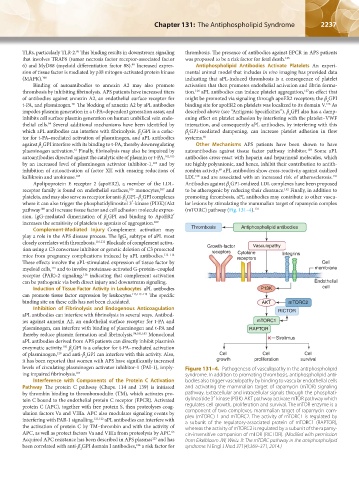
                  pathway  and increase tissue factor and cell adhesion molecule expres-  (mTORC) pathway (Fig. 131–4). 133
                  sion. IgG-mediated dimerization of  β GPI and binding to ApoER2′
                                              2
                  increases the sensitivity of platelets to agonists of aggregation. 109
                     Complement-Mediated Injury  Complement activation may   Thrombosis    Antiphospholipid antibodies
                  play a role in the APS disease process. The IgG  subtype of aPL most
                                                     2
                  closely correlates with thrombosis. 110,111  Blockade of complement activa-
                  tion using a C3 convertase inhibitor or genetic deletion of C3 protected   Growth-factor  Vasculopathy
                                                                                 receptors
                                                                                          Cytokine
                  mice from pregnancy complications induced by aPL antibodies. 112–114    receptors      Integrins
                  These effects involve the aPL-stimulated expression of tissue factor by                             Cell
                  myeloid cells,  and to involve proteinase-activated G-protein–coupled                             membrane
                            115
                  receptor (PAR)-2 signaling,  indicating that complement activation
                                      116
                  can be pathogenic via both direct injury and downstream signaling.                                Endothelial
                     Induction of Tissue Factor Activity in Leukocytes  aPL antibodies            P13K                cell
                  can promote tissue factor expression by leukocytes. 115,117–119  The specific
                  binding site on these cells has not been elucidated.                            AKT      mTORC2
                     Inhibition of Fibrinolysis and Endogenous Anticoagulation                          RICTOR
                  aPL antibodies can interfere with fibrinolysis in several ways. Antibod-
                  ies against annexin A2, an endothelial surface receptor for t-PA and          mTORC1
                  plasminogen, can interfere with binding of plasminogen and t-PA and         RAPTOR
                  thereby reduce plasmin formation and fibrinolysis. 94,101,103  Monoclonal
                  aPL antibodies derived from APS patients can directly inhibit plasmin’s              Sirolimus
                  enzymatic activity.  β GPI is a cofactor for t-PA–mediated activation
                               102
                                  2
                  of plasminogen,  and anti-β GPI can interfere with this activity. Also,   Cell  Cell          Cell
                             120
                                       2
                  it has been reported that women with APS have significantly increased   growth  proliferation  survival
                  levels of circulating plasminogen activator inhibitor-1 (PAI-1), imply-  Figure 131–4.  Pathogenesis of vasculopathy in the antiphospholipid
                  ing impaired fibrinolysis. 104                        syndrome. In addition to promoting thrombosis, antiphospholipid anti-
                     Interference with Components of the Protein C Activation   bodies also trigger vasculopathy by binding to vascular endothelial cells
                  Pathway  The protein C pathway (Chaps. 114 and 139) is initiated   and activating the mammalian target of rapamycin (mTOR) signaling
                  by thrombin binding to thrombomodulin (TM), which activates pro-  pathway. Extracellular and intracellular signals through the phosphati-
                  tein C bound to the endothelial protein C receptor (EPCR). Activated   dylinositide 3′-kinase (PI3K)-AKT pathway activate mTOR pathway which
                  protein C (APC), together with free protein S, then proteolyses coag-  regulates cell growth, proliferation and survival. The mTOR enzyme is a
                  ulation factors Va and VIIIa. APC also modulates signaling events by   component of two complexes, mammalian target of rapamycin com-
                                                                        plex (mTORC) 1 and mTORC2. The activity of mTORC1 is regulated by
                  interfering with PAR-1 signalling. 121,122  aPL antibodies can interfere with   a subunit of the regulatory-associated protein of mTORC1 (RAPTOR),
                  the activation of protein C by TM–thrombin and with the activity of   whereas the activity of mTORC2 is regulated by a subunit of the rapamy-
                  APC, as well as protect factors Va and VIIIa from proteolysis by APC.    cin-insensitive companion of mTOR (RICTOR). (Modifed with permission
                                                                    65
                  Acquired APC resistance has been described in APS plasmas  and has   from Eikelbloom JW, Weitz JI: The mTORC pathway in the antiphospholipid
                                                             123
                                                        124
                  been correlated with anti-β GPI domain I antibodies,  a risk factor for   syndrome. N Engl J Med 371(4):369–371, 2014.)
                                     2
          Kaushansky_chapter 131_p2233-2252.indd   2237                                                                 9/18/15   5:10 PM

