


Page 2260 - Williams Hematology ( PDFDrive )
P. 2260
2234  Part XII:  Hemostasis and Thrombosis                   Chapter 131:  The Antiphospholipid Syndrome             2235


                                                                                                               58
                  Antigenic Specificities                               lipoprotein (LDL) and may play a role in its clearance.  β GPI binds to
                                                                                                                  2
                  Antibodies against phospholipid that arise during the immunologic   lipopolysaccharide and the scavenged complex is taken up by mono-
                                                                                      59
                  response to syphilis and other infections (with the notable exception of   cytes/macrophages.   β GPI  reduces  platelet  adhesion  to  collagen  in
                                                                                         2
                  leprosy ) recognize anionic phospholipid epitopes directly,  whereas   flow chambers by interfering with the platelet–von Willebrand factor
                       46
                                                             47
                  pathogenic aPL antibodies recognize phospholipid-binding proteins,   (VWF) interaction by binding to its A2 domain, thereby interfering
                                                                                                                  60
                  primarily β GPI. 48,49                                with its binding to the platelet glycoprotein Ib complex.  β GPI may
                                                                                                                    2
                          2
                     β GPI (also named apolipoprotein H), a member of the comple-  also promote fibrinolysis as a cofactor for tissue-type plasminogen acti-
                      2
                                                                                                                          61
                  ment control protein or short consensus repeat superfamily,  is a highly   vator (t-PA) via its SCR domain V, which increases fibrinolytic activity.
                                                            50
                  glycosylated single-chain plasma protein composed of 326 amino   The protein may have a further effect on fibrinolysis by binding to endo-
                  acids, with a molecular weight of approximately 50 kDa (Fig. 131–1).   thelial cells via annexin A2, a protein that also serves as a receptor for
                                                                                         62
                  β GPI has five short consensus repeat (SCR) stretches of approximately    plasminogen and t-PA.  Homozygous β GPI-null mice have not been
                                                                                                      2
                   2
                                                                                                             63
                  60 amino acids  (also referred to as complement control protein [CCP]   demonstrated to display a thrombotic phenotype.  However, the pro-
                             45
                  repeats). Epitopic specificities for individual domains may have patho-  tein may play a role—though not a critical one—in the reproductive
                  genic and prognostic significance (see “Immunoassays” below). 51–54  process, as there was a reduction in the number of viable implantation
                     The affinity of β GPI for anionic phospholipids derives from cat-  sites in β GPI-null mice and reduced fetal weight and fetal-to-placen-
                                                                               2
                                 2
                  ionic residues from its aminoterminus that have affinity for anionic   tal weight ratio in late gestation, suggesting compromised placental
                  polar heads of phospholipids and a hydrophobic loop which inserts into   function. 64
                  the lipid bilayer. β GPI has five domains for which antibodies have been   In addition to β GPI, a number of other antigenic targets have been
                                                                                       2
                               2
                  identified. IgG antibodies against an epitope comprising Gly40-Arg43   identified for aPL, including, but not limited to, prothrombin, coagula-
                  in the domain I of β GPI have been reported to have a stronger correla-  tion factor V, protein C, protein S, annexin A2, annexin A5, high- and
                                2
                  tion with thrombosis than antibodies against other epitopes.  Recent   low-molecular-weight kininogens, and factors VII/VIIa and vimentin–
                                                              51
                  data support the concept that β GPI undergoes conformational changes   cardiolipin complex. 65–68
                                        2
                  that may be important for the APS disease process. By transmission
                  electron microscopy, unbound β GPI appears to be in a closed confor-
                                         2
                  mation because of the affinity of a portion of carboxyterminal domain   Proposed Pathogenic Mechanisms
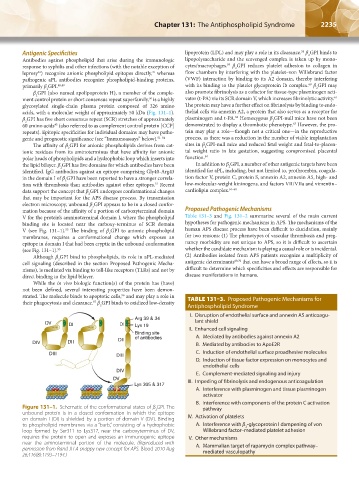
                  V for the protein’s amninoterminal domain I, where the phospholipid   Table 131–3 and  Fig. 131–2 summarize several of the main current
                  binding site is located near the carboxy-terminus of SCR domain     hypotheses for pathogenic mechanisms in APS. The mechanisms of the
                  V (see Fig. 131–1).  The binding of  β GPI to anionic phospholipid   human APS disease process have been difficult to elucidation, mainly
                                55
                                               2
                  membranes, requires a conformational change which exposes an   for two reasons: (1) The phenotypes of vascular thrombosis and preg-
                  epitope in domain I that had been cryptic in the unbound conformation   nancy morbidity are not unique to APS, so it is difficult to ascertain
                  (see Fig. 131–1). 55                                  whether the candidate mechanism is playing a causal role or is incidental.
                     Although β GPI bind to phospholipids, its role in aPL-mediated   (2) Antibodies isolated from APS patients recognize a multiplicity of
                              2
                  cell signaling (described in the section Proposed Pathogenic Mecha-  antigenic determinants 69,70  that can have a broad range of effects, so it is
                  nisms), is mediated via binding to toll-like receptors (TLRs) and not by   difficult to determine which specificities and effects are responsible for
                  direct binding to the lipid bilayer.                  disease manifestations in humans.
                     While the in vivo biologic function(s) of the protein has (have)
                  not been defined, several interesting properties have been  demon-
                  strated. The molecule binds to apoptotic cells,  and may play a role in   TABLE 131–3.  Proposed Pathogenic Mechanisms for
                                                   56
                  their phagocytosis and clearance.  β GPI binds to oxidized low-density
                                          57
                                            2                              Antiphospholipid Syndrome
                                                                          I.   Disruption of endothelial surface and annexin A5 anticoagu-
                                                        Arg 39 & 34         lant shield
                         DV      DI               DI
                            +  +        +  +            Lys 19            II.   Enhanced cell signaling
                                                        Binding site        A.   Mediated by antibodies against annexin A2
                     DIV         DII              DII   of antibodies       B.  Mediated by antibodies to ApoE2R
                           DIII                  DIII                       C.   Induction of endothelial surface proadhesive molecules
                                                                            D.   Induction of tissue factor expression on monocytes and
                                                                              endothelial cells
                                                 DIV
                                                                            E.   Complement-mediated signaling and injury
                                                DV                       III.   Impeding of fibrinolysis and endogenous anticoagulation
                                                 +  +  Lys 305 & 317
                                                                            A.   Interference with plasminogen and tissue plasminogen
                                                                              activator
                                                                            B.   Interference with components of the protein C activation
                  Figure 131–1.  Schematic of the conformational states of β GPI. The   pathway
                                                              2
                  unbound protein is in a closed conformation in which the epitope   IV.   Activation of platelets
                  on domain I (DI) is shielded by a portion of domain V (DV). Binding
                  to phospholipid membranes via a “barb,” consisting of a hydrophobic   A.   Interference with β -glycoprotein I dampening of von
                                                                                             2
                  loop formed by Ser311 to Lys317, near the carboxyterminus of DV,   Willebrand factor–mediated platelet adhesion
                  requires the protein to open and exposes an immunogenic epitope   V.   Other mechanisms
                  near the aminoterminal portion of the molecule.  (Reproduced with   A.   Mammalian target of rapamycin complex pathway–
                  permission from Rand JH A snappy new concept for APS. Blood 2010 Aug   mediated vasculopathy
                  26;116(8):1193–1194.)
          Kaushansky_chapter 131_p2233-2252.indd   2235                                                                 9/18/15   5:10 PM

