


Page 2339 - Williams Hematology ( PDFDrive )
P. 2339
2312  Part XII:  Hemostasis and Thrombosis                      Chapter 135:  Fibrinolysis and Thrombolysis          2313


                  PRINCIPLES OF THERAPY                                 prolonged depending on the intensity of the lytic state. Tests reflecting
                  The basic principle of all fibrinolytic therapy is administration of suf-  Plg activation, such as the euglobulin clot lysis time, will be abnormal.
                  ficient Plg activator to achieve a high local concentration at the site of   Platelet membrane proteins may also be degraded, resulting in abnor-
                                                                                        320–322
                  the thrombus, thereby accelerating conversion of Plg to plasmin, and   mal platelet function.   Overall, these effects contribute to a hypoco-
                  increasing the rate of fibrin dissolution. However, if large amounts of   agulable lytic state that may be beneficial for vessel patency, but may
                  Plg activator overwhelm the natural regulatory systems, plasmin may   also exacerbate a bleeding complication. High doses of a nonspecific
                  be formed in the blood, resulting in degradation of susceptible proteins,   activator, such as streptokinase, will cause a more marked lytic state,
                  the “lytic state.”  In addition, if high concentrations of activator reach   compared to that seen with a fibrin-specific agent such as reteplase.
                             319
                  fibrin deposits at sites of injury, bleeding, often exacerbated by plasmic   Patient selection for fibrinolytic therapy depends on careful con-
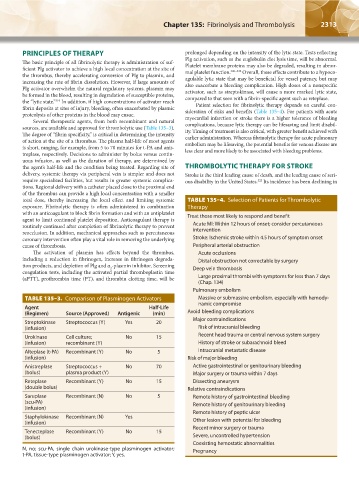
                  proteolysis of other proteins in the blood may ensue.  sideration of risks and benefits (Table 135–4). For patients with acute
                     Several therapeutic agents, from both recombinant and natural   myocardial infarction or stroke there is a higher tolerance of bleeding
                  sources, are available and approved for thrombolytic use (Table 135–3).   complications, because lytic therapy can be lifesaving and limit disabil-
                  The degree of “fibrin specificity,” is critical in determining the intensity   ity. Timing of treatment is also critical, with greater benefit achieved with
                  of action at the site of a thrombus. The plasma half-life of most agents   earlier administration. Whereas fibrinolytic therapy for acute pulmonary
                  is short, ranging, for example, from 5 to 70 minutes for t-PA and anis-  embolism may be lifesaving, the potential benefits for venous disease are
                  treplase, respectively. Decisions to administer by bolus versus contin-  less clear and more likely to be associated with bleeding problems.
                  uous infusion, as well as the duration of therapy, are determined by
                  the agent’s half-life and the condition being treated. Regarding site of   THROMBOLYTIC THERAPY FOR STROKE
                  delivery, systemic therapy via peripheral vein is simpler and does not   Stroke is the third leading cause of death, and the leading cause of seri-
                  require specialized facilities, but results in greater systemic complica-  ous disability in the United States.  Its incidence has been declining in
                                                                                                 323
                  tions. Regional delivery with a catheter placed close to the proximal end
                  of the thrombus can provide a high local concentration with a smaller
                  total dose, thereby increasing the local effect and limiting systemic   TABLE 135–4.  Selection of Patients for Thrombolytic
                  exposure. Fibrinolytic  therapy  is  often  administered in  combination   Therapy
                  with an anticoagulant to block fibrin formation and with an antiplatelet   Treat those most likely to respond and benefit
                  agent to limit continued platelet deposition. Anticoagulant therapy is
                  routinely continued after completion of fibrinolytic therapy to prevent      Acute MI: Within 12 hours of onset; consider percutaneous
                  reocclusion. In addition, mechanical approaches such as percutaneous   intervention
                  coronary intervention often play a vital role in removing the underlying     Stroke: Ischemic stroke within 4.5 hours of symptom onset
                  cause of thrombosis.                                     Peripheral arterial obstruction
                     The activation of plasmin has effects beyond the thrombus,      Acute occlusions
                  including a reduction in fibrinogen, increase in fibrinogen degrada-      Distal obstruction not correctable by surgery
                  tion products, and depletion of Plg and α -plasmin inhibitor. Screening     Deep vein thrombosis
                                               2
                  coagulation tests, including the activated partial thromboplastin time
                  (aPTT), prothrombin time (PT), and thrombin clotting time, will be        Large proximal thrombi with symptoms for less than 7 days
                                                                             (Chap. 134)
                                                                           Pulmonary embolism
                   TABLE 135–3.  Comparison of Plasminogen Activators         Massive or submassive embolism, especially with hemody-
                                                                             namic compromise
                   Agent                                    Half-Life
                   (Regimen)    Source (Approved)  Antigenic  (min)      Avoid bleeding complications
                                                                           Major contraindications
                   Streptokinase   Streptococcus (Y)  Yes      20
                   (infusion)                                                Risk of intracranial bleeding
                   Urokinase    Cell culture;       No         15            Recent head trauma or central nervous system surgery
                   (infusion)   recombinant (Y)                              History of stroke or subarachnoid bleed
                   Alteplase (t-PA)   Recombinant (Y)  No      5             Intracranial metastatic disease
                   (infusion)                                            Risk of major bleeding
                   Anistreplase   Streptococcus +   No         70          Active gastrointestinal or genitourinary bleeding
                   (bolus)      plasma product (Y)                         Major surgery or trauma within 7 days
                   Reteplase    Recombinant (Y)     No         15          Dissecting aneurysm
                   (double bolus)                                        Relative contraindications
                   Saruplase    Recombinant (N)     No         5           Remote history of gastrointestinal bleeding
                   (scu-PA)                                                Remote history of genitourinary bleeding
                   (infusion)
                                                                           Remote history of peptic ulcer
                   Staphylokinase   Recombinant (N)  Yes                   Other lesion with potential for bleeding
                   (infusion)
                                                                           Recent minor surgery or trauma
                   Tenecteplase   Recombinant (Y)   No         15
                   (bolus)                                                 Severe, uncontrolled hypertension
                                                                           Coexisting hemostatic abnormalities
                  N,  no;  scu-PA,  single  chain  urokinase-type  plasminogen  activator;     Pregnancy
                  t-PA, tissue-type plasminogen activator; Y, yes.


          Kaushansky_chapter 135_p2303-2326.indd   2313                                                                 9/18/15   5:13 PM

