


Page 2343 - Williams Hematology ( PDFDrive )
P. 2343
2316  Part XII:  Hemostasis and Thrombosis                      Chapter 135:  Fibrinolysis and Thrombolysis          2317


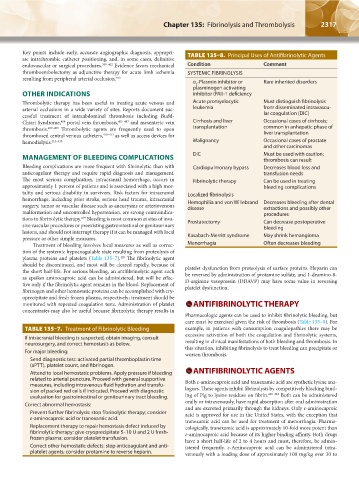
                  Key  points  include  early,  accurate  angiographic  diagnosis,  appropri-  TABLE 135–8.  Principal Uses of Antifibrinolytic Agents
                  ate intrathrombic catheter positioning, and, in some cases, definitive
                  endovascular or surgical procedures. 399–402  Evidence favors mechanical   Condition  Comment
                  thromboembolectomy as adjunctive therapy for acute limb ischemia   SYSTEMIC FIBRINOLYSIS
                  resulting from peripheral arterial occlusion. 403
                                                                           α -Plasmin inhibitor or   Rare inherited disorders
                                                                            2
                                                                             plasminogen activating
                  OTHER INDICATIONS                                        inhibitor (PAI)-1 deficiency
                  Thrombolytic therapy has been useful in treating acute venous and      Acute promyelocytic   Must distinguish fibrinolysis
                  arterial occlusions in a wide variety of sites. Reports document suc-  leukemia  from disseminated intravascu-
                  cessful treatment of intraabdominal thrombosis including Budd-                   lar coagulation (DIC)
                  Chiari Syndrome,  portal vein thrombosis, 405–407  and mesenteric vein      Cirrhosis and liver   Occasional cases of cirrhosis;
                               404
                  thrombosis. 407–409  Thrombolytic agents are frequently used to open   transplantation  common in anhepatic phase of
                  thrombosed central venous catheters, 410–413  as well as access devices for      liver transplantation
                  hemodialysis. 414–418                                    Malignancy              Occasional cases of prostate
                                                                                                   and other carcinomas
                  MANAGEMENT OF BLEEDING COMPLICATIONS                     DIC                     Must be used with caution;
                                                                                                   thrombosis can result
                  Bleeding complications are more frequent with fibrinolytic than with     Cardiopulmonary bypass  Decreases blood loss and
                  anticoagulant therapy and require rapid diagnosis and management.                  transfusion needs
                  The most serious complication, intracranial hemorrhage, occurs in     Fibrinolytic therapy  Can be used in treating
                  approximately 1 percent of patients and is associated with a high mor-             bleeding complications
                  tality and serious disability in survivors. Risk factors for intracranial   Localized fibrinolysis
                  hemorrhage, including prior stroke, serious head trauma, intracranial   Hemophilia and von Willebrand  Decreases bleeding after dental
                  surgery, tumor or vascular disease such as aneurysms or arteriovenous   disease  extractions and possibly other
                  malformation and uncontrolled hypertension, are strong contraindica-             procedures
                  tions to fibrinolytic therapy.  Bleeding is most common at sites of inva-  Prostatectomy  Can decrease postoperative
                                      419
                  sive vascular procedures or preexisting gastrointestinal or genitourinary        bleeding
                  lesions, and should not interrupt therapy if it can be managed with local
                  pressure or other simple measures.                     Kasabach-Merritt syndrome  May shrink hemangioma
                     Treatment of bleeding involves local measures as well as correc-  Menorrhagia  Often decreases bleeding
                  tion of the systemic hypocoagulable state resulting from proteolysis of
                  plasma proteins and platelets (Table 135–7).  The fibrinolytic agent
                                                   420
                  should be discontinued, and most will be cleared rapidly, because of   platelet dysfunction from proteolysis of surface proteins. Heparin can
                  the short half-life. For serious bleeding, an antifibrinolytic agent such   be reversed by administration of protamine sulfate, and 1-deamino-8-
                  as epsilon aminocaproic acid can be administered, but will be effec-  D-arginine vasopressin (DDAVP) may have some value in reversing
                  tive only if the fibrinolytic agent remains in the blood. Replacement of   platelet dysfunction.
                  fibrinogen and other hemostatic proteins can be accomplished with cry-
                  oprecipitate and fresh frozen plasma, respectively; treatment should be
                  monitored with repeated coagulation tests. Administration of platelet   ANTIFIBRINOLYTIC THERAPY
                  concentrates may also be useful because fibrinolytic therapy results in
                                                                        Pharmacologic agents can be used to inhibit fibrinolytic bleeding, but
                                                                        care must be exercised given the risk of thrombosis (Table 135–8). For
                   TABLE 135–7.  Treatment of Fibrinolytic Bleeding     example,  in  patients  with  consumption  coagulopathies  there  may  be
                                                                        excessive activation of both the coagulation and fibrinolytic systems,
                   If intracranial bleeding is suspected, obtain imaging, consult
                     neurosurgery, and correct hemostasis as below.     resulting in clinical manifestations of both bleeding and thrombosis. In
                   For major bleeding:                                  this situation, inhibiting fibrinolysis to treat bleeding can precipitate or
                                                                        worsen thrombosis.
                      Send diagnostic test: activated partial thromboplastin time
                    (aPTT), platelet count, and fibrinogen.
                      Attend to local hemostatic problems. Apply pressure if bleeding   ANTIFIBRINOLYTIC AGENTS
                    related to arterial puncture. Proceed with general supportive   Both ε-aminocaproic acid and tranexamic acid are synthetic lysine ana-
                    measures, including intravenous fluid hydration and transfu-
                    sion of packed red cells if indicated. Proceed with diagnostic   logues. These agents inhibit fibrinolysis by competitively blocking bind-
                    evaluation for gastrointestinal or genitourinary tract bleeding.  ing of Plg to lysine residues on fibrin. 421–424  Both can be administered
                   Correct abnormal hemostasis:                         orally or intravenously, have rapid absorption after oral administration
                                                                        and are excreted primarily through the kidneys. Only ε-aminocaproic
                      Prevent further fibrinolysis: stop fibrinolytic therapy; consider   acid is approved for use in the United States, with the exception that
                    ε-aminocaproic acid or tranexamic acid.             tranexamic acid can be used for treatment of menorrhagia. Pharma-
                      Replacement therapy to repair hemostasis defect induced by   cologically, tranexamic acid is approximately 10-fold more potent than
                    fibrinolytic therapy: give cryoprecipitate 5–10 U and 2 U fresh-  ε-aminocaproic acid because of its higher binding affinity. Both drugs
                    frozen plasma; consider platelet transfusion.       have a short half-life of 2 to 4 hours and must, therefore, be admin-
                      Correct other hemostatic defects: stop anticoagulant and anti-  istered frequently.  ε-Aminocaproic acid can be administered intra-
                    platelet agents; consider protamine to reverse heparin.  venously with a loading dose of approximately 100 mg/kg over 30 to


          Kaushansky_chapter 135_p2303-2326.indd   2317                                                                 9/18/15   5:14 PM

