


Page 2340 - Williams Hematology ( PDFDrive )
P. 2340
2314           Part XII:  Hemostasis and Thrombosis                                                                                                                          Chapter 135:  Fibrinolysis and Thrombolysis         2315


               recent years due to control of risk factors, but total numbers are increas-  irreversible necrosis is shorter, the risk and consequences of bleeding are
               ing as a consequence of aging of the population. Although aspirin and   greater, and there is more variability in the thrombo(embolic) occluding
               anticoagulants may be useful in prevention, thrombolytic therapy is the   lesion. Further, the occlusive platelet-fibrin thrombus that precipitates a
               only available intervention during the acute stage.    myocardial infarction is quite small, whereas the occlusive lesion caus-
                   The appropriate use of thrombolytic therapy for stroke is based   ing ischemic stroke may be a large in situ thrombus, small platelet-fibrin
               on an understanding of its pathogenesis. Ischemic stroke is most com-  embolus, or large embolus of varying age and composition originating
               monly  caused  by  rupture  of  an  atherosclerotic  plaque  within  a  large   from the left atrium. Thrombolysis has had a smaller impact for stroke
               or medium-sized artery in the neck or cranium. In addition, transient   than it has for myocardial infarction, based largely on these differences.
               ischemic attacks (TIAs) and strokes involving small arteries can result
               from embolization of platelet-fibrin thrombi that form on atheroscle-  Early Thrombolytic Studies
               rotic vessels in the neck and ascending aorta, or from embolization of   The current therapeutic approach began with small, open-label stud-
               thrombi that form in the heart in association with atrial fibrillation,   ies that used intravenous or intraarterial streptokinase, urokinase, and
               valve dysfunction, artificial valves, or endocardial thrombi. Up to    t-PA to determine dose, recanalization rate, hemorrhagic potential, and
               30 percent of strokes have no defined etiology.        clinical predictors of response. 324–339  These studies demonstrated that
                   Current approaches to thrombolytic therapy for stroke are based on   recanalization could be achieved, that early treatment was essential,
               imaging to define the etiology, results of clinical trials, and the experience   and that the rate of intracranial hemorrhage and hemorrhagic trans-
               with thrombolysis for acute myocardial infarction. Modern computed   formation within the ischemic area was high. Phase II studies defined
               tomography (CT) imaging and magnetic resonance imaging (MRI) can   the optimum dosage and time window for intravenous t-PA and served
               identify ischemic areas and localize areas of hemorrhage quite early.   as the basis for larger phase III trials that led to the current t-PA-based
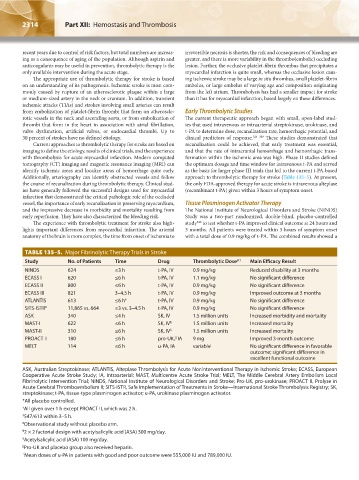
               Additionally, arteriography can identify obstructed vessels and follow   approach to thrombolytic therapy for stroke (Table 135–5). At present,
               the course of recanalization during thrombolytic therapy. Clinical stud-  the only FDA-approved therapy for acute stroke is intravenous alteplase
               ies have generally followed the successful designs used for myocardial   (recombinant t-PA) given within 3 hours of symptom onset.
               infarction that demonstrated the critical pathologic role of the occluded
               vessel, the importance of early recanalization in preserving myocardium,   Tissue Plasminogen Activator Therapy
               and the impressive decrease in morbidity and mortality resulting from   The National Institute of Neurological Disorders and Stroke (NINDS)
               early reperfusion. They have also characterized the bleeding risk.  Study  was  a  two-part  randomized,  double-blind,  placebo-controlled
                   The experience with thrombolytic treatment for stroke also high-  study  to test whether t-PA improved clinical outcome at 24 hours and
                                                                          340
               lights important differences from myocardial infarction. The arterial   3 months. All patients were treated within 3 hours of symptom onset
               anatomy of the brain is more complex, the time from onset of ischemia to   with a total dose of 0.9 mg/kg of t-PA. The combined results showed a

                TABLE 135–5.  Major Fibrinolytic Therapy Trials in Stroke
                Study          No. of Patients  Time         Drug        Thrombolytic Dose* †  Main Efficacy Result
                NINDS          624            ≤3 h           t-PA, IV    0.9 mg/kg          Reduced disability at 3 months
                ECASS I        620            ≤6 h           t-PA, IV    1.1 mg/kg          No significant difference
                ECASS II       800            ≤6 h           t-PA, IV    0.9 mg/kg          No significant difference
                ECASS III      821            3–4.5 h        t-PA, IV    0.9 mg/kg          Improved outcome at 3 months
                ATLANTIS       613            ≤6 h ‡         t-PA, IV    0.9 mg/kg          No significant difference
                SITS-ISTR #    11,865 vs. 664  ≤3 vs. 3–4.5 h  t-PA, IV  0.9 mg/kg          No significant difference
                ASK            340            ≤4 h           SK, IV      1.5 million units  Increased morbidity and mortality
                MAST-I         622            ≤6 h           SK, IV ¶    1.5 million units  Increased mortality
                MAST-II        310            ≤6 h           SK, IV §    1.5 million units  Increased mortality
                                                                   ||
                PROACT II      180            ≤6 h           pro-UK,  IA  9 mg              Improved 3-month outcome
                MELT           114            ≤6 h           u-PA, IA    variable ’         No significant difference in favorable
                                                                                            outcome; significant difference in
                                                                                            excellent functional outcome

               ASK, Australian Streptokinase; ATLANTIS, Alteplase Thrombolysis for Acute Noninterventional Therapy in Ischemic Stroke; ECASS, European
               Cooperative Acute Stroke Study; IA, intraarterial; MAST, Multicentre Acute Stroke Trial; MELT, The Middle Cerebral Artery Embolism Local
               Fibrinolytic Intervention Trial; NINDS, National Institute of Neurological Disorders and Stroke; Pro-UK, pro-urokinase; PROACT II, Prolyse in
               Acute Cerebral Thromboembolism II; SITS-ISTR, Safe Implementation of Treatments in Stroke—International Stroke Thrombolysis Registry; SK,
               streptokinase; t-PA, tissue-type plasminogen activator; u-PA, urokinase plasminogen activator.
               *All placebo controlled.
               † All given over 1 h except PROACT II, which was 2 h.
               ‡ 547/613 within 3–5 h.
               # Observational study without placebo arm.
               ¶ 2 × 2 factorial design with acetylsalicylic acid (ASA) 300 mg/day.
               § Acetylsalicylic acid (ASA) 100 mg/day.
               || Pro-UK and placebo group also received heparin.
               < Mean doses of u-PA in patients with good and poor outcome were 555,000 IU and 789,000 IU.


          Kaushansky_chapter 135_p2303-2326.indd   2314                                                                 9/18/15   5:13 PM

