


Page 2342 - Williams Hematology ( PDFDrive )
P. 2342
2316           Part XII:  Hemostasis and Thrombosis                                                                                                                          Chapter 135:  Fibrinolysis and Thrombolysis         2317


               than 5 percent of stroke patients currently receive t-PA treatment, indi-  Anticoagulation is useful to prevent thrombus extension, while throm-
               cating the need for focused community educational efforts. 366–368  Ran-  bolytic therapy or surgery can restore perfusion.
               domized studies with rt-PA have shown that intravenous thrombolytic   Early approaches to acute peripheral arterial occlusion involved
               therapy can be safely extended to 4.5 hours after symptom onset in   streptokinase. Several small studies demonstrated reperfusion in
               selected patients, whereas streptokinase was associated with an unac-  approximately 40 percent of patients, with greatest success when occlu-
               ceptably high rate of intracranial hemorrhage. 344,345,347  In addition, intra-  sions were recent; bleeding complications occurred in up to one-third
                                                                                                              382
               cranial hemorrhage can be reduced by identifying patients at greatest   of subjects.  Following the report in 1974 by Dotter  of successful
                                                                              381
               risk using MRI diffusion–perfusion mismatch to identify reversible   thrombolysis in peripheral arterial occlusion using locally administered
               ischemia. 346,369–371  The combination of potent antiplatelet therapy using   thrombolysis, practice moved progressively to the nearly exclusive use
               a glycoprotein IIb/IIIa antagonist with a lower dose of a thrombolytic   of local intraarterially administered treatment. Advantages include
               agent may improve results. 372–377                     delivery of a high concentration of drug directly to the site of throm-
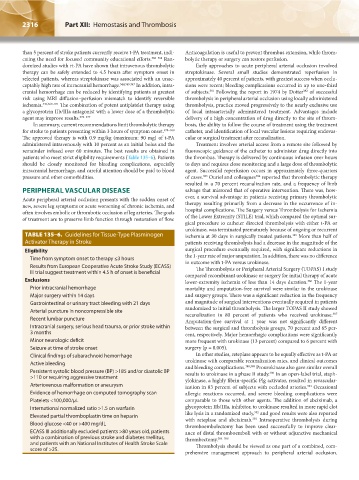
                   In summary, current recommendations limit thrombolytic therapy   bosis, the ability to follow the course of treatment using the treatment
               for stroke to patients presenting within 3 hours of symptom onset. 378–380    catheter, and identification of local vascular lesions requiring endovas-
               The approved therapy is with 0.9 mg/kg (maximum: 90 mg) of t-PA   cular or surgical treatment after recanalization.
               administered intravenously with 10 percent as an initial bolus and the   Treatment involves arterial access from a remote site followed by
               remainder infused over 60 minutes. The best results are obtained in   fluoroscopic guidance of the catheter to administer drug directly into
               patients who meet strict eligibility requirements (Table 135–6). Patients   the thrombus. Therapy is delivered by continuous infusion over hours
               should be closely monitored for bleeding complications, especially   to days and requires close monitoring and a large dose of thrombolytic
               intracranial hemorrhage, and careful attention should be paid to blood   agent. Successful reperfusion occurs in approximately three-quarters
                                                                                              384
               pressure and other comorbidities.                      of cases.  Ouriel and colleagues  reported that thrombolytic therapy
                                                                            383
                                                                      resulted in a 70 percent recanalization rate, and a frequency of limb
               PERIPHERAL VASCULAR DISEASE                            salvage that mirrored that of operative intervention. There was, how-
               Acute peripheral arterial occlusion presents with the sudden onset of   ever, a survival advantage in patients receiving primary thrombolytic
               new, severe leg symptoms or acute worsening of chronic ischemia, and   therapy resulting primarily from a decrease in the occurrence of in-
               often involves embolic or thrombotic occlusion of leg arteries. The goals   hospital complications. The Surgery versus Thrombolysis for Ischemia
               of treatment are to preserve limb function through restoration of flow.   of the Lower Extremity (STILE) trial, which compared the optimal sur-
                                                                      gical procedure to catheter directed thrombolysis with either t-PA or
                                                                      urokinase, was terminated prematurely because of ongoing or recurrent
                TABLE 135–6.  Guidelines for Tissue-Type Plasminogen   ischemia at 30 days in surgically treated patients.  More than half of
                                                                                                          385
                Activator Therapy in Stroke                           patients receiving thrombolysis had a decrease in the magnitude of the
                Eligibility                                           surgical procedure eventually required, with significant reductions in
                  Time from symptom onset to therapy ≤3 hours         the 1-year rate of major amputation. In addition, there was no difference
                   Results from European Cooperative Acute Stroke Study (ECASS)   in outcome with t-PA versus urokinase.
                                                                          The Thrombolysis or Peripheral Arterial Surgery (TOPAS) I study
                  III trial suggest treatment within 4.5 h of onset is beneficial  compared recombinant urokinase or surgery for initial therapy of acute
                Exclusions                                            lower-extremity ischemia of less than 14 days duration.  The 1-year
                                                                                                               386
                  Prior intracranial hemorrhage                       mortality and amputation-free survival were similar in the urokinase
                  Major surgery within 14 days                        and surgery groups. There was a significant reduction in the frequency
                  Gastrointestinal or urinary tract bleeding with 21 days  and magnitude of surgical interventions eventually required in patients
                  Arterial puncture in noncompressible site           randomized to initial thrombolysis. The larger TOPAS II study showed
                                                                                                                       387
                  Recent lumbar puncture                              recanalization  in  80 percent  of  patients  who received  urokinase.
                                                                      Amputation-free survival at 1 year was not significantly different
                   Intracranial surgery, serious head trauma, or prior stroke within   between the surgical and thrombolysis groups, 70 percent and 65 per-
                  3 months                                            cent, respectively. Major hemorrhagic complications were significantly
                  Minor neurologic deficit                            more frequent with urokinase (13 percent) compared to 6 percent with
                  Seizure at time of stroke onset                     surgery (p = 0.005).
                  Clinical findings of subarachnoid hemorrhage            In other studies, reteplase appears to be equally effective as t-PA or
                  Active bleeding                                     urokinase with comparable recanalization rates, and clinical outcomes
                                                                                          388,389
                   Persistent systolic blood pressure (BP) >185 and/or diastolic BP   and bleeding complications.   Prourokinase also gave similar overall
                                                                      results to urokinase in a phase II study.  In an open-label trial, staph-
                                                                                                  390
                  >110 or requiring aggressive treatment              ylokinase, a highly fibrin-specific Plg activator, resulted in revascular-
                  Arteriovenous malformation or aneurysm              ization in 83 percent of subjects with occluded arteries.  Occasional
                                                                                                               391
                  Evidence of hemorrhage on computed tomography scan  allergic reactions occurred, and severe bleeding complications were
                  Platelets <100,000/μL                               comparable to those with other agents. The addition of abciximab, a
                  International normalized ratio >1.5 on warfarin     glycoprotein IIb/IIIa, inhibitor, to urokinase resulted in more rapid clot
                                                                                             392
                  Elevated partial thromboplastin time on heparin     like lysis in a randomized study,  and good results were also reported
                                                                                             393
                  Blood glucose <40 or >400 mg/dL                     with reteplase and abciximab.  Intraoperative thrombolysis during
                                                                      thromboembolectomy has been used successfully to improve clear-
                   ECASS III additionally excluded patients >80 years old, patients   ance of distal thromboemboli with or without adjunctive mechanical
                  with a combination of previous stroke and diabetes mellitus,   thrombectomy. 394–398
                  and patients with an National Institutes of Health Stroke Scale   Thrombolysis should be viewed as one part of a combined, com-
                  score of >25.
                                                                      prehensive management approach to peripheral arterial occlusion.


          Kaushansky_chapter 135_p2303-2326.indd   2316                                                                 9/18/15   5:13 PM

