


Page 2356 - Williams Hematology ( PDFDrive )
P. 2356
2330           Part XIII:  Transfusion Medicine                                                                                                                       Chapter 136: Erythrocyte Antigens and Antibodies           2331


                             GPA/GPB (MNSs), CD235
                             GPC/GPD (Gerbich), CD236
                             CD44 (Indian)
                             CR1 (CD35; Knops)                                             DAF (CD55, Cromer)
                             CD239 (Lutheran, B-CAM)                                       AChE (Yt)
                             ICAM-4 (LW), CD242                                            Dombrock (CD297, ART4)
                             CD99 (Xg)                                                     CD108 (JMH)
                             CD147 (Ok)                                  CD240 (Rh)        Emm
                             ERMAP (Sc)                                  CD241 (RhAg)      CD59
                             SMIM1 (VEL)                                 Kx
                                                    CD238 (Kell)         Band 3 (CD233, Diego)           NH
                                 ABO                                                                       2
                                 Hh (CD173)  NH 2  COOH                  AQP-1 (Colton)
                                 Lewis                       CD234 (Duffy)  Kidd
                                 I                           ABCB6 (LAN)  AQP-3 (GIL)
                            P1   FORS                                    CD151 (Raph)
                            P                       NH 2                 ABCG2 (JR)
                            P k
                                                                                                     Outside


                                  COOH              NH 2          COOH        NH 2   COOH
                                        Type I     Type II
                           Carbohydrate  Singlepass  Singlepass        Multipass            GPI-linked

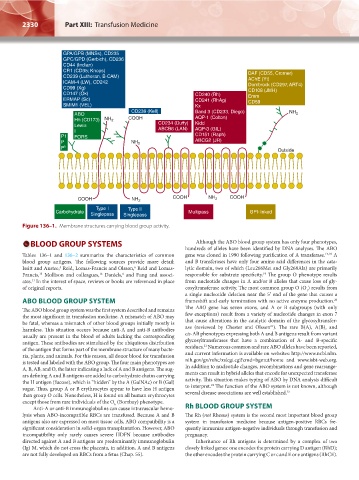
               Figure 136–1.  Membrane structures carrying blood group activity.

                  BLOOD GROUP SYSTEMS                                     Although the ABO blood group system has only four phenotypes,
                                                                      hundreds of alleles have been identified by DNA analyses. The ABO
               Tables   136–1  and  136–2  summarize  the  characteristics  of  common   gene was cloned in 1990 following purification of A transferase. 17,18  A
               blood group antigens. The following sources provide more detail:   and B transferases have only four amino acid differences in the cata-
               Issitt and Anstee,  Reid, Lomas-Francis and Olsson,  Reid and Lomas-  lytic domain, two of which (Leu266Met and Gly268Ala) are primarily
                                                     6
                            5
               Francis,  Mollison and colleagues,  Daniels,  and Fung and associ-  responsible for substrate specificity.  The group O phenotype results
                                         16
                                                                                                19
                                                 4
                     15
               ates.  In the interest of space, reviews or books are referenced in place   from nucleotide changes in A and/or B alleles that cause loss of gly-
                   11
               of original reports.                                   cosyltransferase activity. The most common group O (O ) results from
                                                                                                               1
                                                                      a single nucleotide deletion near the 5′ end of the gene that causes a
               ABO BLOOD GROUP SYSTEM                                 frameshift and early termination with no active enzyme production.
                                                                                                                        20
               The ABO blood group system was the first system described and remains   The  ABO gene has seven exons, and A or B subgroups (with only
               the most significant in transfusion medicine. A mismatch of ABO may   few exceptions) result from a variety of nucleotide changes in exon 7
               be fatal, whereas a mismatch of other blood groups initially mostly is   that cause alterations in the catalytic domain of the glycosyltransfer-
                                                                                                   21
               harmless. This situation occurs because anti-A and anti-B antibodies   ase (reviewed by Chester and Olsson ). The rare B(A), A(B), and
               usually are present in the blood of adults lacking the corresponding   cis-AB phenotypes expressing both A and B antigens result from variant
               antigen. These antibodies are stimulated by the ubiquitous distribution   glycosyltransferases  that have a combination of A-  and B-specific
                                                                            21
               of the antigen that forms part of the membrane structure of many bacte-  residues.  Numerous common and rare ABO alleles have been reported,
               ria, plants, and animals. For this reason, all donor blood for transfusion   and current information is available on websites: http://www.ncbi.nlm.
               is tested and labeled with the ABO group. The four main phenotypes are   nih.gov/gv/mhc/xslcgi.cgi?cmd=bgmut/home and www.isbt-web.org.
               A, B, AB, and O, the latter indicating a lack of A and B antigens. The sug-  In addition to nucleotide changes, recombinations and gene rearrange-
               ars defining A and B antigens are added to carbohydrate chains carrying   ments can result in hybrid alleles that encode for unexpected transferase
               the H antigen (fucose), which is “hidden” by the A (GalNAc) or B (Gal)   activity. This situation makes typing of ABO by DNA analysis difficult
                                                                               22
               sugar. Thus, group A or B erythrocytes appear to have less H antigen   to interpret.  The function of the ABO system is not known, although
               than group O cells. Nonetheless, H is found on all human erythrocytes   several disease associations are well established. 23
               except those from rare individuals of the O  (Bombay) phenotype.
                                              h
                   Anti-A or anti-B immunoglobulins can cause intravascular hemo-  Rh BLOOD GROUP SYSTEM
               lysis when ABO-incompatible RBCs are transfused. Because A and B   The Rh (not Rhesus) system is the second most important blood group
               antigens also are expressed on most tissue cells, ABO compatibility is a   system in transfusion medicine because antigen-positive RBCs fre-
               significant consideration in solid-organ transplantation. However, ABO   quently immunize antigen-negative individuals through transfusion and
               incompatibility only rarely causes severe HDFN because antibodies   pregnancy.
               directed against A and B antigens are predominantly immunoglobulin   Inheritance of Rh antigens is determined by a complex of two
               (Ig) M, which do not cross the placenta, in addition, A and B antigens   closely linked genes: one encodes the protein carrying D antigen (RhD);
               are not fully developed on RBCs from a fetus (Chap. 55).  the other encodes the protein carrying C or c and E or e antigens (RhCE).


          Kaushansky_chapter 136_p2327-2352.indd   2330                                                                 9/21/15   4:30 PM

