


Page 2368 - Williams Hematology ( PDFDrive )
P. 2368
2342           Part XIII:  Transfusion Medicine                                                                                                                       Chapter 136: Erythrocyte Antigens and Antibodies           2343


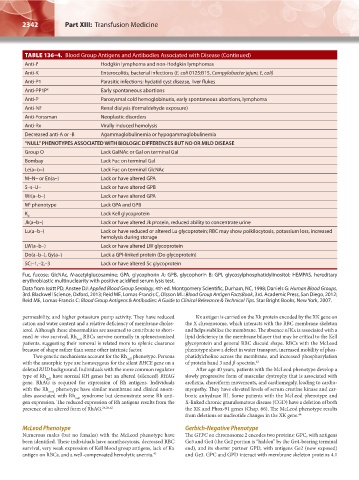
                TABLE 136–4.  Blood Group Antigens and Antibodies Associated with Disease (Continued)
                Anti-I T                  Hodgkin lymphoma and non-Hodgkin lymphomas
                Anti-K                    Enterocolitis, bacterial infections (E. coli 0125:B15, Campylobacter jejuni, E. coli)
                Anti-P1                   Parasitic infections: hydatid cyst disease, liver flukes
                Anti-PP1P k               Early spontaneous abortions
                Anti-P                    Paroxysmal cold hemoglobinuria, early spontaneous abortions, lymphoma
                Anti-NF                   Renal dialysis (formaldehyde exposure)
                Anti-Forssman             Neoplastic disorders
                Anti-Rx                   Virally induced hemolysis
                Decreased anti-A or -B    Agammaglobulinemia or hypogammaglobulinemia
                “NULL” PHENOTYPES ASSOCIATED WITH BIOLOGIC DIFFERENCES BUT NO OR MILD DISEASE
                Group O                   Lack GalNAc or Gal on terminal Gal
                Bombay                    Lack Fuc on terminal Gal
                Le(a–b–)                  Lack Fuc on terminal GlcNAc
                M–N– or En(a–)            Lack or have altered GPA
                S–s–U–                    Lack or have altered GPB
                Wr(a–b–)                  Lack or have altered GPA
                M  phenotype              Lack GPA and GPB
                  k
                K                         Lack Kell glycoprotein
                 0
                Jk(a–b–)                  Lack or have altered Jk protein, reduced ability to concentrate urine
                Lu(a–b–)                  Lack or have reduced or altered Lu glycoprotein; RBC may show poikilocytosis, potassium loss, increased
                                          hemolysis during storage
                LW(a–b–)                  Lack or have altered LW glycoprotein
                Do(a–b–), Gy(a–)          Lack a GPI-linked protein (Do glycoprotein)
                SC:–1,–2,–3               Lack or have altered Sc glycoprotein
               Fuc, fucose; GlcNAc, N-acetylglucosamine; GPA, glycophorin A; GPB, glycophorin B; GPI, glycosylphosphatidylinositol; HEMPAS, hereditary
               erythroblastic multinuclearity with positive acidified serum lysis test.
               Data from Issitt PD, Anstee DJ: Applied Blood Group Serology, 4th ed. Montgomery Scientific, Durham, NC, 1998; Daniels G: Human Blood Groups,
               3rd. Blackwell Science, Oxford, 2013; Reid ME, Lomas-Francis C, Olsson ML: Blood Group Antigen FactsBook, 3rd. Academic Press, San Diego, 2012;
               Reid ME, Lomas-Francis C: Blood Group Antigens & Antibodies: A Guide to Clinical Relevance & Technical Tips. Star Bright Books, New York, 2007.


               permeability, and higher potassium pump activity. They have reduced   Kx antigen is carried on the Xk protein encoded by the XK gene on
               cation and water content and a relative deficiency of membrane choles-  the X chromosome, which interacts with the RBC membrane skeleton
               terol. Although these abnormalities are assumed to contribute to short-  and helps stabilize the membrane. The absence of Kx is associated with a
               ened in vivo survival, Rh  RBCs survive normally in splenectomized   lipid deficiency in the membrane bilayer that may be critical to the Kell
                                  null
               patients, suggesting their removal is related more to splenic clearance   glycoprotein and general RBC discoid shape. RBCs with the McLeod
               because of shape rather than some other intrinsic factor.  phenotype show a defect in water transport, increased mobility of phos-
                   Two genetic mechanisms account for the Rh  phenotype. Persons   phatidylcholine across the membrane, and increased phosphorylation
                                                  null
               with the amorphic type are homozygous for the silent RHCE gene on a   of protein band 3 and β-spectrin. 43
               deleted RHD background. Individuals with the more common regulator   After age 40 years, patients with the McLeod phenotype develop a
               type of Rh  have normal RH genes but an altered (silenced) RHAG   slowly progressive form of muscular dystrophy that is associated with
                       null
               gene. RhAG is required for expression of Rh antigens. Individuals   areflexia, choreiform movements, and cardiomegaly, leading to cardio-
               with the Rh mod  phenotype have similar membrane and clinical anom-  myopathy. They have elevated levels of serum creatine kinase and car-
               alies associated with Rh  syndrome but demonstrate some Rh anti-  bonic anhydrase III. Some patients with the McLeod phenotype and
                                 null
               gen expression. The reduced expression of Rh antigens results from the   X-linked chronic granulomatous disease (CGD) have a deletion of both
               presence of an altered form of RhAG. 24,26,42          the XK and Phox-91 genes (Chap. 66). The McLeod phenotype results
                                                                      from deletions or nucleotide changes in the XK gene. 44

               McLeod Phenotype                                       Gerbich-Negative Phenotype
               Numerous males (but no females) with the McLeod phenotype have   The GYPC on chromosome 2 encodes two proteins: GPC, with antigens
               been identified. These individuals have acanthocytosis, decreased RBC   Ge3 and Ge4 (the Ge2 portion is “hidden” by the Ge4-bearing terminal
               survival, very weak expression of Kell blood group antigens, lack of Kx   end), and its shorter partner GPD, with antigens Ge2 (now exposed)
               antigen on RBCs, and a well-compensated hemolytic anemia. 43  and Ge3. GPC and GPD interact with membrane skeleton proteins 4.1


          Kaushansky_chapter 136_p2327-2352.indd   2342                                                                 9/21/15   4:31 PM

