


Page 2411 - Williams Hematology ( PDFDrive )
P. 2411
2382           Part XIII:  Transfusion Medicine                                                                                                                   Chapter 139:  Preservation and Clinical Use of Platelets       2383


                       100                                             10

                    Percentage of circulating platelets  destroyed randomly  60  Platelet survival time (days)  8 6 4
                        80


                        40


                        20


                         0                                              2 0
                          0      100    200     300    400     500            0     100    200    300    400     500
                   A              Platelet count (platelets/µL × 10 )  B            Platelet count (platelets/µL × 10 )
                                                         3
                                                                                                          3
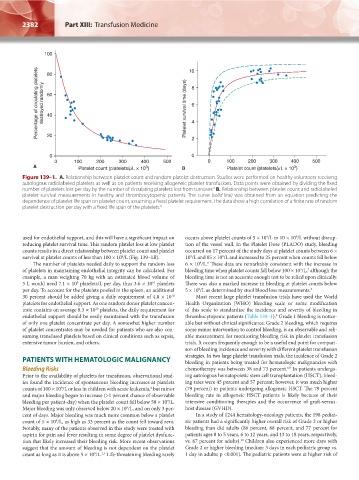
               Figure 139–1.  A. Relationship between platelet count and random platelet destruction. Studies were performed on healthy volunteers receiving
               autologous radiolabeled platelets as well as on patients receiving allogeneic platelet transfusions. Data points were obtained by dividing the fixed
               number of platelets lost per day by the number of circulating platelets lost from turnover.  B. Relationship between platelet count and radiolabeled
                                                                               3
               platelet survival measurements in healthy and thrombocytopenic patients. The curve (solid line) was obtained from an equation predicting the
               dependence of platelet life span on platelet count, assuming a fixed platelet requirement. The data show a high correlation of a finite rate of random
               platelet destruction per day with a fixed life span of the platelets. 3


               used for endothelial support, and this will have a significant impact on   occurs above platelet counts of 5 × 10 /L to 10 × 10 /L without disrup-
                                                                                                 9
                                                                                                           9
               reducing platelet survival time. This random platelet loss at low platelet   tion of the vessel wall. In the Platelet Dose (PLADO) study, bleeding
               counts results in a direct relationship between platelet count and platelet   occurred on 17 percent of the study days at platelet counts between 6 ×
               survival at platelet counts of less than 100 × 10 /L (Fig. 139–1B).  10 /L and 85 × 10 /L and increased to 25 percent when counts fell below
                                                                                  9
                                                                        9
                                                 9
                   The number of platelets needed daily to support the random loss   6 × 10 /L.  These data are remarkably consistent with the increase in
                                                                           9
                                                                             6
               of platelets in maintaining endothelial integrity can be calculated. For   bleeding time when platelet counts fall below 100 × 10 /L,  although the
                                                                                                               7
                                                                                                             9
               example, a man weighing 70 kg with an estimated blood volume of    bleeding time is not an accurate enough test to be relied upon clinically.
               5 L would need 7.1 × 10  platelets/L per day, thus 3.6 × 10  platelets   There was also a marked increase in bleeding at platelet counts below
                                  9
                                                           10
               per day. To account for the platelets pooled in the spleen, an additional    5 × 10 /L as determined by stool blood loss measurements. 2
                                                                          9
               30 percent should be added giving a daily requirement of 4.8 × 10    Most recent large platelet transfusion trials have used the World
                                                                 10
               platelets for endothelial support. As one random donor platelet concen-  Health Organization (WHO) bleeding scale or some modification
               trate contains on average 8.3 × 10  platelets, the daily requirement for   of this scale to standardize the incidence and severity of bleeding in
                                        10
               endothelial support should be easily maintained with the transfusion   thrombocytopenic patients (Table 139–1).  Grade 1 bleeding is notice-
                                                                                                    8
               of only one platelet concentrate per day. A somewhat higher number   able but without clinical significance. Grade 2 bleeding, which requires
               of platelet concentrates may be needed for patients who are also con-  some minor intervention to control bleeding, is an observable and reli-
               suming transfused platelets based on clinical conditions such as sepsis,   able measurement for monitoring bleeding risk in platelet transfusion
               extensive tumor burden, and others.                    trials. It occurs frequently enough to be a useful end point for compari-
                                                                      son of bleeding incidence and severity with different platelet transfusion
                                                                      strategies. In two large platelet transfusion trials, the incidence of Grade 2
               PATIENTS WITH HEMATOLOGIC MALIGNANCY                   bleeding in patients being treated for hematologic malignancies with
               Bleeding Risks                                         chemotherapy was between 38 and 73 percent.  In patients undergo-
                                                                                                        6,9
               Prior to the availability of platelets for transfusion, observational stud-  ing autologous hematopoietic stem cell transplantation (HSCT), bleed-
               ies found the incidence of spontaneous bleeding increases at platelets   ing rates were 45 percent and 57 percent; however, it was much higher
                            9
               counts of 100 × 10 /L or less in children with acute leukemia,  but minor   (79 percent) in patients undergoing allogeneic HSCT. The 79 percent
                                                          4
               and major bleeding began to increase (>1 percent chance of observable   bleeding rate in allogeneic HSCT patients is likely because of their
               bleeding per patient-day) when the platelet count fell below 50 × 10 /L.   intensive conditioning therapies and the occurrence of graft-versus-
                                                                9
                                                  9
               Major bleeding was only observed below 20 × 10 /L, and on only 3 per-  host disease (GVHD).
               cent of days. Major bleeding was much more common below a platelet   In a study of 1244 hematology-oncology patients, the 198 pediat-
               count of 5 × 10 /L, as high as 33 percent as the count fell toward zero.   ric patients had a significantly higher overall risk of Grade 2 or higher
                           9
               Notably, many of the patients observed in this study were treated with   bleeding than did adults (86 percent, 88 percent, and 77 percent for
               aspirin for pain and fever resulting in some degree of platelet dysfunc-  patients ages 0 to 5 years, 6 to 12 years, and 13 to 18 years, respectively,
               tion that likely increased their bleeding risk. More recent observations   vs. 67 percent for adults).  Children also experienced more days with
                                                                                         10
               suggest that the amount of bleeding is not dependent on the platelet   Grade 2 or higher bleeding (median: 3 days in each pediatric group vs.
               count as long as it is above 5 × 10 /L.  Life-threatening bleeding rarely   1 day in adults; p <0.001). The pediatric patients were at higher risk of
                                       9
                                          2,5
          Kaushansky_chapter 139_p2381-2392.indd   2382                                                                 9/18/15   2:22 PM

