


Page 2415 - Williams Hematology ( PDFDrive )
P. 2415
2386           Part XIII:  Transfusion Medicine                                                                                                                   Chapter 139:  Preservation and Clinical Use of Platelets       2387


                                                                                                               59
                    PLATELET PRODUCTS AVAILABLE                       the infectious risk/donor exposure to very low levels.  The bacte-
                                                                      rial risk associated with platelet transfusions is high because plate-
                  FOR TRANSFUSION                                     lets are stored at 22°C. Some studies suggest a reduction in bacterial
                                                                                                                        60
                                                                      transmission by transfusion with the use of single-donor platelets.
               Platelets are obtained by two different methods: platelet concentrates   However, both the American College of Pathologists and the AABB
               from whole blood or apheresis platelets. The FDA requires at least 5.5   mandate testing of all platelet products for bacteria,  which should
                                                                                                             61
               × 10  platelets/concentrate and 3.0 × 10  platelets/apheresis collection.
                   10
                                            11
                                                                      reduce this potential advantage of single-donor platelets. Currently,
                                                                      the requirement for bacterial testing has increased the use of APs
               PLATELET CONCENTRATES FROM                             because the costs for culture-based testing of an apheresis unit ver-
               WHOLE BLOOD                                            sus testing each platelet concentrate that would be used in a pool has
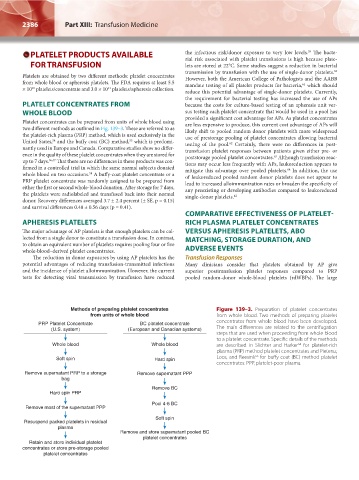
               Platelet concentrates can be prepared from units of whole blood using   provided a significant cost advantage for APs. As platelet concentrates
                                                                      are less expensive to produce, this current cost advantage of APs will
               two different methods as outlined in Fig. 139–3. These are referred to as   likely shift to pooled random donor platelets with more widespread
               the platelet-rich plasma (PRP) method, which is used exclusively in the   use of prestorage pooling of platelet concentrates allowing bacterial
               United States,  and the buffy coat (BC) method,  which is predomi-  testing of the pool.  Certainly, there were no differences in post-
                                                   55
                         54
                                                                                     62
               nantly used in Europe and Canada. Comparative studies show no differ-  transfusion platelet responses between patients given either pre- or
               ence in the quality of these platelet concentrates when they are stored for   poststorage pooled platelet concentrates.  Although transfusion reac-
                                                                                                    63
               up to 7 days. 56,57  That there are no differences in these products was con-  tions may occur less frequently with APs, leukoreduction appears to
               firmed in a controlled trial in which the same normal subjects donated   mitigate this advantage over pooled platelets.  In addition, the use
                                                                                                        64
               whole blood on two occasions.  A buffy-coat platelet concentrate or a   of leukoreduced pooled random donor platelets does not appear to
                                      58
               PRP platelet concentrate was randomly assigned to be prepared from   lead to increased alloimmunization rates or broaden the specificity of
               either the first or second whole-blood donation. After storage for 7 days,   any preexisting or developing antibodies compared to leukoreduced
               the platelets were radiolabeled and transfused back into their normal   single-donor platelets. 42
               donor. Recovery differences averaged 3.7 ± 2.4 percent (± SE, p = 0.15)
               and survival differences 0.48 ± 0.56 days (p = 0.41).
                                                                      COMPARATIVE EFFECTIVENESS OF PLATELET-
               APHERESIS PLATELETS                                    RICH PLASMA PLATELET CONCENTRATES
               The major advantage of AP platelets is that enough platelets can be col-  VERSUS APHERESIS PLATELETS, ABO
               lected from a single donor to constitute a transfusion dose. In contrast,   MATCHING, STORAGE DURATION, AND
               to obtain an equivalent number of platelets requires pooling four or five
               whole-blood–derived platelet concentrates.             ADVERSE EVENTS
                   The reduction in donor exposures by using AP platelets has the   Transfusion Responses
               potential advantages of reducing transfusion-transmitted infections   Many clinicians consider that platelets obtained by AP give
               and the incidence of platelet alloimmunization. However, the current   superior posttransfusion platelet responses compared to PRP
               tests for detecting viral transmission by transfusion have reduced   pooled random-donor whole-blood platelets (rdWBPs). The large


                                Methods of preparing platelet concentrates      Figure 139–3.  Preparation of platelet concentrates
                                      from units of whole blood                 from  whole  blood. Two  methods  of  preparing  platelet
                     PRP Platelet Concentrate          BC platelet concentrate  concentrates from whole blood have been developed.
                         (U.S. system)             (European and Canadian systems)  The main differences are related to the centrifugation
                                                                                steps that are used when proceeding from whole blood
                                                                                to a platelet concentrate. Specific details of the methods
                         Whole blood                       Whole blood          are described in Slichter and Harker  for platelet-rich
                                                                                                            54
                                                                                plasma (PRP) method platelet concentrates and Pietersz,
                                                                                              55
                           Soft spin                        Hard spin           Loos, and Reesink  for buffy coat (BC) method platelet
                                                                                concentrates. PPP, platelet-poor plasma.
                Remove supernatant PRP to a storage   Remove supernatant PPP
                             bag
                                                           Remove BC
                         Hard spin PRP
                                                           Pool 4-6 BC
                Remove most of the supernatant PPP
                                                            Soft spin
                Resuspend packed platelets in residual
                           plasma
                                                Remove and store supernatant pooled BC
                                                        platelet concentrates
                  Retain and store individual platelet
               concentrates or store pre-storage pooled
                      platelet concentrates


          Kaushansky_chapter 139_p2381-2392.indd   2386                                                                 9/18/15   2:22 PM

