


Page 2416 - Williams Hematology ( PDFDrive )
P. 2416
2386  Part XIII:  Transfusion Medicine               Chapter 139:  Preservation and Clinical Use of Platelets        2387


                                                                             1.0
                                                                             0.9
                         1.0                                                 0.8
                         0.9
                      Probability of remaining  event free 0.7            Probability of remaining  event free 0.7
                         0.8
                                                                             0.6
                                                                             0.5
                         0.6
                                                                             0.4
                         0.5
                                                                             0.3
                         0.4
                                                                             0.2
                         0.3
                                                                             0.1
                         0.2
                         0.1
                         0.0                                                 0.0  0  5    10    15    20   25    30    35
                            0     5    10   15    20    25   30    35   B            Time since first platelet transfusion (days)
                     A           Time since first platelet transfusion (days)  No. Patients at Risk
                     No. Patients at risk                               ABO Identical  467  215  78  31  10  3    1
                     Apheresis  552  338  168  68  32   16    4         Minor Mismatch 75  30  8  2    1    1
                     WBP    220  119   56    30   15    5               Major Mismatch 198  72  27  5
                                                   1.0
                                                   0.9
                                                Probability of remaining  event free 0.7
                                                   0.8
                                                   0.6
                                                   0.5
                                                   0.4
                                                   0.3
                                                   0.2
                                                   0.1
                                                   0.0
                                                     0      5     10     15     20    25     30
                                              C            Time since first platelet transfusion (days)
                                               No. Patients at risk
                                                0-2 Days  48  13   5
                                                 3 Days  158  47   16     1
                                                 4 Days  223  69   13     1
                                                 5 Days  221  71   23     4     1      1
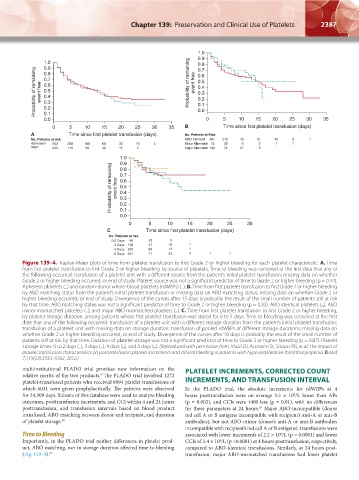
                  Figure 139–4.  Kaplan-Meier plots of time from platelet transfusion to first Grade 2 or higher bleeding for each platelet characteristic. A. Time
                  from first platelet transfusion to first Grade 2 or higher bleeding by source of platelets. Time to bleeding was censored at the first date that any of
                  the following occurred: transfusion of a platelet unit with a different source from the patient’s initial platelet transfusion; missing data on whether
                  Grade 2 or higher bleeding occurred; or end of study. Platelet source was not a significant predictor of time to Grade 2 or higher bleeding (p = 0.44).
                  Apheresis platelets ( ) and random-donor whole-blood platelets (rdWBPs) ( ). B. Time from first platelet transfusion to first Grade 2 or higher bleeding
                  by ABO matching status from the patient’s initial platelet transfusion or missing data on ABO matching status; missing data on whether Grade 2 or
                  higher bleeding occurred; or end of study. Divergence of the curves after 15 days is probably the result of the small number of patients still at risk
                  by that time. ABO matching status was not a significant predictor of time to Grade 2 or higher bleeding (p = 0.33). ABO identical platelets ( ), ABO
                  minor mismatched platelets ( ), and major ABO mismatched platelets ( ). C. Time from first platelet transfusion to first Grade 2 or higher bleeding,
                  by platelet storage duration, among patients whose first platelet transfusion was stored for 0 to 5 days. Time to bleeding was censored at the first
                  date that any of the following occurred: transfusion of a platelet unit with a different storage duration from the patient’s initial platelet transfusion;
                  transfusion of a platelet unit with missing data on storage duration; transfusion of pooled rdWBPs of different storage durations; missing data on
                  whether Grade 2 or higher bleeding occurred; or end of study. Divergence of the curves after 10 days is probably the result of the small number of
                  patients still at risk by that time. Duration of platelet storage was not a significant predictor of time to Grade 2 or higher bleeding (p = 0.87). Platelet
                  storage times: 0 to 2 days ( ), 3 days ( ), 4 days ( ), and 5 days ( ). (Reproduced with permission from Triulzi DJ, Assmann SF, Strauss RG, et al: The impact of
                  platelet transfusion characteristics on posttransfusion platelet increments and clinical bleeding in patients with hypo-proliferative thrombocytopenia. Blood
                  7;119(23):5553–5562, 2012.)
                  multiinstitutional PLADO trial  provides new  information  on the   PLATELET INCREMENTS, CORRECTED COUNT
                  relative merits of the two products.  The PLADO trial involved 1272
                                            6
                  platelet-transfused patients who received 8994 platelet transfusions of   INCREMENTS, AND TRANSFUSION INTERVAL
                  which 6031 were given prophylactically. The patients were observed   In  the  PLADO  trial,  the  absolute  increments  for  rdWBPs  at  4
                  for 24,309 days. Subsets of this database were used to analyze bleeding   hours  posttransfusion  were  on  average  3.5  ×  10 /L  lower  than  APs
                                                                                                             9
                  outcomes, posttransfusion increments, and CCI within 4 and 24 hours   (p = 0.002), and CCIs were 1400 less (p = 0.01), with no differences
                  posttransfusion, and transfusion intervals based on blood product   for these parameters at 24 hours.  Major ABO-incompatible (donor
                                                                                                 65
                  transfused, ABO matching between donor and recipient, and duration   red cell A or B antigens incompatible with recipient’s anti-A or anti-B
                  of platelet storage. 65                               antibodies), but not ABO-minor (donor’s anti-A or anti-B antibodies
                                                                        incompatible with recipient’s red cell A or B antigens), transfusions were
                  Time to Bleeding                                      associated with lower increments of 2.2 × 10 /L (p = 0.0001) and lower
                                                                                                        9
                  Importantly, in the PLADO trial neither differences in platelet prod-  CCIs of 1.4 × 10 /L (p <0.0001) at 4 hours posttransfusion, respectively,
                                                                                    9
                  uct, ABO matching, nor in storage duration affected time to bleeding    compared to ABO-identical transfusions. Similarly, at 24 hours post-
                  (Fig. 139–4). 65                                      transfusion, major ABO-mismatched transfusions had lower platelet


          Kaushansky_chapter 139_p2381-2392.indd   2387                                                                 9/18/15   2:22 PM

