


Page 2413 - Williams Hematology ( PDFDrive )
P. 2413
2384           Part XIII:  Transfusion Medicine                                                                                                                   Chapter 139:  Preservation and Clinical Use of Platelets       2385


               undergoing allogeneic HSCT had at least one episode of Grade 2 or   counts of 100 × 10 /L or greater, the bleeding time averages approxi-
                                                                                    9
                                                                                                               9
               greater bleeding compared to 73 percent of patients undergoing che-  mately 5 minutes. At platelet counts of less than 100 × 10 /L, there is an
               motherapy for hematologic malignancy, and 57 percent of autologous   inverse relationship between platelet count and bleeding time; that is, as
                                                                                                              7
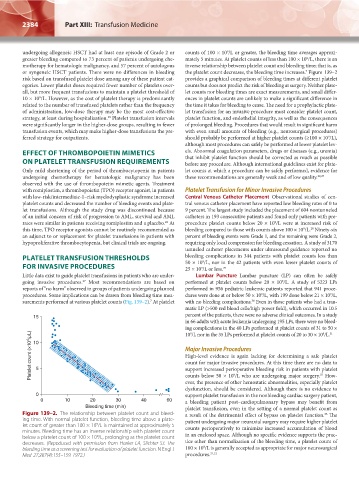
               or syngeneic HSCT patients. There were no differences in bleeding   the platelet count decreases, the bleeding time increases.  Figure  139–2
               risk based on transfused platelet dose among any of these patient cat-  provides a graphical comparison of bleeding times at different platelet
               egories. Lower platelet doses required fewer number of platelets over-  counts but does not predict the risk of bleeding at surgery. Neither plate-
               all, but more frequent transfusions to maintain a platelet threshold of   let counts nor bleeding times are exact measurements, and small differ-
               10 × 10 /L. However, as the cost of platelet therapy is predominantly   ences in platelet counts are unlikely to make a significant difference in
                     9
               related to the number of transfused platelets rather than the frequency   the time it takes for bleeding to cease. The need for a prophylactic plate-
               of administration, low-dose therapy may be the most cost-effective   let transfusion for an invasive procedure must consider platelet count,
               strategy, at least during hospitalization.  Platelet transfusion intervals   platelet function, and endothelial integrity, as well as the consequences
                                            25
               were significantly longer in the higher-dose groups, resulting in fewer   of prolonged bleeding. Procedures that would result in significant harm
               transfusion events, which may make higher-dose transfusions the pre-  with even small amounts of bleeding (e.g., neurosurgical procedures)
               ferred strategy for outpatients.                       should probably be performed at higher platelet counts (≥100 × 10 /L),
                                                                                                                      9
                                                                      although most procedures can safely be performed at lower platelet lev-
               EFFECT OF THROMBOPOIETIN MIMETICS                      els. Abnormal coagulation parameters, drugs or diseases (e.g., uremia)
               ON PLATELET TRANSFUSION REQUIREMENTS                   that inhibit platelet function should be corrected as much as possible
                                                                      before any procedure. Although international guidelines exist for plate-
               Only mild shortening of the period of thrombocytopenia in patients   let counts at which a procedure can be safely performed, evidence for
               undergoing chemotherapy for hematologic malignancy has been   these recommendations are generally weak and of low quality. 22,27
               observed with the use of thrombopoietin mimetic agents. Treatment
               with romiplostim, a thrombopoietin (TPO) receptor agonist, in patients   Platelet Transfusion for Minor Invasive Procedures
               with low-risk/intermediate-1–risk myelodysplastic syndrome increased   Central Venous Catheter Placement  Observational studies of cen-
               platelet counts and decreased the number of bleeding events and plate-  tral venous catheter placement have reported low bleeding rates of 0 to
               let transfusions. Although the study drug was discontinued because   9 percent. The largest study included the placement of 604 nontunneled
               of an initial concern of risk of progression to AML, survival and AML   catheters in 193 consecutive patients and found only patients with pre-
                                                                                                    9
               rates were similar in patients receiving romiplostim and a placebo.  At   procedure platelet counts below 20 × 10 /L were at increased risk of
                                                               26
                                                                                                                28
                                                                                                              9
               this time, TPO receptor agonists cannot be routinely recommended as   bleeding compared to those with counts above 100 × 10 /L.  Ninety-six
               an adjunct to or replacement for platelet transfusions in patients with   percent of bleeding events were Grade 1, and the remaining were Grade 2,
               hypoproliferative thrombocytopenia, but clinical trials are ongoing.  requiring only local compression for bleeding cessation. A study of 3170
                                                                      tunneled catheter placements under ultrasound guidance reported no
               PLATELET TRANSFUSION THRESHOLDS                        bleeding complications in 344 patients with platelet counts less than
                                                                            9
               FOR INVASIVE PROCEDURES                                50 × 10 /L, nor in the 42 patients with even lower platelet counts of
                                                                                   29
                                                                           9
                                                                      25 × 10 /L or less.
               Little data exist to guide platelet transfusions in patients who are under-  Lumbar Puncture  Lumbar puncture (LP) can often be safely
               going invasive procedures.  Most recommendations are based on   performed at platelet counts below 20 × 10 /L. A study of 5223 LPs
                                    27
                                                                                                      9
               reports of “no harm” observed in groups of patients undergoing planned   performed in 956 pediatric leukemic patients reported that 941 proce-
               procedures. Some implications can be drawn from bleeding time mea-  dures were done at or below 50 × 10 /L, with 199 done below 21 × 10 /L,
                                                                                                                       9
                                                                                               9
                                                                                            30
               surements performed at various platelet counts (Fig. 139–2).  At platelet   with no bleeding complications.  Even in those patients who had a trau-
                                                          7
                                                                      matic LP (>500 red blood cells/high power field), which occurred in 10.5
                   15                                                 percent of the patients, there were no adverse clinical outcomes. In a study
                                                                      in 66 adults with acute leukemia undergoing 195 LPs, there were no bleed-
                                                                      ing complications in the 40 LPs performed at platelet counts of 31 to 50 ×
                  Platelet count (×10 4 /µL)  10 5                    Major Invasive Procedures
                                                                        9
                                                                                                                    9
                                                                                                                       31
                                                                      10 /L nor in the 35 LPs performed at platelet counts of 20 to 30 × 10 /L.
                                                                      High-level evidence is again lacking for determining a safe platelet
                                                                      count for major invasive procedures. At this time there are no data to
                                                                      support increased perioperative bleeding risk in patients with platelet
                                                                                      9
                                                                                                                   32
                                                                      counts below 50 × 10 /L who are undergoing major surgery.  How-
                                                                      ever, the presence of other hemostatic abnormalities, especially platelet
                                                                      dysfunction, should be considered. Although there is no evidence to
                    0                                                 support platelet transfusion in the nonbleeding cardiac surgery patient,
                     0        10      20       30      40       60    a bleeding patient post–cardiopulmonary bypass may benefit from
                                     Bleeding time (min)              platelet transfusion, even in the setting of a normal platelet count as
               Figure 139–2.  The relationship between platelet count and bleed-  a result of the detrimental effect of bypass on platelet function.  The
                                                                                                                     33
               ing time. With normal platelet function, bleeding time above a plate-  patient undergoing major neuraxial surgery may require higher platelet
               let count of greater than 100 × 10 /L is maintained at approximately 5   counts  perioperatively  to minimize  increased  accumulation  of  blood
                                        9
               minutes. Bleeding time has an inverse relationship with platelet count   in an enclosed space. Although no specific evidence supports the prac-
                                        9
               below a platelet count of 100 × 10 /L, prolonging as the platelet count
               decreases.  (Repoduced  with  permission  from  Harker  LA,  Slichter  SJ:  The   tice other than normalization of the bleeding time, a platelet count of
                                                                            9
               bleeding time as a screening test for evaluation of platelet function. N Engl J   100 × 10 /L is generally accepted as appropriate for major neurosurgical
               Med  27;287(4):155–159. 1972.)                         procedures. 21,22
          Kaushansky_chapter 139_p2381-2392.indd   2384                                                                 9/18/15   2:22 PM

