


Page 2412 - Williams Hematology ( PDFDrive )
P. 2412
2382  Part XIII:  Transfusion Medicine               Chapter 139:  Preservation and Clinical Use of Platelets        2383


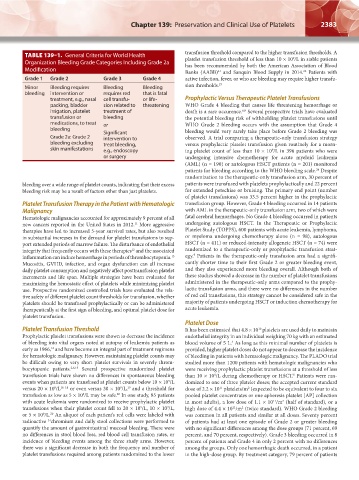
                   TABLE 139–1.  General Criteria for World Health      transfusion threshold compared to the higher transfusion thresholds. A
                                                                        platelet transfusion threshold of less than 10 × 10 /L in stable patients
                                                                                                             9
                     Organization Bleeding Grade Categories Including Grade 2a   has been recommended by both the American Association of Blood
                   Modification                                         Banks (AABB)  and Sanquin Blood Supply in 2014.  Patients with
                                                                                   21
                                                                                                                22
                   Grade 1  Grade 2          Grade 3      Grade 4       active infection, fever, or who are bleeding may require higher transfu-
                   Minor   Bleeding requires   Bleeding   Bleeding      sion thresholds. 23
                   bleeding  intervention or   requires red   that is fatal
                           treatment, e.g., nasal   cell transfu-  or life-   Prophylactic Versus Therapeutic Platelet Transfusions
                           packing, bladder   sion related to   threatening  WHO Grade 4 bleeding that causes life threatening hemorrhage or
                           irrigation, platelet   treatment of          death is a rare occurence.  Several prospective trials have evaluated
                                                                                            6,9
                           transfusion or    bleeding                   the potential bleeding risk of withholding platelet transfusions until
                           medications, to treat   or                   WHO Grade 2 bleeding occurs with the assumption that Grade 4
                           bleeding          Significant                bleeding would very rarely take place before Grade 2 bleeding was
                           Grade 2a: Grade 2   intervention to          observed. A trial comparing a therapeutic-only transfusion strategy
                           bleeding excluding   treat bleeding,         versus prophylactic platelet transfusion given routinely for a morn-
                           skin manifestations  e.g., endoscopy         ing platelet count of less than 10 × 10 /L in 396 patients who were
                                                                                                     9
                                             or surgery                 undergoing intensive chemotherapy for acute myeloid leukemia
                                                                        (AML) (n = 190) or autologous HSCT patients (n = 201) monitored
                                                                        patients for bleeding according to the WHO bleeding scale.  Despite
                                                                                                                    24
                                                                        randomization to the therapeutic-only transfusion arm, 30 percent of
                  bleeding over a wide range of platelet counts, indicating that their excess   patients were transfused with platelets prophylactically and 22 percent
                  bleeding risk may be a result of factors other than just platelets.  for extended petechiae or bruising. The primary end point (number
                                                                        of platelet transfusions) was 33.5 percent higher in the prophylactic
                  Platelet Transfusion Therapy in the Patient with Hematologic   transfusion group. However, Grade 4 bleeding occurred in 14 patients
                  Malignancy                                            with AML in the therapeutic-only transfusion arm, two of which were
                  Hematologic malignancies accounted for approximately 9 percent of all   fatal cerebral hemorrhages. No Grade 4 bleeding occurred in patients
                  new cancers reported in the United States in 2012.  More aggressive   undergoing autologous HSCT. In the Therapeutic or Prophylactic
                                                       11
                  therapies have led to increased 5-year survival rates, but also resulted   Platelet Study (TOPPS), 600 patients with acute leukemia, lymphoma,
                  in substantial increases in the demand for platelet transfusions to sup-  or myeloma undergoing chemotherapy alone (n = 98), autologous
                  port extended periods of marrow failure. The disturbance of endothelial   HSCT (n = 411) or reduced-intensity allogeneic HSCT (n = 74) were
                  integrity that frequently occurs with these therapies  and the associated   randomized to a therapeutic-only or prophylactic transfusion strat-
                                                      12
                                                                           9
                  inflammation can induce hemorrhage in periods of thrombocytopenia.    egy.  Patients in the therapeutic-only transfusion arm had a signifi-
                                                                    13
                  Mucositis, GVHD, infection, and organ dysfunction can all increase   cantly shorter time to their first Grade 2 or greater bleeding event,
                  daily platelet consumption and negatively affect posttransfusion platelet   and they also experienced more bleeding overall. Although both of
                  increments and life span. Multiple strategies have been evaluated for   these studies showed a decrease in the number of platelet transfusions
                  maximizing the hemostatic effect of platelets while minimizing platelet   administered in the therapeutic-only arms compared to the prophy-
                  use. Prospective randomized controlled trials have evaluated the rela-  lactic transfusion arms, and there were no differences in the number
                  tive safety of different platelet count thresholds for transfusion, whether   of red cell transfusions, this strategy cannot be considered safe in the
                  platelets should be transfused prophylactically or can be administered   majority of patients undergoing HSCT or induction chemotherapy for
                  therapeutically at the first sign of bleeding, and optimal platelet dose for   acute leukemia.
                  platelet transfusion.
                                                                        Platelet Dose
                  Platelet Transfusion Threshold                        It has been estimated that 4.8 × 10  platelets are used daily to maintain
                                                                                                 10
                  Prophylactic platelet transfusions were shown to decrease the incidence   endothelial integrity in an individual weighing 70 kg with an estimated
                  of bleeding into vital organs noted at autopsy of leukemia patients as   blood volume of 5 L.  As long as this minimal number of platelets is
                                                                                        3
                  early as 1966,  and have become an integral part of treatment regimens   provided, higher platelet doses do not appear to decrease the incidence
                           14
                  for hematologic malignancy. However, maintaining platelet counts may   of bleeding in patients with hematologic malignancy. The PLADO trial
                  be difficult owing to very short platelet survivals in severely throm-  studied more than 1200 patients with hematologic malignancies who
                  bocytopenic patients. 2,6,15  Several prospective randomized platelet   were receiving prophylactic platelet transfusions at a threshold of less
                  transfusion trials have shown no differences in spontaneous bleeding   than 10 × 10 /L during chemotherapy or HSCT.  Patients were ran-
                                                                                                             6
                                                                                  9
                  events when patients are transfused at platelet counts below 10 × 10 /L   domized to one of three platelet doses; the accepted current standard
                                                                   9
                  versus 20 × 10 /L 16–18  or even versus 30 × 10 /L,  and a threshold for   dose of 2.2 × 10  platelets/m  (expected to be equivalent to four to six
                             9
                                                   9
                                                                                             2
                                                                                    11
                                                     19
                  transfusion as low as 5 × 10 /L may be safe.  In one study, 85 patients   pooled platelet concentrates or one apheresis platelet [AP] collection
                                      9
                                                 20
                  with acute leukemia were randomized to receive prophylactic platelet   in most adults), a low dose of 1.1 × 10 /m  (half of standard), or a
                                                                                                      11
                                                                                                         2
                  transfusions when their platelet count fell to 20 × 10 /L, 10 × 10 /L,   high dose of 4.4 × 10 /m  (twice standard). WHO Grade 2 bleeding
                                                                                        11
                                                                                           2
                                                         9
                                                                  9
                  or 5 × 10 /L.  An aliquot of each patient’s red cells were labeled with   was common in all patients and similar at all doses. Seventy percent
                         9
                           20
                  radioactive  chromium and daily stool collections were performed to   of patients had at least one episode of Grade 2 or greater bleeding
                          51
                  quantify the amount of gastrointestinal mucosal bleeding. There were   with no significant differences among the dose groups (71 percent, 69
                  no differences in stool blood loss, red blood cell transfusion rates, or   percent, and 70 percent, respectively). Grade 3 bleeding occurred in 8
                  incidence of bleeding events among the three study arms. However,   percent of patients and Grade 4 in only 2 percent with no differences
                  there was a significant decrease in both the frequency and number of   among the groups. Only one hemorrhagic death occurred, in a patient
                  platelet transfusions required among patients randomized to the lower   in the high-dose group. By treatment category, 79 percent of patients
          Kaushansky_chapter 139_p2381-2392.indd   2383                                                                 9/18/15   2:22 PM

