


Page 368 - Williams Hematology ( PDFDrive )
P. 368
342  Part V:  Therapeutic Principles        Chapter 22:  Pharmacology and  Toxicity of  Antineoplastic Drugs          343


                                                                                                297
                  (including nuclear factor [NF]-κB, caspase inhibitors, and Bcl-2 fam-  load”), such as immunoglobulins.  It is not yet determined, if this con-
                  ily members). 284–287  The composite outcome of these events is an irre-  cept also applies to mantle cell lymphoma.
                                                         285
                  versible commitment of myeloma cells to apoptosis,  as well as the   The safety profile of both bortezomib and carfilzomib includes
                  sensitization of myeloma cells to diverse established agents (e.g., alky-  thrombocytopenia, possibly reflecting a requirement for constitutive
                  lator, 287,288   anthracyclines, 287,289   and  thalidomide  derivatives)  or  inves-  proteasome activity in platelets to degrade the apoptosis regulator,
                                                 287
                                                                                                      298
                  tigational agents such as HDAC inhibitors . As a result, bortezomib   Bax, and preserve their normal life span.  Unlike bortezomib, carfil-
                  has been a key component of diverse antimyeloma combination regi-  zomib does not cause peripheral neuropathy, but cardiopulmonary side
                  mens.  However, patients eventually develop resistance to bortezomib   effects (e.g., dyspnea, hypoxemia, pulmonary hypertension) and serum
                      290
                                                                                                       292
                  or experience sensory peripheral neuropathy,  the main dose-limiting   creatinine elevations have been reported.  These differences may be
                                                  291
                  toxicity for this drug. Carfilzomib and other second-generation protea-  explained by reports that bortezomib, but not carfilzomib, also inhibits
                  some inhibitors were thus developed to circumvent these limitations. In   the neuroprotective molecule, Htra2/Omi,  and blocks a number of
                                                                                                       299
                  2012, carfilzomib received FDA accelerated approval for the treatment   serum proteases, including cathepsin G and cathepsin A, which may
                  of myeloma patients relapsed and refractory to bortezomib and at least   contribute to renal injury. 300–302 ; inhibition of proteases may contribute
                  one thalidomide derivative.  The observation that carfilzomib can be   to renal injury.  The mechanistic basis for cardiopulmonary adverse
                                      292
                                                                                   303
                  active in some bortezomib-refractory cases has been attributed to the   events with proteasome inhibition remains under investigation.
                  fact that new proteasomes must be synthesized to fully restore protea-  The clinical activity of bortezomib and carfilzomib, as well as the
                  some capacity in cells treated with this irreversible inhibitor. However,   promising early studies with additional second-generation proteasome
                  the reversible-versus-irreversible nature of a proteasome inhibitor may   inhibitors, has validated the notion that pathways for intracellular regu-
                  not be the only determinant of its clinical activity; for example, another   lation of protein homeostasis represent an important therapeutic target
                  second-generation proteasome inhibitor in clinical trials, MLN2238,   for plasma cell dyscrasias, mantle cell lymphoma, and potentially other
                  and its clinically administered prodrug, ixazomib (MLN9708), exhibit   neoplasias.
                         293
                  preclinical  and clinical activity in bortezomib-resistant cells, despite
                  reversible binding to β5. 294
                     Despite  the  important  role  of  the  proteasome  for  normal  cells,     THERAPEUTIC MONOCLONAL
                  the administration of bortezomib and carfilzomib is associated with a   ANTIBODIES
                  clinically meaningful therapeutic window, likely because the clinically
                  achievable levels of these agents do not completely shut down the chy-  Monoclonal antibodies are an important class of agents for the treat-
                  motrypsin-like activity  of the proteasome and also spare its other   ment of hematologic malignancies. As a group, lymphoid cells express a
                                   295
                                                 296
                  proteolytic (trypsin-like and caspase-like)  activities. Consequently,   variety of antigens that are attractive targets for monoclonal-based ther-
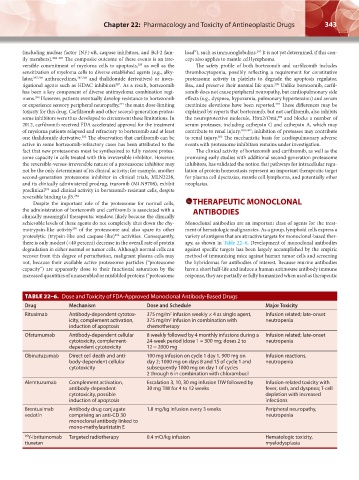
                  there is only modest (<40 percent) decrease in the overall rate of protein   apy, as shown in Table 22–6. Development of monoclonal antibodies
                  degradation in either normal or tumor cells. Although normal cells can   against specific targets has been largely accomplished by the empiric
                  recover from this degree of perturbation, malignant plasma cells may   method of immunizing mice against human tumor cells and screening
                  not, because their available active proteasome particles (“proteasome   the hybridomas for antibodies of interest. Because murine antibodies
                  capacity”) are apparently close to their functional saturation by the   have a short half-life and induce a human antimouse antibody immune
                  increased quantities of unassembled or misfolded proteins (“proteasome   response, they are partially or fully humanized when used as therapeutic


                   TABLE 22–6.  Dose and Toxicity of FDA-Approved Monoclonal Antibody-Based Drugs
                   Drug          Mechanism                  Dose and Schedule                      Major Toxicity
                   Rituximab     Antibody-dependent cytotox-  375 mg/m  infusion weekly × 4 as single agent,   Infusion related; late-onset
                                                                   2
                                 icity, complement activation,   375 mg/m  infusion in combination with   neutropenia
                                                                   2
                                 induction of apoptosis     chemotherapy
                   Ofatumumab    Antibody-dependent cellular   8 weekly followed by 4 monthly infusions during a   Infusion related; late-onset
                                 cytotoxicity, complement-   24-week period (dose 1 = 300 mg; doses 2 to    neutropenia
                                 dependent cytotoxicity     12 = 2000 mg
                   Obinutuzumab  Direct cell death and anti-  100 mg infusion on cycle 1 day 1, 900 mg on    Infusion reactions,
                                 body-dependent cellular    day 2; 1000 mg on days 8 and 15 of cycle 1 and   neutropenia
                                 cytotoxicity               subsequently 1000 mg on day 1 of cycles
                                                            2 through 6 in combination with chlorambucil
                   Alemtuzumab   Complement activation,     Escalation 3, 10, 30 mg infusion TIW followed by    Infusion-related toxicity with
                                   antibody-dependent       30 mg TIW for 4 to 12 weeks            fever, rash, and dyspnea; T-cell
                                   cytotoxicity, possible                                          depletion with increased
                                 induction of apoptosis                                            infections
                   Brentuximab   Antibody drug conjugate    1.8 mg/kg infusion every 3 weeks       Peripheral neuropathy,
                   vedotin       comprising an anti-CD 30                                          neutropenia
                                 monoclonal antibody linked to
                                 mono-methylauristatin E
                   90 Y-ibritumomab   Targeted radiotherapy  0.4 mCi/kg infusion                   Hematologic toxicity,
                   tiuxetan                                                                        myelodysplasia


          Kaushansky_chapter 22_p0313-0352.indd   343                                                                   9/18/15   10:26 PM

