


Page 371 - Williams Hematology ( PDFDrive )
P. 371
346            Part V:  Therapeutic Principles                                                                                                          Chapter 22:  Pharmacology and  Toxicity of  Antineoplastic Drugs           347


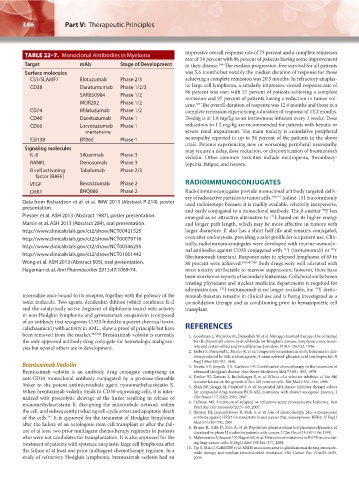
                TABLE 22–7.  Monoclonal Antibodies in Myeloma         impressive overall response rate of 75 percent and a complete remission
                                                                      rate of 34 percent with 96 percent of patients having some improvement
                Target             mAb          Stage of Development  in their disease.  The median progression-free survival for all patients
                                                                                 346
                Surface molecules                                     was 5.6 months but notably the median duration of response for those
                  CS1/SLAMF7       Elotuzumab   Phase 2/3             achieving a complete remission was 20.5 months. In refractory anaplas-
                  CD38             Daratumumab   Phase 1/2/3          tic large cell lymphoma, a similarly impressive overall response rate of
                                   SAR650984    Phase 1/2             86 percent was seen with 57 percent of patients achieving a complete
                                                                      remission and 97 percent of patients having a reduction in tumor vol-
                                   MOR202       Phase 1/2             ume.  The overall duration of response was 12.6 months and those in a
                                                                          307
                  CD74             Milatuzumab  Phase 1/2             complete remission experiencing a duration of response of 13.2 months.
                  CD40             Dacetuzumab  Phase 1               Dosing is at 1.8 mg/kg as an intravenous infusion every 3 weeks. Dose
                  CD56             Lorvotuzumab   Phase 1             reductions to 1.2 mg/kg are recommended for patients with hepatic or
                                     mertansine                       severe renal impairment. The main toxicity is cumulative peripheral
                  CD138            BT062        Phase 1               neuropathy reported in up to 54 percent of the patients in the above
                                                                      trials. Patients experiencing new or worsening peripheral neuropathy
                Signaling molecules                                   may require a delay, dose reduction, or discontinuation of brentuximab
                  IL-6             Siltuximab   Phase 3               vedotin. Other common toxicities include neutropenia, thrombocy-
                  RANKL            Denosumab    Phase 3               topenia, fatigue, and nausea.
                   B cell activating    Tabalumab  Phase 2/3
                    factor (BAFF)
                  VEGF             Bevacizumab  Phase 2               RADIOIMMUNOCONJUGATES
                  DKK1             BHQ880       Phase 2               Radioimmunoconjugates provide monoclonal antibody targeted deliv-
                                                                      ery of radioactive particles to tumor cells. 306,347  Iodine-131 is a commonly
               Data from Richardson et al. et al. IMW 2013 (Abstract P-214), poster   used radioisotope because it is readily available, relatively inexpensive,
               presentation.                                          and easily conjugated to a monoclonal antibody. The β-emitter  Y has
                                                                                                                    90
               Plesner et al. ASH 2013 (Abstract 1987), poster presentation.  emerged as an attractive alternative to  I, based on its higher energy
                                                                                                  131
               Martin et al. ASH 2013 (Abstract 284), oral presentation.  and longer path length, which may be more effective in tumors with
               http://www.clinicaltrials.gov/ct2/show/NCT00421525     larger diameters. It also has a short half-life and remains conjugated,
               http://www.clinicaltrials.gov/ct2/show/NCT00079716     even after endocytosis, providing a safer profile for outpatient use. Clin-
               http://www.clinicaltrials.gov/ct2/show/NCT00346255     ically, radioimmunoconjugates were developed with murine monoclo-
                                                                      nal antibodies against CD20 conjugated with  I (tositumomab) or  Y
                                                                                                       131
                                                                                                                       90
               http://www.clinicaltrials.gov/ct2/show/NCT01001442     (ibritumomab tiuxetan). Response rates in relapsed lymphoma of 65 to
               Wong et al. ASH 2013 (Abstract 505), oral presentation.  80 percent were achieved. 306,347,348  Both drugs were well tolerated with
               Hageman et al. Ann Pharmacother 2013;47:1069-74.       most toxicity attributable to marrow suppression; however, there have
                                                                      been worrisome reports of secondary leukemias. Collaboration between
                                                                      treating physicians and nuclear medicine departments is required for
                                                                      administration.  I tositumomab is no longer available, but  Y ibritu-
                                                                                  131
                                                                                                                  90
               internalize once bound to its receptor, together with the potency of the   momab tiuxetan remains in clinical use and is being investigated as a
               toxin molecule. Two agents, denileukin diftitox (which combines IL-2   consolidation therapy and as conditioning prior to hematopoietic cell
               and the catalytically active fragment of diphtheria toxin) with activity   transplant.
               in non-Hodgkin lymphoma and gemtuzumab ozogamicin (composed
               of an antibody that recognizes CD33 linked to a potent chemical toxin,
               calicheamicin) with activity in AML, show a proof of principle but have   REFERENCES
               been removed from the market. 343,344  Brentuximab vedotin is currently     1.  Goodman L, Wintrobe M, Dameshek W, et al: Nitrogen mustard therapy: Use of methyl
               the only approved antibody drug conjugate for hematologic malignan-  bis (B-chlorethyl) amino hydrochloride for Hodgkin’s disease, lymphosarcoma, leuke-
               cies but several others are in development.               mia and certain allied and miscellaneous disorders. JAMA 126:132, 1946.
                                                                        2.  Farber S, Diamond L, Mercer R, et al: Temporary remissions in acute leukemia in chil-
                                                                         dren produced by folic acid antagonist, 4-aminopteroyl-glutamic acid (aminopterin). N
                                                                         Engl J Med 238:787, 1948.
               Brentuximab Vedotin                                      3.  Devita VT, Serpick AA, Carbone PP: Combination chemotherapy in the treatment of
               Brentuximab vedotin is an antibody drug conjugate comprising an   advanced Hodgkin’s disease. Ann Intern MedIntern Med 73:881–895, 1970.
               anti-CD30  monoclonal  antibody  conjugated  by  a  protease-cleavable     4.  Druker BJ, Tamura S, Buchdunger E, et al: Effects of a selective inhibitor of the Abl
                                                                         tyrosine kinase on the growth of Bcr-Abl positive cells. Nat Med 2:561–566, 1996.
               linker to the potent antimicrotubule agent monomethylauristatin E.     5.  Shah NP, Skaggs BJ, Branford S, et al: Sequential ABL kinase inhibitor therapy selects
               When brentuximab vedotin binds to CD30-expressing cells, it is inter-  for compound drug-resistant BCR-ABL mutations with altered oncogenic potency. J
               nalized  with proteolytic cleavage  of the  linker resulting in  release  of   Clin Invest 117:2562–2569, 2007.
               monomethylauristatin E, disrupting the microtubule network within     6.  Tallman MS: Treatment of relapsed or refractory acute promyelocytic leukemia. Best
                                                                         Pract Res Clin Haematol 20:57–65, 2007.
               the cell, and subsequently inducing cell-cycle arrest and apoptotic death     7.  Slamon DJ, Leyland-Jones B, Shak S, et al: Use of chemotherapy plus a monoclonal
               of the cells.  It is approved for the treatment of Hodgkin lymphoma   antibody against HER2 for metastatic breast cancer that overexpresses HER2. N Engl J
                        345
               after the failure of an autologous stem cell transplant or after the fail-  Med 344:783–792, 2001.
               ure of at least two prior multiagent chemotherapy regimens in patients     8.  Bruno R, Hille D, Riva A, et al: Population pharmacokinetics/pharmacodynamics of
                                                                         docetaxel in phase II studies in patients with cancer. J Clin Oncol 16:187–196, 1998.
               who were not candidates for transplantation. It is also approved for the     9.  Maheswaran S, Sequist LV, Nagrath S, et al: Detection of mutations in EGFR in circulat-
               treatment of patients with systemic anaplastic large cell lymphoma after   ing lung-cancer cells. N Engl J Med 359:366–377, 2008.
               the failure of at least one prior multiagent chemotherapy regimen. In a     10.  Yip S, Miao J, Cahill DP, et al: MSH6 mutations arise in glioblastomas during temozolo-
                                                                         mide therapy and mediate temozolomide resistance. Clin Cancer Res 15:4622–4629,
               study of refractory Hodgkin lymphoma, brentuximab vedotin had an   2009.


          Kaushansky_chapter 22_p0313-0352.indd   346                                                                   9/18/15   10:26 PM

