


Page 370 - Williams Hematology ( PDFDrive )
P. 370
344  Part V:  Therapeutic Principles        Chapter 22:  Pharmacology and  Toxicity of  Antineoplastic Drugs          345


                  the treatment of patients with previously untreated CLL. This approval   have received purine analogues. 336,337  Patients should receive antibiotic
                  was based on a phase III, 781-person trial with three arms comparing   prophylaxis against Pneumocystis carinii and herpes virus during treat-
                  single-agent chlorambucil versus chlorambucil plus rituximab versus   ment. Serious infections with cytomegalovirus are seen and monitoring
                  chlorambucil plus obinutuzumab.  A  main feature  of this trial  was   is recommended. Alemtuzumab in combination with chemotherapy
                                           333
                  that it enrolled mainly older patients (median age: 73 years) with mul-  has been explored in the treatment of T-cell lymphomas but trials were
                  tiple medical comorbidities representative of the majority of patients   limited by significant infectious complications. 338
                  diagnosed with CLL. The median progression-free survival was greatly
                  improved in obinutuzumab plus chlorambucil arm at 26.7 months ver-  Elotuzumab, Daratumumab, and Others
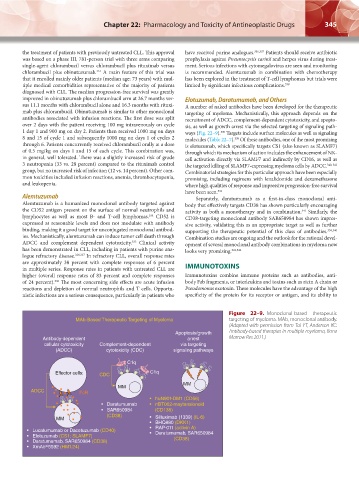
                  sus 11.1 months with chlorambucil alone and 16.3 months with rituxi-  A number of naked antibodies have been developed for the therapeutic
                  mab plus chlorambucil. Obinutuzumab is similar to other monoclonal   targeting  of myeloma. Mechanistically, this  approach  depends  on the
                  antibodies associated with infusion reactions. The first dose was split   recruitment of ADCC, complement-dependent cytotoxicity, and apopto-
                  over 2 days with the patient receiving 100 mg intravenously on cycle   sis, as well as growth arrest via the selected targeting of signaling path-
                  1 day 1 and 900 mg on day 2. Patients then received 1000 mg on days   ways (Fig. 22–9).  Targets include surface molecules as well as signaling
                                                                                    339
                  8 and 15 of cycle 1 and subsequently 1000 mg on days 1 of cycles 2   molecules (Table 22–7).  Of these antibodies, one of the most promising
                                                                                         339
                  through 6. Patients concurrently received chlorambucil orally at a dose   is elotuzumab, which specifically targets CS1 (also known as SLAMF7)
                  of 0.5 mg/kg on days 1 and 15 of each cycle. This combination was,   through which its mechanism of action includes the enhancement of NK-
                  in general, well tolerated. There was a slightly increased risk of grade   cell activation directly via SLAMF7 and indirectly by CD16, as well as
                  3 neutropenia (33 vs. 28 percent) compared to the rituximab control   the targeted killing of SLAMF7-expressing myeloma cells by ADCC. 340, 341
                  group, but no increased risk of infection (12 vs. 14 percent). Other com-  Combinatorial strategies for this particular approach have been especially
                  mon toxicities included infusion reactions, anemia, thrombocytopenia,   promising, including regimens with lenalidomide and dexamethasone
                  and leukopenia.                                       where high qualities of response and impressive progression-free survival
                                                                        have been seen. 341
                  Alemtuzumab                                               Separately, daratumumab as a first-in-class monoclonal anti-
                  Alemtuzumab is a humanized monoclonal antibody targeted against   body that effectively targets CD38 has shown particularly encouraging
                  the CD52 antigen present on the surface of normal neutrophils and   activity  as  both  a  monotherapy  and  in  combination.   Similarly,  the
                                                                                                               342
                  lymphocytes  as  well  as  most  B-  and  T-cell  lymphomas.   CD52  is   CD38-targeting monoclonal antibody SAR650984 has shown impres-
                                                            334
                  expressed at reasonable levels and does not modulate with antibody   sive activity, validating this as an appropriate target as well as further
                  binding, making it a good target for unconjugated monoclonal antibod-  supporting the therapeutic potential of this class of antibodies. 339,340
                  ies. Mechanistically, alemtuzumab can induce tumor cell death through   Combination studies are ongoing and the outlook for the rational devel-
                  ADCC and complement dependent cytotoxicity.  Clinical activity   opment of several monoclonal antibody combinations in myeloma now
                                                       335
                  has been demonstrated in CLL, including in patients with purine ana-  looks very promising. 341,342
                  logue refractory disease. 336,337  In refractory CLL, overall response rates
                  are  approximately  38  percent  with complete  responses  of  6  percent
                  in multiple series. Response rates in patients with untreated CLL are   IMMUNOTOXINS
                  higher (overall response rates of 83 percent and complete responses   Immunotoxins combine immune proteins such as antibodies, anti-
                             336
                  of 24 percent).  The most concerning side effects are acute infusion   body Fab fragments, or interleukins and toxins such as ricin A chain or
                  reactions and depletion of normal neutrophils and T cells. Opportu-  Pseudomonas exotoxin. These molecules have the advantage of the high
                  nistic infections are a serious consequence, particularly in patients who   specificity of the protein for its receptor or antigen, and its ability to

                                                                                       Figure 22–9.  Monoclonal-based therapeutic
                                    MAb-Based Therapeutic Targeting of Myeloma         targeting of myeloma. MAb, monoclonal antibody.
                                                                                       (Adapted with permission from Tai YT, Anderson KC:
                                                                     Apoptosis/growth  Antibody-based therapies in multiple myeloma, Bone
                         Antibody-dependent                              arrest        Marrow Res 2011.)
                         cellular cytotoxicity  Complement-dependent   via targeting
                             (ADCC)           cytotoxicity (CDC)    signaling pathways

                                                     C1q
                             Effector cells:  CDC            C1q
                                                                        MM
                                                  MM
                     ADCC            FcR
                                                            •   huN901-DM1 (CD56)
                                            •   Daratumumab  •   nBT062-maytansionoid
                                            •   SAR650984       (CD138)
                                                (CD38)      •   Siltuximab (1339) (IL-6)
                             MM
                                                            •   BHQ880 (DKK1)
                                                            •   RAP-011 (activin A)
                   •   Lucatumumab or Dacetuzumab (CD40)    •   Daratumumab, SAR650984
                   •   Elotuzumab (CS1; SLAMF7)                      (CD38)
                   •   Daratumumab, SAR650984 (CD38)

                   •   XmAb 5592 (HM1.24)


          Kaushansky_chapter 22_p0313-0352.indd   345                                                                   9/18/15   10:26 PM

