


Page 435 - Williams Hematology ( PDFDrive )
P. 435
410            Part V:  Therapeutic Principles                                                                                                                                        Chapter 26:  Immune Cell Therapy             411


                   CD4+ Th cells are required for optimal CD8+ CTL responses and   for controlling CMV infection after HSCT. However, the isolation
               may eliminate CMV-infected cells that express class II MHC in vivo.   and propagation of antigen-specific T-cell clones requires specific
               Studies using recombinant CMV proteins or peptide panels have identi-  expertise and is time-consuming. Culture methods for enrichment
               fied CD4+ T-cell responses to pp65, IE-1, glycoprotein B, and the major   of polyclonal CMV-specific T cells circumvent prolonged  ex vivo
               capsid protein (UL86) in normal CMV+ individuals. 10,24,25  manipulation and T-cell expansion and enabled broader application
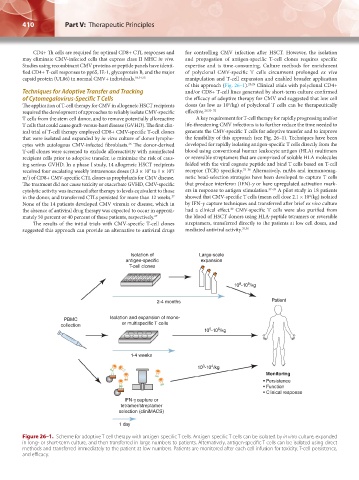
                                                                      of this approach (Fig. 26–1). 28,29  Clinical trials with polyclonal CD4+
               Techniques for Adoptive Transfer and Tracking          and/or CD8+ T-cell lines generated by short-term culture confirmed
               of Cytomegalovirus-Specific T Cells                    the efficacy of adoptive therapy for CMV and suggested that low cell
                                                                                     5
               The application of T-cell therapy for CMV in allogeneic HSCT recipients   doses (as low as 10 /kg) of polyclonal T cells can be therapeutically
               required the development of approaches to reliably isolate CMV-specific   effective. 28,30–32
               T cells from the stem cell donor, and to remove potentially alloreactive   A key requirement for T-cell therapy for rapidly progressing and/or
               T cells that could cause graft-versus-host disease (GVHD). The first clin-  life-threatening CMV infections is to further reduce the time needed to
               ical trial of T-cell therapy employed CD8+ CMV-specific T-cell clones   generate the CMV-specific T cells for adoptive transfer and to improve
               that were isolated and expanded by in vitro culture of donor lympho-  the feasibility of this approach (see Fig. 26–1). Techniques have been
                                                   26
               cytes with autologous CMV-infected fibroblasts.  The donor-derived   developed for rapidly isolating antigen-specific T cells directly from the
               T-cell clones were screened to exclude alloreactivity with noninfected   blood using conventional human leukocyte antigen (HLA) multimers
               recipient cells prior to adoptive transfer, to minimize the risk of caus-  or reversible streptamers that are comprised of soluble HLA molecules
               ing serious GVHD. In a phase I study, 14 allogeneic HSCT recipients   folded with the viral cognate peptide and bind T cells based on T-cell
                                                          7
                                                                 9
               received four escalating weekly intravenous doses (3.3 × 10  to 1 × 10 /  receptor (TCR) specificity. 33–36  Alternatively, mAbs and immunomag-
                 2
               m ) of CD8+ CMV-specific CTL clones as prophylaxis for CMV disease.   netic bead-selection strategies have been developed to capture T cells
               The treatment did not cause toxicity or exacerbate GVHD, CMV-specific   that produce interferon (IFN)-γ or have upregulated activation mark-
               cytolytic activity was increased after therapy to levels equivalent to those   ers in response to antigen stimulation. 37–39  A pilot study in 18 patients
                                                                                                                4
                                                                 27
               in the donor, and transferred CTLs persisted for more than 12 weeks.    showed that CMV-specific T cells (mean cell dose 2.1 × 10 /kg) isolated
               None of the 14 patients developed CMV viremia or disease, which in   by IFN-γ capture techniques and transferred after brief ex vivo culture
                                                                                     40
               the absence of antiviral drug therapy was expected to occur in approxi-  had a clinical effect.  CMV-specific T cells were also purified from
               mately 50 percent or 40 percent of these patients, respectively. 27  the blood of HSCT donors using HLA-peptide tetramers or reversible
                   The results of the initial trials with CMV-specific T-cell clones   streptamers, transferred directly to the patients at low cell doses, and
               suggested this approach can provide an alternative to antiviral drugs   mediated antiviral activity. 35,36

                                                    Isolation of           Large-scale
                                                  antigen-specific         expansion
                                                   T-cell clones


                                                                                           9
                                                                                        8
                                                                                      10 -10 /kg
                                                            2-4 months                             Patient

                             PBMC            Isolation and expansion of mono-
                            collection           or multispecific T cells
                                                                                 6
                                                                              5
                                                                            10 -10 /kg

                                                    1-4 weeks
                                                                            3
                                                                               4
                                                                          10 -10 /kg
                                                                                                 Monitoring
                                                                                                • Persistence
                                                                                                • Function
                                                                                                • Clinical response
                                                  IFN-γ capture or
                                                tetramer/streptamer
                                                selection (cliniMACS)
                                                1 day

               Figure 26–1.  Scheme for adoptive T-cell therapy with antigen-specific T cells. Antigen-specific T cells can be isolated by in vitro culture, expanded
               in long- or short-term culture, and then transferred in large numbers to patients. Alternatively, antigen-specific T cells can be isolated using direct
               methods and transferred immediately to the patient at low numbers. Patients are monitored after each cell infusion for toxicity, T-cell persistence,
               and efficacy.


          Kaushansky_chapter 26_p0409-0420.indd   410                                                                   9/17/15   6:01 PM

