


Page 437 - Williams Hematology ( PDFDrive )
P. 437
412            Part V:  Therapeutic Principles                                                                                                                                        Chapter 26:  Immune Cell Therapy             413


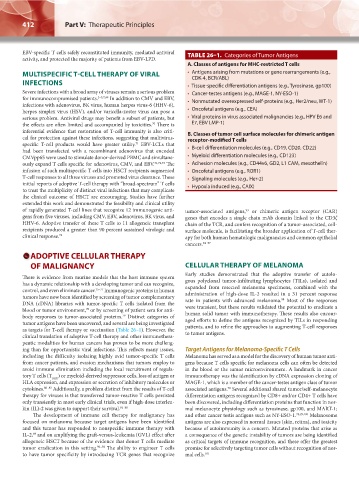
               EBV-specific T cells safely reconstituted immunity, mediated antiviral   TABLE 26–1.  Categories of Tumor Antigens
               activity, and protected the majority of patients from EBV-LPD.
                                                                       A. Classes of antigens for MHC-restricted T cells
               MULTISPECIFIC T-CELL THERAPY OF VIRAL                   •   Antigens arising from mutations or gene rearrangements (e.g.,
                                                                        CDK-4, BCR/ABL)
               INFECTIONS                                              •   Tissue-specific differentiation antigens (e.g., Tyrosinase, gp100)
               Severe infections with a broad array of viruses remain a serious problem   •   Cancer-testes antigens (e.g., MAGE-1, NY-ESO-1)
               for immunocompromised patients. 2–5,7,69  In addition to CMV and EBV,   •   Nonmutated overexpressed self-proteins (e.g., Her2/neu, WT-1)
               infections with adenovirus, BK virus, human herpes virus-6 (HHV-6),
               herpes simplex virus (HSV), and/or varicella-zoster virus can pose a   •   Oncofetal antigens (e.g., CEA)
               serious problem. Antiviral drugs may benefit a subset of patients, but   •   Viral proteins in virus associated malignancies (e.g., HPV E6 and
                                                           70
               the effects are often limited and accompanied by toxicities.  There is   E7, EBV LMP-1)
               inferential evidence that restoration of T-cell immunity is also criti-  B. Classes of tumor cell surface molecules for chimeric antigen
               cal for protection against these infections, suggesting that multivirus-   receptor-modified T cells
                                                     71
               specific T-cell products would have greater utility.  EBV-LCLs that
               had been transfected with a recombinant adenovirus that encoded   •   B-cell differentiation molecules (e.g., CD19, CD20, CD22)
               CMVpp65 were used to stimulate donor-derived PBMC and simultane-  •   Myeloid differentiation molecules (e.g., CD123)
               ously expand T cells specific for adenovirus, CMV, and EBV. 31,72,73  The   •   Adhesion molecules (e.g., CD44v6, GD2, L1 CAM, mesothelin)
               infusion of such multispecific T cells into HSCT recipients augmented   •   Oncofetal antigens (e.g., ROR1)
               T-cell responses to all three viruses and promoted virus clearance. These   •   Signaling molecules (e.g., Her-2)
               initial reports of adoptive T-cell therapy with “broad-spectrum” T cells   •   Hypoxia induced (e.g., CAIX)
               to treat the multiplicity of distinct viral infections that may complicate
               the clinical outcome of HSCT are encouraging. Studies have further
               extended this work and demonstrated the feasibility and clinical utility
               of rapidly generated T-cell lines that recognize 12 immunogenic anti-  tumor-associated antigens,  or chimeric antigen receptor (CAR)
                                                                                          93
               gens from five viruses, including CMV, EBV, adenovirus, BK virus, and   genes that encodes a single chain mAb domain linked to the CD3ζ
               HHV-6. Adoptive transfer of these T cells to 11 allogeneic transplant   chain of the TCR, and confers recognition of a tumor-associated, cell-
               recipients produced a greater than 90 percent sustained virologic and   surface molecule, is facilitating the broader application of T-cell ther-
               clinical response. 74                                  apy for both human hematologic malignancies and common epithelial
                                                                      cancers. 94–97
                     ADOPTIVE CELLULAR THERAPY
                  OF MALIGNANCY                                       CELLULAR THERAPY OF MELANOMA
                                                                      Early studies demonstrated that the adoptive transfer of autolo-
               There is evidence from murine models that the host immune system   gous polyclonal tumor-infiltrating lymphocytes (TILs), isolated and
               has a dynamic relationship with a developing tumor and can recognize,   expanded from resected melanoma specimens, combined with the
               control, and even eliminate cancer. 75–77  Immunogenic proteins in human   administration of high-dose IL-2 resulted in a 31 percent response
               tumors have now been identified by screening of tumor complementary   rate in patients with advanced melanoma.  Most of the responses
                                                                                                      98
               DNA (cDNA) libraries with tumor-specific T cells isolated from the   were transient, but these results validated the potential to eradicate a
               blood or tumor environment,  or by screening of patient sera for anti-  human solid tumor with immunotherapy. These results also encour-
                                     78
                                                 79
               body responses to tumor-associated proteins.  Distinct categories of   aged efforts to define the antigens recognized by TILs in responding
               tumor antigens have been uncovered, and several are being investigated   patients, and to refine the approaches to augmenting T-cell responses
               as targets for T-cell therapy or vaccination (Table 26–1). However, the   to tumor antigens.
               clinical translation of adoptive T-cell therapy and other immunothera-
               peutic modalities for human cancers has proven to be more challeng-
               ing than for opportunistic viral infections. This reflects many issues,   Target Antigens for Melanoma-Specific T Cells
               including the difficulty isolating highly avid tumor-specific T cells   Melanoma has served as a model for the discovery of human tumor anti-
               from cancer patients, and evasion mechanisms that tumors employ to   gens because T cells specific for melanoma cells can often be detected
               avoid immune elimination including the local recruitment of regula-  in the blood or the tumor microenvironment. A landmark in cancer
               tory T cells (T REG ) or myeloid-derived suppressor cells, loss of antigen or   immunotherapy was the identification by cDNA expression cloning of
               HLA expression, and expression or secretion of inhibitory molecules or   MAGE-1, which is a member of the cancer-testes antigen class of tumor
               cytokines. 80–83  Additionally, a problem distinct from the results of T-cell   associated antigens.  Several additional shared tumor/self-melanocyte
                                                                                    78
               therapy for viruses is that transferred tumor-reactive T cells persisted   differentiation antigens recognized by CD8+ and/or CD4+ T cells have
               only transiently in most early clinical trials, even if high-dose interleu-  been discovered, including differentiation proteins that function in nor-
               kin (IL)-2 was given to support their survival. 84–88  mal melanocyte physiology such as tyrosinase, gp100, and MART-1;
                   The development of immune cell therapy for malignancy has   and other cancer testis antigens such as NY-ESO-1. 78,99,100  Melanosome
               focused on melanoma because target antigens have been identified   antigens are also expressed in normal tissues (skin, retina), and toxicity
               and this tumor has responded to nonspecific immune therapy with   because of autoimmunity is a concern. Mutated proteins that arise as
               IL-2,  and on amplifying the graft-versus-leukemia (GVL) effect after   a consequence of the genetic instability of tumors are being identified
                   89
               allogeneic HSCT because of the evidence that donor T cells mediate   as critical targets of immune recognition, and these offer the greatest
               tumor eradication in this setting. 90–92  The ability to engineer T cells   promise for selectively targeting tumor cells without recognition of nor-
               to have tumor specificity by introducing TCR genes that recognize   mal cells. 101


          Kaushansky_chapter 26_p0409-0420.indd   412                                                                   9/17/15   6:01 PM

