


Page 439 - Williams Hematology ( PDFDrive )
P. 439
414            Part V:  Therapeutic Principles                                                                                                                                        Chapter 26:  Immune Cell Therapy             415


               engraftment of human leukemia in nonobese diabetic/severe combined   CTL selectively lysed leukemic blasts and prevented engraftment of
               immunodeficiency mice, providing evidence that the leukemic stem cell   leukemia in immunodeficient mice, suggesting that these T cells may
               can be recognized by allogeneic T cells. 126           mediate an antileukemic effect without affecting normal hematopoie-
                   Most mHAgs result from nonsynonymous single nucleotide poly-  sis in vivo. 140,144  Recent work has identified WT-1–specific T cells after
               morphisms (SNPs) in the coding sequence of donor and recipient genes   HLA-identical sibling HSCT and correlated these cells with a GVL
                                                                          145
               that alter the HLA binding or TCR contact of HLA-bound peptides.   effect.  In a recent pilot trial, 11 high-risk leukemia patients received
                                                                                                 146
               There are several million SNPs with an allele frequency of greater than   infusions of WT-1–specific T cells.  In four of these patients, the
               5 percent in the human genome, including approximately 50,000 SNPs   infused T cells were generated in the presence of IL-21, which mod-
                                              127
               that lead to amino acid changes in proteins.  Identification of the poly-  ulates the differentiation of T cells in culture. The transferred T cells
               morphic genes that encode mHAgs is facilitated by the data on genetic   exhibited evidence of leukemic activity, and CTL that were generated
               variation from the human HapMap project, which has enabled the use   with IL-21 had superior antileukemic activity and survived long-term
               of whole-genome association analysis for mHAg discovery in addition   as memory T cells.  Additional study in a larger number of patients is
                                                                                    146
                                                     123
               to conventional techniques for antigen discovery.  Identifying the   needed, but these results offer a potential safe and effective treatment for
               subset of mHAgs that will be the most useful to target to augment the   patients with limited treatment options.
               GVL effect requires consideration of several factors, including the allele
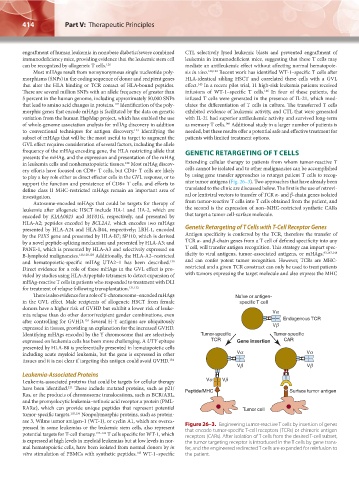
               frequency of the mHAg encoding gene, the HLA restricting allele that   GENETIC RETARGETING OF T CELLS
               presents the mHAg, and the expression and presentation of the mHAg
                                                  128
               in leukemia cells and nonhematopoietic tissues.  Most mHAg discov-  Extending cellular therapy to patients from whom tumor-reactive T
               ery efforts have focused on CD8+ T cells, but CD4+ T cells are likely   cells cannot be isolated and to other malignancies can be accomplished
               to play a key role either as direct effector cells in the GVL response, or to   by using gene transfer approaches to retarget patient T cells to recog-
               support the function and persistence of CD8+ T cells, and efforts to   nize tumor antigens (Fig. 26–3). Two approaches that have already been
               define class II MHC-restricted mHAgs remain an important area of   translated to the clinic are discussed below. The first is the use of retrovi-
               investigation.                                         ral or lentiviral vectors to transfer of TCR α- and β-chain genes isolated
                   Autosome-encoded mHAgs that could be targets for therapy of   from tumor-reactive T cells into T cells obtained from the patient, and
               leukemia after allogeneic HSCT include HA-1 and HA-2, which are   the second is the expression of non–MHC-restricted synthetic CARs
               encoded by  KIAA0023 and  MY01G, respectively, and presented by   that target a tumor cell-surface molecule.
               HLA-A2; peptides encoded by  BCL2A1, which encodes two mHAgs
               presented by HLA-A24 and HLA-B44, respectively; LRH-1, encoded   Genetic Retargeting of T Cells with T-Cell Receptor Genes
               by the P2X5 gene and presented by HLA-B7; SP110, which is derived   Antigen specificity is conferred by the TCR, therefore the transfer of
               by a novel peptide-splicing mechanism and presented by HLA-A3; and   TCR α- and β-chain genes from a T cell of defined specificity into any
               PANE-1, which is presented by HLA-A3 and selectively expressed on   T cell, will transfer antigen recognition. This strategy can impart spec-
               B-lymphoid malignancies. 123,128,129  Additionally, the HLA-A2–restricted   ificity to viral antigens, tumor-associated antigens, or mHAgs, 93,147,148
               and hematopoietic-specific mHAg UTA2–1 has been described.    and  can  confer  potent  tumor  recognition.  However,  TCRs  are  MHC-
                                                                 130
               Direct evidence for a role of these mHAgs in the GVL effect is pro-  restricted and a given TCR construct can only be used to treat patients
               vided by studies using HLA-A/peptide tetramers to detect expansion of   with tumors expressing the target molecule and also express the MHC
               mHAg-reactive T cells in patients who responded to treatment with DLI
               for treatment of relapse following transplantation. 131,132
                   There is also evidence for a role of Y-chromosome–encoded mHAgs     Naïve or antigen-
               in the GVL effect. Male recipients of allogeneic HSCT from female        specific T cell
               donors have a higher risk of GVHD but exhibit a lower risk of leuke-
               mia relapse than do other donor/recipient gender combinations, even                 Va
                                    133
               after controlling for GVHD.  Several H-Y antigens are ubiquitously                      Endogenous TCR
               expressed in tissues, providing an explanation for the increased GVHD.              Vb
               Identifying mHAgs encoded by the Y chromosome that are selectively   Tumor-specific  Tumor-specific
               expressed on leukemia cells has been more challenging. A UTY epitope   TCR  Gene insertion  CAR
               presented by HLA-B8 is preferentially presented in hematopoietic cells
               including acute myeloid leukemia, but the gene is expressed in other    Va                      Va
               tissues and it is not clear if targeting this antigen could avoid GVHD. 134
                                                                                       Vb                      Vb
               Leukemia-Associated Proteins
               Leukemia-associated proteins that could be targets for cellular therapy   Va  Vb
                               121
               have been identified.  These include mutated proteins, such as p21/  Peptide/MHC          Surface tumor antigen
               Ras, or the products of chromosome translocations, such as BCR/ABL,
               and the promyelocytic leukemia–retinoic acid receptor α protein (PML-
               RARα), which can provide unique peptides that represent potential         Tumor cell
               tumor-specific targets. 135,136  Nonpolymorphic proteins, such as protein-
               ase 3, Wilms tumor antigen-1 (WT-1), or cyclin A1, which are overex-
               pressed in some leukemias or the leukemic stem cells, also represent   Figure 26–3.  Engineering tumor-reactive T cells by insertion of genes
                                                                      that encode tumor-specific T-cell receptors (TCRs) or chimeric antigen
               potential targets for T-cell therapy. 137–142  T cells specific for WT-1, which   receptors (CARs). After isolation of T cells from the desired T-cell subset,
               is expressed at high levels in myeloid leukemias but at low levels in nor-  the tumor targeting receptor is introduced in the T cells by gene trans-
               mal hematopoietic cells, have been isolated from normal donors by in   fer, and the engineered redirected T cells are expanded for reinfusion to
                                                      143
               vitro stimulation of PBMCs with synthetic peptides.  WT-1–specific   the patient.


          Kaushansky_chapter 26_p0409-0420.indd   414                                                                   9/17/15   6:01 PM

