


Page 436 - Williams Hematology ( PDFDrive )
P. 436
410  Part V:  Therapeutic Principles                                      Chapter 26:  Immune Cell Therapy            411


                     Transferred T cells must persist as functional memory T cells and   T-CELL THERAPY OF EPSTEIN-BARR
                  migrate to sites of virus replication to be effective. Therefore, it was   VIRUS INFECTION
                  essential to verify the presence of the transferred T cells in the blood
                  based on functional or structural properties. In the initial studies of   EBV is a ubiquitous γ-herpesvirus (Chap. 82) that persists in immuno-
                  adoptive therapy with CD8+ CMV-specific T-cell clones, assays of cyto-  competent hosts lifelong without causing disease. Some latently infected
                  lytic activity provided an indirect semiquantitative functional measure   B cells express only the EBNA-1 protein, which has glycine-alanine
                  for the presence of the transferred immune effectors.  New approaches   repeats that inhibit its translation and processing for presentation to
                                                        27
                                                                                   55
                  that use flow cytometric  analysis of  blood samples  have been devel-  CD8+ T cells.  Infected B cells may activate the latency III program
                  oped, such as staining with HLA multimers or intracellular staining, to   of viral genes that includes EBNA-1, EBNA-2, EBNA-3A, EBNA-3B,
                  detect cytokines produced after antigen stimulation. These techniques   EBNA-3C, LMP-1, LMP-2A, and LMP-2B, and induces cell prolifera-
                                                                            56
                  are being employed to enumerate and analyze the function of cells on a   tion.  In normal hosts, both the CD8+ CTL and CD4+ Th cell response
                  single-cell level. 11,34  The unique DNA sequences of the rearranged TCR   to EBV infection is mainly directed against lytic viral proteins and the
                  Vα or Vβ genes have also been used to evaluate survival of transferred T   EBNA-3A, -3B, and -3C latency proteins. 57,58  The CD4+ Th cell response
                                                       27
                  cells in the first trial of CMV-specific T-cell therapy.  Quantitative real-  may also contribute to eliminating class II MHC+ EBV-infected cells in
                                                                           58
                  time polymerase chain reaction with TCR-specific primers that flank   vivo  and EBV-specific CD8+ and CD4+ T cells cooperate to prevent
                  the unique complementarity determining region 3 (CDR3) sequence   the outgrowth of EBV+ B cells in immunocompetent hosts. 59,60  Thus,
                  can provide precise quantitation of transferred T cells in blood samples.   tumors comprised of proliferating EBV+ B cells can arise in individuals
                  Advances in high-throughput sequencing and computational analysis   with a T-cell deficiency, such as solid-organ or HSCT patients receiv-
                  of the TCR sequences have now enabled much more sensitive analy-  ing intense immunosuppression, especially if T-cell depletion is used as
                  sis and sequencing of the CDR3 and detection of unique sequences in   part of the conditioning regimen. 61,62  Historically, patients with EBV-
                  transferred T cells. 36,41,42                         induced lymphoproliferative disease (EBV-LPD) had a grave prognosis,
                                                                        responding poorly to antiviral drugs or chemotherapy, although early
                                                                        detection of EBV reactivation and treatment with mAbs specific for
                  Selection of Defined Subsets of Cytomegalovirus-Specific     CD20 have improved outcomes.  Ultimately, restoration of EBV-specific
                                                                                               63
                  T cells for Adoptive Therapy                          T cells is necessary for control of the virus.
                  The pool of memory T cells contains both CD45RO+CD62L+ cen-
                  tral memory (T ), and CD62L– effector memory (T ) subsets that
                             CM
                                                         EM
                  differ in phenotype,  function, and  migration. 43–45  Studies in  animal   Techniques for Isolation and Adoptive Transfer
                  models have revealed profound differences in the ability of adop-  of Epstein-Barr Virus–Specific T Cells
                  tively transferred T cells from distinct subsets to persist in vivo and   The efficacy of T-cell therapy for EBV-LPD was first demonstrated in a
                  revert to the memory pool. The transfer of effector cells derived from   study in which a low dose of unselected donor lymphocytes was admin-
                  CD8+CD62L+ T  or a rare subset of CD62L+ cells termed memory   istered to five patients with EBV-LPD after T-cell–depleted allogeneic
                              CM
                                                                                                                          64
                  stem cells (T SCM ) that share cell-surface markers of both naïve T cell   HSCT. Complete resolution of EBV-LPD was achieved in all patients,
                  (T ) and T  cells, displayed superior survival in vivo, and/or medi-  but this was complicated by GVHD and two patients developed a
                          CM
                    N
                  ated superior antitumor activity compared with more differentiated   fatal  respiratory failure,  demonstrating  the importance of  select-
                                                                                                   64
                  T . 46–49  Studies in mice provide increasing evidence for a progressive   ing EBV-specific T cells for therapy.  The adoptive transfer of donor
                   EM
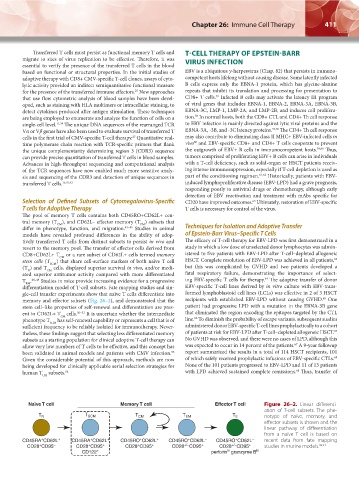
                  differentiation model of T-cell subsets. Fate mapping studies and sin-  EBV-specific T-cell lines derived by in vitro culture with EBV-trans-
                  gle-cell transfer experiments show that naïve T cells differentiate into   formed lymphoblastoid cell lines (LCLs) was effective in 2 of 3 HSCT
                                                                                                                       65
                  memory and effector subsets (Fig. 26–2), and demonstrated that the   recipients with established EBV-LPD without causing GVHD.  One
                  stem cell–like properties of self-renewal and differentiation are pres-  patient had progressive LPD with a mutation in the EBNA-3B gene
                  ent in CD62L+ T CM  cells. 50–52  It is uncertain whether the intermediate   that eliminated the region encoding the epitopes targeted by the CTL
                                                                           66
                  phenotype T SCM  has self-renewal capability or represents a cell that is of   line.  To diminish the probability of escape variants, subsequent studies
                  sufficient frequency to be reliably isolated for immunotherapy. Never-  administered donor EBV-specific T-cell lines prophylactically to a cohort
                                                                                                                          67
                  theless, these findings suggest that selecting less differentiated memory   of patients at risk for EBV-LPD after T-cell–depleted allogeneic HSCT.
                  subsets as a starting population for clinical adoptive T-cell therapy can   No GVHD was observed, and there were no cases of LPD, although this
                                                                                                             67
                  allow very low numbers of T cells to be effective, and this concept has   was expected to occur in 14 percent of the patients.  A 9-year followup
                                                                    53
                  been validated in animal models and patients with CMV infection.    report summarized the results in a total of 114 HSCT recipients, 101
                                                                                                                          68
                  Given the considerable potential of this approach, methods are now   of which safely received prophylactic infusions of EBV-specific CTLs.
                  being developed for clinically applicable serial selection strategies for   None of the 101 patients progressed to EBV-LPD and 11 of 13 patients
                                                                                                              68
                  human T  subsets. 54                                  with LPD achieved sustained complete remissions.  Thus, transfer of
                        CM
                    Naïve T cell                   Memory T cell                  Effector T cell  Figure 26–2.  Linear differenti-
                                                                                                   ation of  T-cell subsets.  The phe-
                       T N             T SCM            T CM            T EM            T E        notype  of  naïve, memory,  and
                                                                                                   effector subsets is shown and the
                                                                                                   linear pathway of differentiation
                                                                                                   from a naïve  T cell is based on
                                                                                         +
                                                                         +
                                         +
                                                         +
                        +
                  CD45RA CD62L +  CD45RA CD62L +   CD45RO CD62L +  CD45RO CD62L –  CD45RO CD62L –  recent data from fate mapping
                       +
                                                        +
                                        +
                   CD28 CD95 –      CD28 CD95 +     CD28 CD95 +     CD28 +/– CD95 +  CD28 +/– CD95 +  studies in murine models. 50,51
                                                                                       hi
                                      CD122 +                                    perforin granzyme B hi
          Kaushansky_chapter 26_p0409-0420.indd   411                                                                   9/17/15   6:01 PM

