


Page 440 - Williams Hematology ( PDFDrive )
P. 440
414  Part V:  Therapeutic Principles                                      Chapter 26:  Immune Cell Therapy            415


                  restricting allele. Moreover, it can be difficult to achieve the same surface   V H  V H
                  level of TCR expression in transduced T cells as observed in the parental   Recognition
                  T-cell clone from which the TCR genes were isolated. This problem was   module  V L  V L  Variable spacer
                  apparent in the first clinical trial in which MART-1 TCR-engineered T   Transmembrane
                  cells were used to treat melanoma and the low TCR expression likely   region
                  contributed in part to the limited antitumor activity of the TCR-modified              CD28, 4-1BB, OX40
                       149
                  T cells.  Another problem is that the TCR transfer endows T cells   Signaling module/
                                                                                 costimulation
                  with additional rearranged TCR chains, leading to T cells that could                   CD3z
                  potentially express four different TCR molecules on the cell surface: the
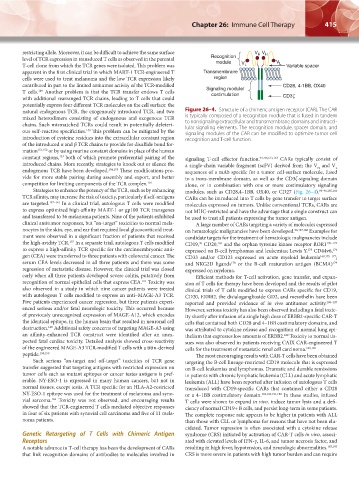
                  natural endogenous TCR, the exogenously introduced TCR, and two   Figure 26–4.  Structure of a chimeric antigen receptor (CAR). The CAR
                  mixed heterodimers consisting of endogenous and exogenous TCR   is typically composed of a recognition module that is fused in tandem
                  chains. Such mismatched TCRs could result in potentially deleteri-  to nonsignaling extracellular and transmembrane domains and intracel-
                                                                        lular signaling elements. The recognition module, spacer domain, and
                                       150
                  ous self-reactive specificities.  This problem can be mitigated by the   signaling modules of the CAR can be modified to optimize tumor cell
                  introduction of cysteine residues into the extracellular constant region   recognition and T-cell function.
                  of the introduced α and β TCR chains to provide for disulfide bond for-
                  mation 151,152  or by using murine constant domains in place of the human
                  constant regions,  both of which promote preferential pairing of the   signaling T-cell effector function. 94–96,163,164  CARs typically consist of
                              153
                  introduced chains. More recently, strategies to knock out or silence the   a single-chain variable fragment (scFV) derived from the V  and V
                                                                                                                     H
                                                                                                                           L
                  endogenous TCR have been developed. 154,155  These modifications pro-  sequences of a mAb specific for a tumor cell-surface molecule, fused
                  vide for more stable pairing during assembly and export, and better   to a trans-membrane domain, as well as the CD3ζ-signaling domain
                  competition for limiting components of the TCR complex. 156  alone, or in combination with one or more costimulatory signaling
                     Strategies to enhance the potency of the TCR, such as by enhancing   modules,  such as  CD28,4–1BB, OX40, or  CD27  (Fig.  26–4). 94–96,165,166
                  TCR affinity, may increase the risk of toxicity, particularly if self-antigens   CARs can be introduced into T cells by gene transfer to target surface
                  are targeted. 157–161  In a clinical trial, autologous T cells were modified   molecules expressed on tumors. Unlike conventional TCRs, CARs are
                  to express optimized high-affinity MART-1 or gp100 TCR transgenes   not MHC-restricted and have the advantage that a single construct can
                  and transferred to 36 melanoma patients. Nine of the patients exhibited   be used to treat all patients expressing the tumor antigen.
                  clinical antitumor responses, but “on-target” toxicities to normal mela-  A large number of CARs targeting a variety of molecules expressed
                  nocytes in the skin, eye, and ear that required local glucocorticoid treat-  on hematologic malignancies have been developed. 96,167,168  Examples for
                  ment were observed in a significant fraction of patients that received   candidate targets for the treatment of hematologic malignancies include
                  the high-avidity TCR.  In a separate trial, autologous T cells modified   CD19,  CD20,  and the orphan tyrosine kinase receptor ROR1 170–172
                                  157
                                                                             96
                                                                                   169
                  to express a high-affinity TCR specific for the carcinoembryonic anti-  expressed on B-cell lymphomas and leukemias; Lewis Y,  CD44v6,
                                                                                                                 173
                                                                                                                          174
                  gen (CEA) were transferred to three patients with colorectal cancer. The   CD33  and/or CD123 expressed on  acute myeloid  leukemia 168,175–177 ;
                  serum CEA levels decreased in all three patients and there was some   and NKG2D ligands  or the B-cell maturation antigen (BCMA)
                                                                                                                          179
                                                                                        178
                  regression of metastatic disease. However, the clinical trial was closed   expressed on myeloma.
                  early when all three patients developed severe colitis, putatively from   Efficient methods for T-cell activation, gene transfer, and expan-
                  recognition of normal epithelial cells that express CEA.  Toxicity was   sion of T cells for therapy have been developed and the results of pilot
                                                          161
                  also observed in a study in which nine cancer patients were treated   clinical trials of T cells modified to express CARs specific for CD19,
                  with autologous T cells modified to express an anti–MAGE-A3 TCR.   CD20, ERBB2, the disialoganglioside GD2, and mesothelin have been
                  Five patients experienced cancer regression, but three patients experi-  reported  and  provided  evidence  of  in vivo  antitumor  activity. 180–187
                  enced serious and/or fatal neurologic toxicity. This occurred because   However, serious toxicity has also been observed including a fatal toxic-
                  of previously unrecognized expression of MAGE-A12, which encodes   ity shortly after infusion of a single high dose of ERBB2-specific CAR-T
                  the identical epitope, in the human brain that resulted in neuronal cell   cells that contained both CD28 and 4–1BB costimulatory domains, and
                          160
                  destruction.  Additional safety concerns of targeting MAGE-A3 using   was attributed to cytokine release and recognition of normal lung epi-
                  an affinity-enhanced TCR construct were identified after an unex-  thelium that expresses low amounts of ERBB2.  Toxicity to normal tis-
                                                                                                          188
                  pected fatal cardiac toxicity. Detailed analysis showed cross-reactivity   sues was also observed in patients receiving CAIX CAR-engineered T
                  of the engineered MAGE-A3 TCR-modified T cells with a titin-derived   cells for the treatment of metastatic renal cell carcinoma. 189,190
                  peptide. 158,159                                          The most encouraging results with CAR-T cells have been obtained
                     Such serious “on-target and off-target” toxicities of TCR gene   targeting the B-cell lineage-restricted CD19 molecule that is expressed
                  transfer suggested that targeting antigens with restricted expression on   on B-cell leukemias and lymphomas. Dramatic and durable remissions
                  tumor cells such as mutant epitopes or cancer testes antigens is pref-  in patients with chronic lymphatic leukemia (CLL) and acute lymphatic
                  erable. NY-ESO-1 is expressed in many human cancers, but not in   leukemia (ALL) have been reported after infusion of autologous T cells
                  normal tissues, except testis. A TCR specific for an HLA-A2-restricted   transduced with CD19-specific CARs that contained either a CD28
                  NY-ESO-1 epitope was used for the treatment of melanoma and syno-  or a 4–1BB costimulatory domain. 182,183,191,192  In these studies, infused
                            162
                  vial sarcoma.  Toxicity was not observed, and encouraging results   T cells were shown to expand in vivo, induce tumor lysis and a defi-
                  showed that the TCR-engineered T cells mediated objective responses   ciency of normal CD19+ B cells, and persist long-term in some patients.
                  in four of six patients with synovial cell carcinoma and five of 11 mela-  The complete response rate appears to be higher in patients with ALL
                  noma patients.                                        than those with CLL or lymphoma for reasons that have not been elu-
                                                                        cidated. Tumor regression is often associated with a cytokine release
                  Genetic Retargeting of T Cells with Chimeric Antigen   syndrome (CRS) initiated by activation of CAR-T cells in vivo, associ-
                  Receptors                                             ated with elevated levels of IFN-γ, IL-6, and tumor necrosis factor, and
                  A notable advance in T-cell therapy has been the development of CARs   resulting in high fever, hypotension, and neurologic abnormalities. 183,193
                  that link recognition domains of antibodies to molecules involved in   CRS is more severe in patients with high tumor burden and can require


          Kaushansky_chapter 26_p0409-0420.indd   415                                                                   9/17/15   6:01 PM

