


Page 513 - Williams Hematology ( PDFDrive )
P. 513
488            Part VI:  The Erythrocyte                                                                                                                                                     Chapter 32:  Erythropoiesis           489


               by the report that the pivotal transcription factors for erythropoiesis,   59 Fe plasma clearance  59 Fe RBC utilization
               GATA-1 and NFE-2, directly regulate and control differentiation via                 Erythroid hypoplasia
               miRNA-199b-5p. This miRNA then targets c-Kit, an important recep-                   Erythroid ineffectiveness
               tor on early erythroid cells.  Some miRNAs likely play a role in the   10          100
                                    144
               commitment to erythroid versus megakaryocytic differentiation. Thus,
               miRNA-18a  was reported to be upregulated during  erythropoiesis   8                            Normal
               and downregulated during megakaryopoiesis, while miRNA-145 was   6                  80           range
               upregulated in megakaryopoiesis and downregulated in erythropoie-       Normal
               sis. Their mRNA targets and their functional significance are being   4  range      60
                     145
               defined.  LIN28B and its targeted let-7 have regulated expression   CPM x factor  Percent uptake
                                                    146
               during the fetal-to-adult erythroid cell transition.  Another impor-                40
               tant erythroid development and function is regulated by miRNA-351.   2
               A complex regulatory transcriptional repressor system controlling                   20
               heterochromatin formation exists composed of KRAB-ZFP–mediated
               repression that include cofactor KAP1 (KRAB-associated protein-1).   1               0
               Deletion of KAP1 in mice upregulates miRNA-351 and several other   0  306090 120150   0    7 Days 14  21
                                                                                   Minutes
               microRNAs, which then downregulate Nix and mitochondrial autoph-
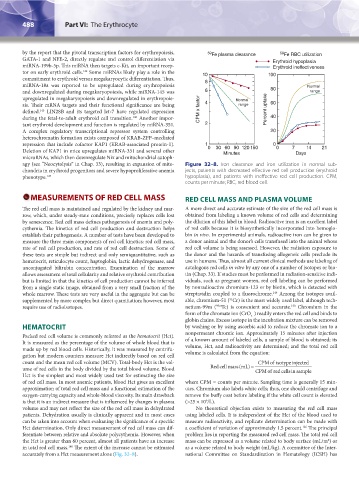
               agy (see “Neocytolysis” in Chap. 33), resulting in expansion of mito-  Figure 32–8.  Iron clearance and iron utilization in normal sub-
               chondria in erythroid progenitors and severe hypoproliferative anemia   jects, patients with decreased effective red cell production (erythroid
               phenotype. 147                                         hypoplasia), and patients with ineffective red cell production. CPM,
                                                                      counts per minute; RBC, red blood cell.
                  MEASUREMENTS OF RED CELL MASS                       RED CELL MASS AND PLASMA VOLUME

               The red cell mass is maintained and regulated by the kidney and mar-  A more direct and accurate estimate of the size of the red cell mass is
               row, which, under steady-state conditions, precisely replaces cells lost   obtained from labeling a known volume of red cells and determining
               by senescence. Red cell mass defines pathogenesis of anemia and poly-  the dilution of this label in blood. Radioactive iron is an excellent label
               cythemia. The kinetics of red cell production and destruction helps   of red cells because it is biosynthetically incorporated into hemoglo-
               establish their pathogenesis. A number of tests have been developed to   bin in vivo. In experimental animals, radioactive iron can be given to
               measure the three main components of red cell kinetics: red cell mass,   a donor animal and the donor’s cells transfused into the animal whose
               rate of red cell production, and rate of red cell destruction. Some of   red cell volume is being assessed. However, the radiation exposure to
               these tests are simple but indirect and only semiquantitative, such as   the donor and the hazards of transfusing allogeneic cells preclude its
               hematocrit, reticulocyte count, haptoglobin, lactic dehydrogenase, and   use in humans. Thus, almost all current clinical methods use labeling of
               unconjugated  bilirubin  concentration.  Examination  of  the  marrow   autologous red cells in vitro by any one of a number of isotopes or bio-
               allows assessment of total cellularity and relative erythroid contribution   tin (Chap. 33). If studies must be performed in radiation-sensitive indi-
               but is limited in that the kinetics of cell production cannot be inferred   viduals, such as pregnant women, red cell labeling can be performed
               from a single static image, obtained from a very small fraction of the   by nonradioactive chromium-123 or by biotin, which is detected with
               whole marrow. These tests are very useful in the aggregate but can be   streptavidin coupled to a fluorochrome.  Among the isotopes avail-
                                                                                                   149
               supplemented by more complex but direct quantitation; however, most   able, chromium-51 ( Cr) is the most widely used label, although tech-
                                                                                     51
                                                                                                          150
                                                                                99m
               require use of radioisotopes.                          netium-99m ( Tc) is convenient and accurate.  Chromium in the
                                                                      form of the chromate ion (CrO ) readily enters the red cell and binds to
                                                                                             −
                                                                                            2
                                                                      globin chains. Excess isotope in the incubation mixture can be removed
               HEMATOCRIT                                             by washing or by using ascorbic acid to reduce the chromate ion to a
               Packed red cell volume is commonly referred as the hematocrit (Hct).   nonpermeant chromic ion. Approximately 15 minutes after injection
               It is measured as the percentage of the volume of whole blood that is   of a known amount of labeled cells, a sample of blood is obtained; its
               made up by red blood cells. Historically, it was measured by centrifu-  volume, Hct, and radioactivity are determined; and the total red cell
               gation but modern counters measure Hct indirectly based on red cell   volume is calculated from the equation:
               count and the mean red cell volume (MCV). Total-body Hct is the vol-           CPMofisotypeinjected
               ume of red cells in the body divided by the total blood volume. Blood   Redcellmass(mL)=  CPMofred cellsin sample
               Hct is the simplest and most widely used test for estimating the size
               of red cell mass. In most anemic patients, blood Hct gives an excellent   where CPM = counts per minute. Sampling time is generally 15 min-
               approximation of total red cell mass and a functional estimation of the   utes. Chromium also labels white cells; thus, one should centrifuge and
               oxygen-carrying capacity and whole-blood viscosity. Its main drawback   remove the buffy coat before labeling if the white cell count is elevated
               is that it is an indirect measure that is influenced by changes in plasma   (>25 × 10 /L).
                                                                             9
               volume and may not reflect the size of the red cell mass in dehydrated   No theoretical objection exists to measuring the red cell mass
               patients. Dehydration usually is clinically apparent and in most cases   using labeled cells. It is independent of the Hct of the blood used to
               can be taken into account when evaluating the significance of a specific   measure radioactivity, and replicate determination can be made with
               Hct determination. Only direct measurement of red cell mass can dif-  a coefficient of variation of approximately 1.5 percent.  The principal
                                                                                                             126
               ferentiate between relative and absolute polycythemia. However, when   problem lies in reporting the measured red cell mass. The total red cell
               the Hct is greater than 60 percent, almost all patients have an increase   mass can be expressed as a volume related to body surface (mL/m ) or
                                                                                                                      2
               in total red cell mass.  The extent of the increase cannot be estimated   as a volume related to body weight (mL/kg). A committee of the Inter-
                               148
               accurately from a Hct measurement alone (Fig. 32–8).   national Committee on Standardization in Hematology (ICSH) has


          Kaushansky_chapter 32_p0479-0494.indd   488                                                                   9/17/15   6:11 PM

