


Page 515 - Williams Hematology ( PDFDrive )
P. 515
490            Part VI:  The Erythrocyte                                                                                                                                                     Chapter 32:  Erythropoiesis           491


               Equation 2                                             The ratio is only an approximation of total erythroid activity because
                                                                      the ratio can be altered by changing the myeloid and erythroid compo-
                                          corrected reticulocyte%
                         Reticulocyteindex=                           nents, and an aspirate or biopsy of a small segment of the marrow may
                                        correctionfactor(usually 2)   not always reflect total marrow activity. These assumptions are valid as
                                                                      long as the marrow reflects the steady-state, if the marrow is recovering
                   Accordingly, the corrected reticulocyte percent may give an erro-  from aplasia, or is developing aplasia, it will not accurately reflect out-
               neous impression of the actual rate of daily red cell production. To take   put of mature red cells. However, when used in conjunction with deter-
               this situation into account when estimating the rate of red cell pro-  mination of red blood cell count and reticulocyte count, under most
               duction in anemic patients with high reticulocyte counts, dividing the   circumstances the ratio provides qualitative information about the rate
               corrected reticulocyte percent by a factor may provide a more accurate   and effectiveness of red blood cell production. A more accurate quan-
               estimate of red cell production.  For simplicity, an average factor of    titation of total erythropoiesis can be made by measuring the rate of
                                       156
               2 often is used; however, the factor depends on the degree of anemia:     production of red cells (ferrokinetics) or, in steady-state conditions, the
               1.5 in mild cases, 2.5 in moderate cases, and 3.0 in severe cases.  rate of destruction of red cells (red cell life span, bilirubin production,
                   An example follows: A patient with autoimmune hemolytic ane-  carbon monoxide excretion).
               mia has a Hct of 10 and reticulocyte count of 70 percent. The marrow
               cannot increase production by 70-fold. To measure the approximate
               true increase, we calculate the reticulocyte index as follows: corrected   FERROKINETICS
                                                                                           158
               reticulocyte percent = 70 × 10/45 = 15, and the reticulocyte index =   In 1950, Huff and associates  described a method for measuring the
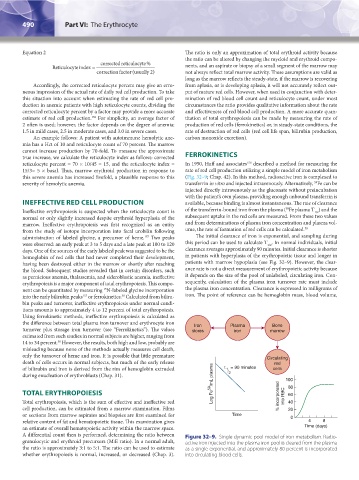
               15/3= 5 × basal. Thus, marrow erythroid production in response to   rate of red cell production utilizing a simple model of iron metabolism
               this severe anemia has increased fivefold, a plausible response to this    (Fig. 32–9; Chap. 42). In this method, radioactive iron is complexed to
               severity of hemolytic anemia.                          transferrin in vitro and injected intravenously. Alternatively,  Fe can be
                                                                                                                 59
                                                                      injected directly intravenously as the gluconate without preincubation
                                                                      with the patient’s own plasma, providing enough unbound transferrin is
               INEFFECTIVE RED CELL PRODUCTION                        available, because binding is almost instantaneous. The rate of clearance
                                                                                                        59
               Ineffective erythropoiesis is suspected when the reticulocyte count is   of the transferrin-bound iron from the plasma ( Fe plasma T ) and the
                                                                                                                 1/2
               normal or only slightly increased despite erythroid hyperplasia of the   subsequent uptake in the red cells are measured. From these two values
               marrow. Ineffective erythropoiesis was first recognized as an entity   and from determinations of plasma iron concentration and plasma vol-
               from the study of isotope incorporation into fecal urobilin following   ume, the rate of formation of red cells can be calculated. 38
               administration of labeled glycine, a precursor of heme.  Two peaks   The initial clearance of iron is exponential, and sampling during
                                                        157
               were observed: an early peak at 3 to 5 days and a late peak at 100 to 120   this period can be used to calculate T . In normal individuals, initial
                                                                                                  1/2
               days. One of the sources of the early labeled peak was suggested to be the   clearance averages approximately 90 minutes. Initial clearance is shorter
               hemoglobin of red cells that had never completed their development,   in patients with hyperplasia of the erythropoietic tissue and longer in
               having been destroyed either in the marrow or shortly after reaching   patients with marrow hypoplasia (see Fig. 32–9). However, the clear-
               the blood. Subsequent studies revealed that in certain disorders, such   ance rate is not a direct measurement of erythropoietic activity because
               as pernicious anemia, thalassemia, and sideroblastic anemia, ineffective   it depends on the size of the pool of unlabeled, circulating iron. Con-
               erythropoiesis is a major component of total erythropoiesis. This compo-  sequently, calculation of the plasma iron turnover rate must include
               nent can be quantitated by measuring  N-labeled glycine incorporation   the plasma iron concentration. Clearance is expressed in milligrams of
                                           15
               into the early bilirubin peaks  or ferrokinetics.  Calculated from biliru-  iron. The point of reference can be hemoglobin mass, blood volume,
                                                 38
                                    157
               bin peaks and turnover, ineffective erythropoiesis under normal condi-
               tions amounts to approximately 4 to 12 percent of total erythropoiesis.
               Using ferrokinetic methods, ineffective erythropoiesis is calculated as
               the difference between total plasma iron turnover and erythrocyte iron
                                                                                                   Bone
                                                                         Iron
               turnover plus storage iron turnover (see “Ferrokinetics”).  The  values   stores  Plasma  marrow
                                                                                      iron
               estimated from such studies in normal subjects are higher, ranging from
               14 to 34 percent.  However, the results, both high and low, probably are
                           38
               misleading because none of the methods actually measures cell death,
               only the turnover of heme and iron. It is possible that little premature          Circulating
               death of cells occurs in normal subjects, but much of the early release              red
               of bilirubin and iron is derived from the rim of hemoglobin extruded   t  = 90 minutes  cells
                                                                                    1
                                                                                    /
               during enucleation of erythroblasts (Chap. 31).                       2                  100
               TOTAL ERYTHROPOIESIS                                            Log Fe 59 /mL plasma  % incorporated  into RBC 80
                                                                                                         60
               Total erythropoiesis, which is the sum of effective and ineffective red                   40
               cell production, can be estimated from a marrow examination. Films                        20
               or sections from marrow aspirates and biopsies are first examined for   Time              0
               relative content of fat and hematopoietic tissue. This examination gives                        4    8
               an estimate of overall hematopoietic activity within the marrow space.                         Time (days)
               A differential count then is performed, determining the ratio between   Figure 32–9.  Single dynamic pool model of iron metabolism. Radio-
               granulocytic and erythroid precursors (M:E ratio). In a normal adult,   active iron injected into the plasma iron pool is cleared from the plasma
               the ratio is approximately 3:1 to 5:1. The ratio can be used to estimate   as a single exponential, and approximately 80 percent is incorporated
               whether erythropoiesis is normal, increased, or decreased (Chap. 3).   into circulating blood cells.


          Kaushansky_chapter 32_p0479-0494.indd   490                                                                   9/17/15   6:11 PM

