


Page 516 - Williams Hematology ( PDFDrive )
P. 516
490  Part VI:  The Erythrocyte                                                   Chapter 32:  Erythropoiesis          491


                  or weight, but a commonly used expression is micrograms of iron per   erroneous impressions of the state of erythropoiesis. Moreover, more
                  deciliters of whole blood per day:                    prolonged sampling of plasma following an intravenous injection of
                     Plasma iron turnover rate (mg iron/dL blood/24 h)  59 Fe has shown that clearance is not a single exponential, but must
                                                                                                                159
                                                                        be represented by several exponential components.  This finding
                           plasma iron(mgdL)  × (100–Hct)               has led to the introduction of more complex models of iron kinet-
                         =                                              ics with a single pool of plasma iron exchanging with a number of
                                 T 1/2 (min)  ×100                      extravascular erythroid and nonerythroid pools. Careful analysis of
                     Under normal conditions, radioactive iron is incorporated into   such models has generated computer-supported methods calculating
                  newly formed red cells after a few days and reaches a maximum approx-  the degree and effectiveness of erythroid activity.  Although possi-
                                                                                                             160
                  imately 10 to 14 days after injection (see Fig. 32–9). Normal utilization   bly more accurate than the conventional method of calculating iron
                  is 70 to 90 percent on day 10 to 14, a value that is so high that further   turnover, the models appear to be too cumbersome for clinical use.
                  increases have little significance. However, decreased utilization is an   Moreover, even these sophisticated methods may not give an accu-
                  important  finding  and suggests  immature  red cells  are  destroyed  in   rate account of the state of erythropoiesis. Despite a constant rate of
                  the marrow before they are released to the circulation (ineffective ery-  red cell production, the plasma iron turnover was found to increase
                  thropoiesis) or that serum iron is diverted to nonerythropoietic tissues   with increasing plasma iron and transferrin saturation. This finding
                  (marrow hypoplasia). The shape of the red cell utilization curve also is   was first thought to result from increased nonerythroid iron uptake
                  important. An early and steep rise (rapid marrow transit time) suggests   and led to the introduction of various correction factors in the calcu-
                  a high EPO level. Finally, an early rise in utilization with a subsequent   lation of red cell iron turnover.  However, the iron in plasma is pres-
                                                                                               160
                  fall off suggests hemolysis.                          ent in two pools, a diferric and a monoferric transferrin pool (Chap.
                     When calculating utilization, the blood volume must be known:  42), and the erythroid and nonerythroid receptors have a four times
                     Red cell iron utilization (%)                      greater avidity for diferric transferrin than for monoferric transferrin.
                                                                        Consequently, total plasma iron turnover depends on the degree of
                           CPMofl mL blood  × blood volume 100          saturation and does not necessarily reflect the number of transferrin
                                                    ×
                         =              59                              receptors, presumably a critical measure of erythropoietic capacity.
                                                                                                                          161
                                  CPMof  Feinjected                     To measure the number of transferrin receptors, adjusting the plasma
                     Using the plasma iron clearance and utilization of iron, the red   iron turnover equations for both nonerythroid uptake and degree of
                  cell turnover in milligrams per dL blood for 24-hours is calculated as   transferrin saturation and expressing the plasma turnover in terms of
                                                                                                            162
                  follows:                                              transferrin rather than iron have been proposed.  Normal erythroid
                     Red cell iron turnover (mg iron/dL blood/24 h) = plasma iron   uptake of transferrin is 60 ± 12 μmol/L of blood per day, a value that
                  turnover × maximal red cell iron utilization          has appropriately decreased and increased in patients with hypoplastic
                     The normal value of red cell iron turnover is 0.30 to 0.70 mg/dL   and hyperplastic marrow.
                                38
                  blood per 24 hours.  This range fits very well with a crude estimation of
                  the iron used for maintaining the red cell mass in 1 dL of blood or 45 mL
                  of packed red cells. The daily red cell production must equal the daily   REFERENCES
                  red cell destruction (45 mL/120 = 0.38 mL), assuming a red cell life span
                  of 120 days. Because 1 mL of packed red cells contains approximately 1     1.  Erslev AJ: Blood and mountains, in Blood, Pure and Eloquent, edited by MM Wintrobe,
                                                                           p 257. McGraw-Hill, New York, 1980.
                  mg of iron, a daily plasma iron turnover of 0.38 mg is needed by 1 dL of     2.  Carnot P, Deflandre C: Sur l’activité hématopoiétique des serum au cours de la régénéra-
                  blood to maintain homeostasis.                           tion du sang. Acad Sci Med 3, 1906.
                     Calculating red cell iron turnover has provided useful infor-    3.  Miescher F: Über die beziehungen zwischen meereshohe und beschaffenheit des blutes.
                                                                           Koresp Bltt Schweitz Aerzte 24, 1893.
                  mation about the total volume and effectiveness of erythroid tissue     4.  Reissmann KR: Studies on the mechanism of erythropoietic stimulation in parabiotic
                  (Table 32–2). However, an elevated serum iron concentration gives   rats during hypoxia. Blood 5(4):372, 1950.
                                                                          5.  Erslev A: Humoral regulation of red cell production. Blood 8(4):349, 1953.
                                                                          6.  Erslev A, Lavietes PH, Van Wagenen G: Erythropoietic stimulation induced by anemic
                                                                           serum. Proc Soc Exp Biol Med 83(3):548, 1953.
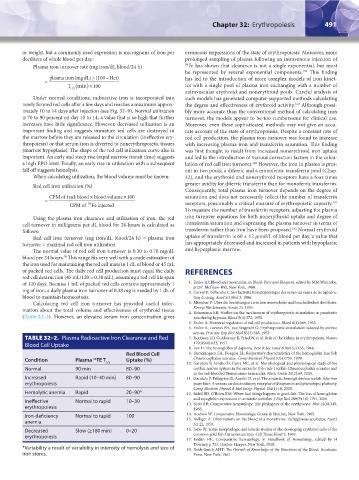
                   TABLE 32–2.  Plasma Radioactive Iron Clearance and Red     7.  Jacobson LO, Goldwasser E, Fried W, et al: Role of the kidney in erythropoiesis. Nature
                   Blood Cell Uptake                                       179(4560):633, 1957.
                                                                          8.  Fox H: The hemoglobin of daphnia. Proc R Soc Lond B Biol Sci 135, 1948.
                                                     Red Blood Cell       9.  Hemmingsen EA, Douglas EL: Respiratory characteristics of the hemoglobin-free fish
                   Condition        Plasma  FE T     Uptake (%)            Chaenocephalus aceratus. Comp Biochem Physiol 33(4):733, 1970.
                                          59
                                              1/2                         10.  Garofalo F, Amelio D, Cerra MC, et al: Morphological and physiological study of the
                   Normal           90 min           80–90                 cardiac nos/no system in the antarctic (hb-/mb-) icefish Chaenocephalus aceratus and
                                                                           in the red-blooded Trematomus bernacchii. Nitric Oxide 20(2):69, 2009.
                   Increased        Rapid (10–40 min)  80–90              11.  Garofalo F, Pellegrino D, Amelio D, et al: The antarctic hemoglobinless icefish, fifty-five
                   erythropoiesis                                          years later: A unique cardiocirculatory interplay of disaptation and phenotypic plasticity.
                                                                           Comp Biochem Physiol A Mol Integr Physiol 154(1):10, 2009.
                   Hemolytic anemia  Rapid           20–90*               12.  Sidell BD, O’Brien KM: When bad things happen to good fish: The loss of hemoglobin
                                                                           and myoglobin expression in antarctic icefishes. J Exp Biol 209(Pt 10):1791, 2006.
                   Ineffective      Normal to rapid  10–30                13.  Scott RB: Comparative hematology: The phylogeny of the erythrocyte. Blut 12(6):340,
                   erythropoiesis                                          1966.
                   Iron-deficiency   Normal to rapid  100                 14.  Andrew W: Comparative Hematology, Grune & Stratton, New York, 1965.
                   anemia                                                 15.  Bolliger A: Observations on the blood of a monotreme Tachyglossus aculeatus. Aust J
                                                                           Sci 22, 1959.
                   Decreased        Slow (≥180 min)  0–20                 16.  Iorio RJ: Some morphologic and kinetic studies of the developing erythroid cells of the
                   erythropoiesis                                          common gold fish Carassius auratus. Cell Tissue Kinet 2, 1969.
                                                                          17.  Jordan HE: Comparative hematology, in  Handbook  of  Hematology, edited by H
                                                                           Downey, p 703. Hoeber-Harper, New York, 1938.
                  *Variability a result of variability in intensity of hemolysis and size of     18.  Robb-Smith AHT: The Growth of Knowledge of the Functions of the Blood, Academic
                  iron stores.                                             Press, New York, 1961.


          Kaushansky_chapter 32_p0479-0494.indd   491                                                                   9/17/15   6:11 PM

