


Page 535 - Williams Hematology ( PDFDrive )
P. 535
510            Part VI:  The Erythrocyte                                                                                                  Chapter 34:  Clinical Manifestations and Classification of Erythrocyte Disorders         511


                                                                      loss-of-function PHD2 variants (encoded by EGLN1 gene) have normal
                             O  transport (Cardiac output x Hct)      EPO levels.
                               2
                                                                          Because of the rarity of HIF2a and PHD2 mutations, their non-
                                                                      erythroid phenotype is not well defined; however, some HIF2a muta-
                                                Severe                tions, possibly associated with genetic mosaicism, are associated with
                                              hypervolemia
                                            4                         congenital polycythemia and later development of pheochromocytoma/
                                                                      paraganglioma and somatistatinoma tumors. In these instances, in most
                                                                      patients, the HIF2a mutation is present in the tumors, which frequently
                            Oxygen transport  1  3  hypervolemia      recur, but not in leukocytes. 44,45
                                    2

                                               Moderate
                                                                      REFERENCES
                                                                        1.  Semenza GL, Nejfelt MK, Chi SM, et al: Hypoxia-inducible nuclear factors bind to an
                                 Normovolemia                            enhancer element located 3′ to the human erythropoietin gene. Proc Natl Acad Sci U S A
                                                                         88(13):5680, 1991.
                                                                        2.  Guillemin K, Krasnow MA: The hypoxic response: Huffing and HIFing. Cell 89(1):9,
                                                                         1997.
                                                                        3.  Hochachka PW, Buck LT, Doll CJ, et al: Unifying theory of hypoxia tolerance: Molecular/
                                                                         metabolic defense and rescue mechanisms for surviving oxygen lack. Proc Natl Acad Sci
                                                                         U S A 93(18):9493, 1996.
                                                                        4.  Semenza GL: O -regulated gene expression: Transcriptional control of cardiorespira-
                                                                                  2
                                                                         tory physiology by HIF-1. J Appl Physiol (1985) 96(3):1173; discussion 1170, 2004.
                             0   20    40   60   80  100                5.  Srinivas V, Zhu X, Salceda S, et al: Hypoxia-inducible factor 1alpha (HIF-1alpha) is a non
                                    Hematocrit (%)                       -heme iron protein. Implications for oxygen sensing. J Biol Chem 273(29):18019, 1998.
                                                                        6.  Ivan M, Kondo K, Yang H, et al: HIFalpha targeted for VHL-mediated destruction by
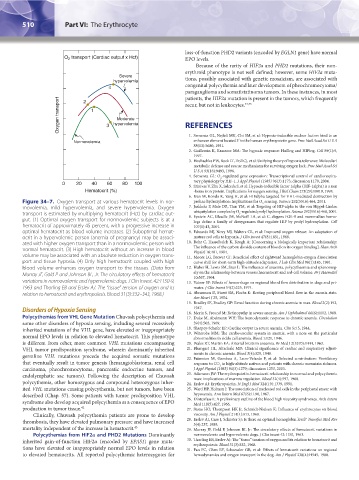
               Figure 34–7.  Oxygen transport at various hematocrit levels in nor-  proline hydroxylation: Implications for O  sensing. Science 292(5516):464, 2001.
                                                                                                2
               movolemia, mild hypervolemia, and severe hypervolemia. Oxygen     7.  Jaakkola P, Mole DR, Tian YM, et al: Targeting of HIF-alpha to the von Hippel-Lindau
               transport is estimated by multiplying hematocrit (Hct) by cardiac out-  ubiquitylation complex by O -regulated prolyl hydroxylation. Science 292(5516):468, 2001.
                                                                                        2
               put. (1) Optimal oxygen transport for normovolemic subjects is at a     8.  Epstein AC, Gleadle JM, McNeill LA, et al: C. elegans EGL-9 and mammalian homo-
                                                                         logs define a family of dioxygenases that regulate HIF by prolyl hydroxylation. Cell
               hematocrit of approximately 45 percent, with a progressive increase in   107(1):43, 2001.
               optimal hematocrit as blood volume increases. (2) Suboptimal hemat-    9.  Edwards MJ, Novy MJ, Walters CL, et al: Improved oxygen release: An adaptation of
               ocrit in a hypervolemic person (anemia of pregnancy) may be associ-  mature red cells to hypoxia. J Clin Invest 47(8):1851, 1968.
               ated with higher oxygen transport than in a normovolemic person with     10.  Bohr C, Hasselbalch K, Krogh A: [Concerning a biologically important relationship:
               normal hematocrit. (3) High hematocrit without an increase in blood   The influence of the carbon dioxide content of blood on its oxygen binding]. Skan Arch
                                                                         Physiol 16:401, 1904.
               volume may be associated with an absolute reduction in oxygen trans-    11.  Moore LG, Brewer GJ: Beneficial effect of rightward hemoglobin-oxygen dissociation
               port and tissue hypoxia. (4) Only high hematocrit coupled with high   curve shift for short-term high-altitude adaptation. J Lab Clin Med 98(1):145, 1981.
               blood volume enhances oxygen transport to the tissues.  (Data from     12.  Huber H, Lewis SM, Szur L: The influence of anaemia, polycythaemia and splenomeg-
               Murray JF, Gold P and Johnson BL, Jr. The circulatory effects of hematocrit   aly on the relationship between venous haematocrit and red-cell volume. Br J Haematol
                                                                         10:567, 1964.
               variations in normovolemic and hypervolemic dogs. J Clin Invest. 42:1150-9,     13.  Vatner SF: Effects of hemorrhage on regional blood flow distribution in dogs and pri-
               1963 and Thorling EB and Erslev AJ. The “tissue” tension of oxygen and its   mates. J Clin Invest 54(2):225, 1974.
               relation to hematocrit and erythropoiesis. Blood 31(3):332–343, 1968.)    14.  Abramson D, Fierst SM, Flachs K: Resting peripheral blood flow in the anemia state.
                                                                         Am Heart J 25, 1954.
                                                                        15.  Bradley SE, Bradley GP: Renal function during chronic anemia in man. Blood 2(2):192,
               Disorders of Hypoxia Sensing                              1947.
               Polycythemias from VHL Gene Mutation Chuvash polycythemia and     16.  Merin S, Freund M: Retinopathy in severe anemia. Am J Ophthalmol 66(6):1102, 1968.
                                                                        17.  Duke M, Abelmann WH: The hemodynamic response to chronic anemia. Circulation
               some other disorders of hypoxia sensing, including several recessively   39(4):503, 1969.
               inherited mutations of the VHL gene, have elevated or inappropriately     18.  Sharpey-Schafer EP: Cardiac output in severe anemia. Clin Sci 5, 1944.
               normal EPO levels in relation to elevated hematocrit. This phenotype     19.  Wintrobe MM: The cardiovascular system in anemia; with a note on the particular
                                                                         abnormalities in sickle cell anemia. Blood 1:121, 1946.
               is different from other, more common VHL mutations encompassing     20.  Wales RT, Martin EA: Arterial bruits in anaemia. Br Med J 2(5370):1444, 1963.
               VHL tumor predisposition syndrome, wherein dominantly inherited     21.  Blumgart HL, Altschule MD: Clinical significance of cardiac and respiratory adjust-
                                                                         ments in chronic anemia. Blood 3(4):329, 1948.
               germline  VHL mutations precede the acquired somatic mutations     22.  Fatemian M, Gamboa A, Leon-Velarde F, et al: Selected contribution: Ventilatory
               that eventually result in tumor genesis (hemangioblastoma, renal cell   response to CO  in high-altitude natives and patients with chronic mountain sickness.
                                                                                  2
               carcinoma, pheochromocytoma, pancreatic endocrine tumors, and   J Appl Physiol (1985) 94(3):1279; discussion 1253, 2003.
               endolymphatic sac tumors). Following the description of Chuvash     23.  Adamson JW: The erythropoietin-hematocrit relationship in normal and polycythemic
                                                                         man: Implications of marrow regulation. Blood 32(4):597, 1968.
               polycythemia, other homozygous and compound heterozygous inher-    24.  Erslev AJ: Erythropoietin. N Engl J Med 324(19):1339, 1991.
               ited VHL mutations causing polycythemia, but not tumors, have been     25.  Ward HP, Holman J: The association of nucleated red cells in the peripheral smear with
               described (Chap. 57). Some patients with tumor predisposition VHL   hypoxemia. Ann Intern Med 67(6):1190, 1967.
               syndrome also develop acquired polycythemia as a consequence of EPO     26.  Dintenfass L: A preliminary outline of the blood high viscosity syndromes. Arch Intern
                                                                         Med 118(5):427, 1966.
               production in tumor tissue. 42                           27.  Stone HO, Thompson HK Jr, Schmidt-Nielsen K: Influence of erythrocytes on blood
                   Clinically, Chuvash polycythemia patients are prone to develop   viscosity. Am J Physiol 214(4):913, 1968.
               thrombosis, they have elevated pulmonary pressure and have increased     28.  Erslev AJ, Caro J, Schuster SJ: Is there an optimal hemoglobin level? Transfus Med Rev
                                                                         3(4):237, 1989.
               mortality independent of the increase in hematocrit. 43    29.  Murray JF, Gold P, Johnson BL Jr: The circulatory effects of hematocrit variations in
                   Polycythemias from HIF2α and PHD2 Mutations Dominantly   normovolemic and hypervolemic dogs. J Clin Invest 42:1150, 1963.
               inherited gain-of-function HIF2α (encoded by  EPAS1) gene muta-    30.  Thorling EB, Erslev AJ: The “tissue” tension of oxygen and its relation to hematocrit and
                                                                         erythropoiesis. Blood 31(3):332, 1968.
               tions have elevated or inappropriately normal EPO levels in relation     31.  Fan FC, Chen RY, Schuessler GB, et al: Effects of hematocrit variations on regional
               to elevated hematocrits. All reported polycythemic heterozygotes for   hemodynamics and oxygen transport in the dog. Am J Physiol 238(4):H545, 1980.


          Kaushansky_chapter 34_p0503-0512.indd   510                                                                   9/17/15   6:12 PM

