


Page 539 - Williams Hematology ( PDFDrive )
P. 539
514            Part VI:  The Erythrocyte                                                                                                                           Chapter 35:  Aplastic Anemia: Acquired and Inherited            515


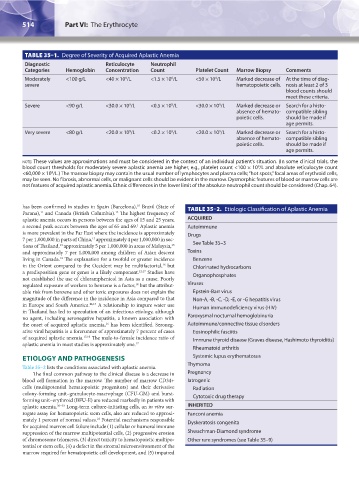
                TABLE 35–1.  Degree of Severity of Acquired Aplastic Anemia
                Diagnostic                 Reticulocyte   Neutrophil
                Categories    Hemoglobin   Concentration  Count          Platelet Count  Marrow Biopsy  Comments
                Moderately    <100 g/L     <40 × 10 /L    <1.5 × 10 /L   <50 × 10 /L   Marked decrease of  At the time of diag-
                                                                 9
                                                                                9
                                                  9
                severe                                                                 hematopoietic cells. nosis at least 2 of 3
                                                                                                        blood counts should
                                                                                                        meet these criteria.
                Severe        <90 g/L      <30.0 × 10 /L  <0.5 × 10 /L   <30.0 × 10 /L  Marked decrease or  Search for a histo-
                                                                 9
                                                                                 9
                                                   9
                                                                                       absence of hemato- compatible sibling
                                                                                       poietic cells.   should be made if
                                                                                                        age permits.
                Very severe   <80 g/L      <20.0 × 10 /L  <0.2 × 10 /L   <20.0 × 10 /L  Marked decrease or  Search for a histo-
                                                   9
                                                                 9
                                                                                 9
                                                                                       absence of hemato- compatible sibling
                                                                                       poietic cells.   should be made if
                                                                                                        age permits.
               note: These values are approximations and must be considered in the context of an individual patient’s situation. (In some clinical trials, the
               blood count thresholds for moderately severe aplastic anemia are higher, e.g., platelet count <100 × 10 /L and absolute reticulocyte count
                                                                                              9
               <60,000 × 10 /L.) The marrow biopsy may contain the usual number of lymphocytes and plasma cells; “hot spots,” focal areas of erythroid cells,
                         9
               may be seen. No fibrosis, abnormal cells, or malignant cells should be evident in the marrow. Dysmorphic features of blood or marrow cells are
               not features of acquired aplastic anemia. Ethnic differences in the lower limit of the absolute neutrophil count should be considered (Chap. 64).
               has been confirmed in studies in Spain (Barcelona),  Brazil (State of   TABLE 35–2.  Etiologic Classification of Aplastic Anemia
                                                      10
               Parana),  and Canada (British Columbia).  The highest frequency of
                                               12
                     11
               aplastic anemia occurs in persons between the ages of 15 and 25 years;   ACQUIRED
               a second peak occurs between the ages of 65 and 69.  Aplastic anemia   Autoimmune
                                                      1
               is more prevalent in the Far East where the incidence is approximately     Drugs
               7 per 1,000,000 in parts of China,  approximately 4 per 1,000,000 in sec-
                                       13
               tions of Thailand,  approximately 5 per 1,000,000 in areas of Malaysia,      See Table 35–3
                                                                 15
                            14
               and approximately 7 per 1,000,000 among children of Asian descent   Toxins
               living in Canada.  The explanation for a twofold or greater incidence     Benzene
                            12
               in the Orient compared to the Occident may be multifactorial,  but     Chlorinated hydrocarbons
                                                              16
               a predisposition gene or genes is a likely component. 12,17  Studies have
               not established the use of chloramphenicol in Asia as a cause. Poorly     Organophosphates
               regulated exposure of workers to benzene is a factor,  but the attribut-  Viruses
                                                     18
               able risk from benzene and other toxic exposures does not explain the     Epstein-Barr virus
               magnitude of the difference in the incidence in Asia compared to that     Non-A, -B, -C, -D, -E, or -G hepatitis virus
               in Europe and South America. 16,17  A relationship to impure water use     Human immunodeficiency virus (HIV)
               in Thailand has led to speculation of an infectious etiology, although
               no agent, including seronegative hepatitis, a known association with   Paroxysmal nocturnal hemoglobinuria
               the onset of acquired aplastic anemia,  has been identified. Seroneg-  Autoimmune/connective tissue disorders
                                           16
               ative viral hepatitis is a forerunner of approximately 7 percent of cases     Eosinophilic fasciitis
               of acquired aplastic anemia. 17,19  The male-to-female incidence ratio of     Immune thyroid disease (Graves disease, Hashimoto thyroiditis)
               aplastic anemia in most studies is approximately one. 17
                                                                         Rheumatoid arthritis
               ETIOLOGY AND PATHOGENESIS                                 Systemic lupus erythematosus
               Table 35–2 lists the conditions associated with aplastic anemia.  Thymoma
                   The final common pathway to the clinical disease is a decrease in   Pregnancy
               blood cell formation in the marrow. The number of marrow CD34+   Iatrogenic
               cells (multipotential hematopoietic progenitors) and their derivative     Radiation
               colony-forming unit–granulocyte-macrophage (CFU-GM) and burst-    Cytotoxic drug therapy
               forming unit–erythroid (BFU-E) are reduced markedly in patients with
               aplastic anemia. 20–23  Long-term culture-initiating cells, an in vitro sur-  INHERITED
               rogate assay for hematopoietic stem cells, also are reduced to approxi-  Fanconi anemia
                                        23
               mately 1 percent of normal values.  Potential mechanisms responsible   Dyskeratosis congenita
               for acquired marrow cell failure include (1) cellular or humoral immune
               suppression of the marrow multipotential cells, (2) progressive erosion   Shwachman-Diamond syndrome
               of chromosome telomeres, (3) direct toxicity to hematopoietic multipo-  Other rare syndromes (see Table 35–9)
               tential or stem cells, (4) a defect in the stromal microenvironment of the
               marrow required for hematopoietic cell development, and (5) impaired


          Kaushansky_chapter 35_p0513-0538.indd   514                                                                   9/19/15   12:23 AM

