


Page 530 - Williams Hematology ( PDFDrive )
P. 530
504  Part VI:  The Erythrocyte  Chapter 34:  Clinical Manifestations and Classification of Erythrocyte Disorders      505


                           120                                          Murmurs usually are heard during systole. Murmurs and bruits
                                                                        have been described in many regions, such as over the jugular vein,
                           110                                          the closed eye, and the parietal region of the skull, and may be sensed by
                                                                        the patient as roaring in the ears (tinnitus), especially at night. They disap-
                          Total blood volume (mL/kg)  90                The myocardium tolerates a prolonged period of sustained hyperactiv-
                                                                        pear promptly after the hemoglobin concentration is restored to normal.
                           100
                                                                                                                          20
                                                                        ity. However, angina pectoris and high-output failure may supervene if
                                                                        anemia is so severe that it exceeds myocardial oxygen demands or if the
                            80
                                                                        patient has coronary artery disease. Cardiomegaly, pulmonary conges-
                                                                        tion, ascites, and edema have been observed, and they require prompt
                            70
                                                                        treatment with oxygen and transfusion of packed red cells.
                            60
                                                                        Increased Pulmonary Function
                            50                                          Significant anemia leads to a compensatory increase in respiratory rate
                                                                        that decreases the oxygen gradient from ambient air to alveolar air and
                            40                                          increases the amount of oxygen available to oxygenate a greater than
                              0      20      40      60     80
                                                                        normal cardiac output. Consequently, exertional dyspnea and orthopnea
                                         Hematocrit (%)
                                                                        are characteristic clinical manifestations of moderate to severe anemia. 19–22
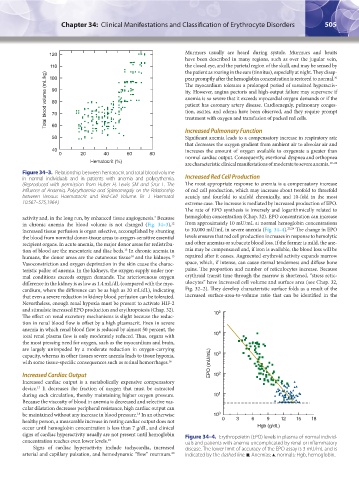
                  Figure 34–3.  Relationship between hematocrit and total blood volume
                  in normal individuals and in patients with anemia and polycythemia.     Increased Red Cell Production
                  (Reproduced with permission from Huber H, Lewis SM and Szur L. The    The most appropriate response to anemia is a compensatory increase
                  Influence  of  Anaemia,  Polycythaemia  and  Splenomegaly  on  the  Relationship   of red cell production, which may increase about twofold to threefold
                  between Venous Haematocrit and Red-Cell Volume.  Br J Haematol   acutely and fourfold to sixfold chronically, and 10-fold in the most
                  10:567–575,1964.)                                     extreme case. The increase is mediated by increased production of EPO.
                                                                        The rate of EPO synthesis is inversely and logarithmically related to
                  activity and, in the long run, by enhanced tissue angiogenesis.  Because   hemoglobin concentration (Chap. 32). EPO concentration can increase
                                                              2
                  in chronic anemia the blood volume is not changed (Fig. 34–3),    from approximately 10 mU/mL at normal hemoglobin concentrations
                                                                    12
                  increased tissue perfusion is organ selective, accomplished by shunting   to 10,000 mU/mL in severe anemia (Fig. 34–4). 23,24  The change in EPO
                  the blood from nonvital donor-tissue areas to oxygen-sensitive essential   levels ensures that red cell production increases in response to hemolytic
                  recipient organs. In acute anemia, the major donor areas for redistribu-  and other anemias or subacute blood loss. If the former is mild, the ane-
                  tion of blood are the mesenteric and iliac beds.  In chronic anemia in   mia may be compensated and, if iron is available, the blood loss will be
                                                    13
                  humans, the donor areas are the cutaneous tissue  and the kidneys.    repaired after it ceases. Augmented erythroid activity expands marrow
                                                      14
                                                                    15
                  Vasoconstriction and oxygen deprivation in the skin cause the charac-  space, which, if intense, can cause sternal tenderness and diffuse bone
                  teristic pallor of anemia. In the kidneys, the oxygen supply under nor-  pains. The proportion and number of reticulocytes increase. Because
                  mal conditions exceeds oxygen demands. The arteriovenous oxygen   erythroid transit time through the marrow is shortened, “stress retic-
                  difference in the kidney is as low as 1.4 mL/dL (compared with the myo-  ulocytes” have increased cell volume and surface area (see Chap. 32,
                  cardium, where the difference can be as high as 20 mL/dL), indicating   Fig. 32–2). They develop characteristic surface folds as a result of the
                  that even a severe reduction in kidney blood perfusion can be tolerated.   increased  surface-area-to-volume  ratio  that  can  be  identified  in  the
                  Nevertheless, enough renal hypoxia must be present to activate HIF-2
                  and stimulate increased EPO production and erythropoiesis (Chap. 32).   5
                  The effect on renal excretory mechanisms is slight because the reduc-  10
                  tion in renal blood flow is offset by a high plasmacrit. Even in severe
                  anemia in which renal blood flow is reduced by almost 50 percent, the
                  total renal plasma flow is only moderately reduced. Thus, organs with   10 4
                  the most pressing need for oxygen, such as the myocardium and brain,
                  are largely unimpeded by a moderate reduction in oxygen-carrying
                  capacity, whereas in other tissues severe anemia leads to tissue hypoxia,   10 3
                  with some tissue-specific consequences such as retinal hemorrhages. 16  EPO (mU/mL)

                  Increased Cardiac Output                                        10 2
                  Increased cardiac output is a metabolically expensive compensatory
                  device.   It  decreases  the fraction  of  oxygen  that  must  be  extracted
                       17
                  during each circulation, thereby maintaining higher oxygen pressure.   10 1
                  Because the viscosity of blood in anemia is decreased and selective vas-
                  cular dilatation decreases peripheral resistance, high cardiac output can
                  be maintained without any increase in blood pressure.  In an otherwise   10 0
                                                        18
                  healthy person, a measurable increase in resting cardiac output does not   0 0  3  6  9  12  15  18
                  occur until hemoglobin concentration is less than 7 g/dL, and clinical         Hgb (g/dL)
                  signs of cardiac hyperactivity usually are not present until hemoglobin   Figure 34–4.  Erythropoietin (EPO) levels in plasma of normal individ-
                  concentration reaches even lower levels. 19           uals and patients with anemia uncomplicated by renal or inflammatory
                     Signs of cardiac hyperactivity include tachycardia, increased   disease. The lower limit of accuracy of the EPO assay is 3 mU/mL and is
                  arterial and capillary pulsation, and hemodynamic “flow” murmurs.    indicated by the dashed line. •, Anemias; ▲, normals; Hgb, hemoglobin.
                                                                    20


          Kaushansky_chapter 34_p0503-0512.indd   505                                                                   9/17/15   6:12 PM

